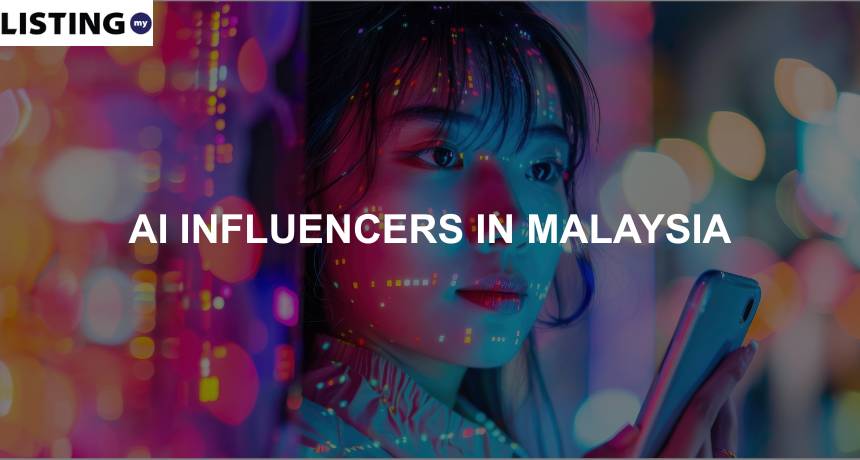
AI Influencers in Malaysia: What They Are and How They Work
- 29 January 2026
- Digital Marketing
Key Takeaways
- AI influencers are computer-generated personas designed for controlled, scalable brand communication
- In Malaysia, transparency and disclosure influence trust more than novelty or realism
- AI influencers reduce behavioural risk but require strong governance and oversight
- Not all virtual influencers use AI, the distinction affects cost, control, and expectations
- Successful adoption depends on clear workflows, approvals, and audience clarity
An AI influencer is a digital persona created using artificial intelligence and computer-generated media to represent a brand online. Unlike human influencers, AI influencers are fully controlled, predictable, and scalable across campaigns.
As AI-generated faces and voices appear more frequently on social platforms, the concern for Malaysian brands is no longer technical feasibility, but rather: “can I use these tools to improve our workflow and operations?”
So for those out of the loop or wondering what AI influencers are and how they are different from other virtual personalities, we will talk you through it all.
AI Influencer Types Compared
Type | Best For | How It’s Created | Control Level | Disclosure Risk |
Human Influencer | Authentic engagement | Real individual | Low | Medium |
Virtual Influencer (CGI) | Visual branding | Manually designed CGI | High | Medium |
AI Influencer | Scalable campaigns | Generative AI + rules | Very high | High if unclear |
Brand Avatar | Education and support | Scripted AI or visuals | Very high | Low |
What Is an AI Influencer?
An AI influencer is a brand-owned digital persona designed to publish content, communicate online, and represent a consistent identity.
- Powered by modern AI systems
Thanks to large language models (LLMs) trained on vast amounts of internet data, AI influencers can generate human-like captions, replies, and scripts that feel natural across platforms. - Brand-controlled by design
Unlike traditional influencers, AI influencers have no personal autonomy. Their appearance, messaging, tone, and behaviour are set through prompts, rules, and approval workflows defined by the brand. - Human oversight remains central
While AI assists with content creation, humans review, approve, and schedule every post. This keeps messaging aligned with brand values and avoids unintended claims or tone shifts. - Looks spontaneous, operates within limits
An AI influencer can appear on Instagram, TikTok, or a website with conversational posts and timely responses, yet it never acts outside brand guidelines.
Why this matters for businesses: This level of control is very attractive to regulated sectors, reputation-sensitive organisations, and brands that prioritise consistency over personality-driven unpredictability.
How Does an AI Influencer Behave?
An AI influencer does not think, decide, or post on its own. It runs through a controlled process designed by people or an influencer marketing agency.
If you are picturing an AI character freely chatting and posting whatever it wants, that is not how it works, especially not for cautious teams.
Here is what actually happens behind the scenes.
1. Persona design
First, the brand decides who this AI influencer is supposed to be.
That includes age range, background, personality, values, tone of voice, and visual style. It’s basically creating a brand spokesperson profile, just in digital form.
This step sets clear boundaries so the character never feels off-brand or confusing.
2. Content generation
Next, AI tools help generate captions, visuals, or short videos based on clear prompts and rules.
Large language models assist with wording, while image or video tools help with visuals. The AI suggests content, but it does not decide what goes live.
3. Human review and approvals
This is the most important step, and the one many people underestimate.
Every post is reviewed by real people before it is published, marketing teams check tone, accuracy, disclosure wording, and whether anything could be misunderstood.
If something feels wrong, it does not get posted.
4. Publishing and monitoring
Once approved, content is published through managed brand accounts. Comments and reactions are monitored, and there is always a plan for how to respond if audiences ask questions, push back, or feel uncomfortable.
“According to the Influencer Marketing Benchmark Report 2025, 60.2% of surveyed marketers already use AI for influencer identification and campaign optimisation, a clear sign that AI has moved into mainstream influencer workflows rather than being an experimental extra.”
Why Are Brands Using AI Influencers?
Despite the scepticism, most brands are not adopting AI influencers because they are trendy.
They are doing it for control, consistency, and risk reduction.
When you look past the surface, the reasons are practical rather than experimental.
Predictable behaviour
AI influencers do not have personal opinions, private lives, or sudden emotional reactions. They do not post off-brand content, start public disputes, or create reputational surprises.
Scalable production
Once the setup is in place, content can be produced faster across platforms. Captions, visuals, and short videos can be adapted and reused without rebuilding campaigns from scratch.
Brand ownership
The digital persona belongs to the brand. It does not leave, renegotiate fees, or take its audience elsewhere, making it a long-term brand asset rather than a temporary partnership.
Message discipline
This matters most in finance, healthcare, education, and regulated industries. AI influencers help keep messaging consistent, accurate, and aligned with internal approvals.
What Are the Risks of Using AI Influencers?
Globally, AI acceptance is mixed to say the least.
Most consumers worry about being misled or misinformation and not about how advanced the software is. Add in that AI feels “fake” and “artificial” (because it is) and there is a lot of debate for the use of it.
Risk Area | What Can Go Wrong | Why It Matters |
Misleading realism | Audiences assume the influencer is human | Trust drops sharply once discovered |
Disclosure confusion | AI nature is unclear or inconsistent | Creates suspicion even without legal breaches |
Ethical discomfort | People dislike synthetic figures selling real products | Brand credibility takes a hit |
Over-automation | Too little human judgment in interactions | Small issues escalate unnecessarily |
What Reduces These Risks
- Clear, consistent disclosure that the influencer is AI-generated
- Human review of all public-facing content
- Defined boundaries for what the AI can and cannot respond to
- A plan for how to handle questions, criticism, or confusion
AI influencers are not risky by default. They become risky when brands treat them as shortcuts instead of managed communication tools.
What Do Malaysian Brands Need to Consider First?
If you are feeling skeptical about AI influencers, that reaction is understandable.
This is especially important in a market where more than 26 million Malaysians use social media and over 97% of the population is online, so missteps scale very quickly.
For brands who are on the fence on AI influencer, consider the following:
1. Transparent AI Disclosure
Make it unmistakable that the persona is AI-generated or virtual.
In Malaysia, the Content Code 2022 and local advertising standards require that advertising content, including content from virtual influencers is clearly identified so people are not misled into thinking they’re dealing with a real human.
- Avoid vague tags like “#sp” or “collab” that can confuse audiences.
- Use clear labels such as “Advertisement”, “Ad”, “Sponsored” or platform tools like “Paid Partnership”.
2. Consistent Labelling Across Platforms
- Every platform has different UI/UX rules (TikTok, Instagram, Facebook).
- Disclosure in the caption might not be enough for video or reel formats.
- Mobile users often scroll fast, so upfront disclosure is essential.
3. Human Oversight for Public Content
AI can generate ideas and drafts, but people must check tone, context, and cultural sensitivities before posting.
Malaysia is multilingual and cultural norms vary across communities. AI can misinterpret nuance easily like.
For example: “Hey Boss, I nak teh ice kurang kurang manis tapau. Ikat tepi ye.”
To a local Malaysian, this sounds like your everyday kopitam or mamak conversation.
To an AI system without context, they don’t know what the heck you are talking about.
4. Align With Local Advertising and Content Norms
Malaysia’s advertising ecosystem emphasises fair practices and consumer protection.
Influencer marketing, including virtual and AI influencers, falls under rules that are designed to avoid misleading consumers and protect local audiences.
Brands should consider:
- How the AI persona communicates in Bahasa Malaysia, English, or mixed code-switching to reflect local culture
- If dialogues or captions could inadvertently offend religious or cultural sensitivities
- How different generations perceive AI voices versus human voices
Policymakers are also debating AI content labelling, for example under the proposed Online Safety Act 2024, which may require AI-generated content to be clearly marked.
Should You Even Consider an AI Influencer?
Before thinking about tools, visuals, or platforms, it helps to pause and ask a few important questions.
- Do we have clear disclosure standards?
If your team is uncomfortable clearly stating that a persona is AI-generated, this is already a red flag. - Do we have humans reviewing every post?
AI can draft content, but someone must always check tone, context, and cultural sensitivity before publishing. - Do we understand our audience’s comfort level with AI?
Some audiences are curious, others are cautious. If confusion or mistrust is likely, proceed carefully or reconsider. - Are we solving a real problem, not chasing novelty?
AI influencers work best when consistency, control, or scalability is the goal, not experimentation for its own sake. - Do we have a plan for questions or backlash?
Audiences will inevitably ask if the persona is real. Silence or defensiveness damages trust faster than honest answers.
If you answer “no” to several of these, an AI influencer may not be the right move, at least not yet.
The Cost of “hiring” a AI Influencer
Category | What You’re Paying For | Price Range | What This Actually Means |
Entry-level AI tools | DIY avatar or AI video platforms | ~RM120 to RM200 per month | Suitable for testing ideas only. Limited realism, limited control, not brand-ready |
Freelance AI persona setup | Basic AI avatar, simple visuals, short clips | ~RM180 to RM300 one-off | One-time deliverables. No long-term persona, no governance, no strategy |
Semi-custom AI influencer | More realistic avatar, scripting, basic workflow | ~RM4,000 to RM8,000+ | Better quality, but still needs internal review and content control |
Full campaign-ready AI influencer | Custom persona, visuals, scripts, approvals, rollout | RM20,000+ depending on scope | Comparable to agency-led campaigns. Built for long-term use, not experimentation |
Ongoing management costs | Content review, monitoring, updates | Varies by team size | Often overlooked. Human oversight is a recurring cost |
How This Compares to Human Influencers in Malaysia
Influencer Type | Typical Cost per Campaign | Key Difference |
Nano influencer (1k–10k) | RM100 – RM500 per post or video | Low cost, low control, inconsistent quality |
Micro influencer (10k–50k) | RM500 – RM2,000 per post or video | Affordable reach, but messaging varies |
Mid-tier influencer | RM2,000 – RM6,000+ per campaign or flagship post | Higher reach, higher reputation risk |
Macro influencer | RM6,000 – RM15,000+ per major campaign | Strong reach, limited brand control |
AI Influencers in Malaysia Require Strategy, Not Experimentation
As more AI tools get released and people are left guessing whether a face, voice, or caption is AI or human, trust becomes the real currency for brands.
The question is no longer how realistic AI can look, but how honest brands choose to be.
If you are looking for an influencer marketing agency, including teams that combine human creators with AI-enabled influencer strategies, Listing.my makes that process easier.
Our business directory helps brands compare verified influencer marketing agencies, review their services, and identify partners who understand local audiences, disclosure expectations, and responsible AI use.
Instead of guessing who to trust, Listing.my helps brands find influencer marketing agencies that fit their goals, whether that means traditional campaigns, AI influencer programmes, or a thoughtful mix of both.
Source:
- Influencer Marketing Benchmark Report 2025 – Influencer Marketing Hub
– Statistic that 60.2% of respondents use AI for influencer identification and campaign optimisation.
- Content Code 2022 – Communications and Multimedia Content Forum of Malaysia (CMCF) – Official code stating that advertising must be clearly recognisable as advertising and that the use of virtual influencers in ads must be disclosed.
- “Content Code 2022 – Part 1” – Christopher & Lee Ong – Notes that social media influencers are obliged to abide by Content Code 2022 in respect of advertisement requirements.
- “Digital 2023: Malaysia” – DataReportal– Shows 26.8 million social media users in Malaysia in January 2023, plus detailed stats on internet and platform usage.
- “Your Guide to Pricing Video Content in Malaysia (2025/2026)” – BigCast Breaks down nano, micro, mid-tier, macro, mega influencer pricing in RM)