N-Type vs. P-Type: Why Panel Tech Matters in the Malaysian Heat
- 18 March 2026
- Business
Key Takeaways
- N-type solar panels typically offer higher efficiency and lower degradation, making them attractive for long-term solar performance in Malaysia’s hot climate.
- P-type panels remain widely used because they are more affordable, making them a practical option for many residential rooftop solar installations.
- Temperature coefficient matters in tropical climates — panels with better heat tolerance can maintain higher energy output under Malaysia’s high rooftop temperatures.
- Degradation rates influence lifetime energy production, with N-type panels generally retaining more of their performance over a 25-year lifespan.
- Solar ROI in Malaysia depends on multiple factors, including panel technology, system design, electricity usage, and benefits from SEDA Malaysia’s ATAP Programme.
N-type and P-type solar panels refer to two different semiconductor structures used in photovoltaic cells. N-type panels typically offer higher efficiency, lower degradation, and better heat tolerance, while P-type panels are more affordable and widely used in residential solar installations.
Malaysia’s climate presents both an opportunity and a challenge for solar energy. With abundant sunshine throughout the year, the country offers strong potential for rooftop solar generation.
However, Malaysia’s high temperatures, humidity, and intense solar irradiance can influence how efficiently solar panels perform over time.
For property owners considering rooftop solar, understanding the difference between N-type vs P-type solar panels is more than a technical detail, it can directly affect energy output, system lifespan, and long-term return on investment.
This guide explains how solar panel technology choices impact performance in Malaysia’s tropical climate, helping homeowners and businesses choose the most suitable system for their property.
N-Type vs P-Type: Performance Comparison Table
Feature | N-Type Panels | P-Type Panels |
Efficiency | Higher | Moderate |
Heat tolerance | Better | Moderate |
Degradation rate | Lower | Slightly higher |
Cost | Higher upfront | Lower upfront |
Lifespan | Longer | Standard |
Understanding the Basics of Solar Panel Technology
What Are P-Type Solar Panels?
P-type solar panels are the most widely used photovoltaic technology globally and have been the industry standard for decades. They are made using boron-doped silicon wafers, which create a positive electrical charge layer within the solar cell.
Most conventional solar panel companies in Malaysia use P-type technology because it is:
- Easier to manufacture
- Lower cost
- Mature and widely tested
Many solar modules using PERC (Passivated Emitter and Rear Cell) technology are based on P-type wafers.
Typical characteristics include:
- Efficiency ranges around ~19–22% (model-dependent)
- Slightly higher degradation over time
- More affordable upfront cost
Because of their lower price point, P-type panels are commonly used in residential solar installations in Malaysia.
What Are N-Type Solar Panels?
N-type solar panels are built using phosphorus-doped silicon wafers, which create a negatively charged layer in the solar cell.
This structure offers several advantages that improve long-term performance. In particular, N-type panels are less susceptible to certain degradation effects that can reduce energy production.
Modern high-performance solar modules often use advanced N-type technologies, including:
- TOPCon (Tunnel Oxide Passivated Contact): TOPCon technology improves efficiency by reducing electron loss, allowing solar cells to capture and convert more sunlight into electricity.
- HJT (Heterojunction Technology): HJT combines crystalline silicon with thin-film layers to enhance efficiency and maintain strong performance even under high temperatures.
- IBC (Interdigitated Back Contact): IBC places electrical contacts on the back of the cell, reducing shading and improving energy conversion efficiency.
These technologies provide improvements in:
- Electrical efficiency: Advanced N-type technologies convert more sunlight into electricity, increasing overall energy output from the same panel surface area.
- Temperature performance: Improved cell designs reduce energy loss in high temperatures, helping panels maintain stronger output in hot climates.
- Long-term stability: Modern N-type structures resist degradation effects better, helping solar panels maintain higher performance over decades.
As solar technology evolves, many manufacturers are increasingly transitioning from P-type to N-type solar cells.
How Solar Cells Generate Electricity
Both N-type and P-type solar panels operate using the photovoltaic effect.
When sunlight strikes the surface of a solar panel:
- Photons from sunlight excite electrons in the silicon layer.
- The electric field created by the semiconductor structure pushes electrons in a specific direction.
- This movement generates direct current (DC) electricity.
The inverter then converts DC electricity into alternating current (AC) that can power homes and businesses.
The difference between N-type vs P-type solar panels lies primarily in the materials used in the semiconductor layers, which influence efficiency, degradation, and heat tolerance.
Key Differences Between N-Type and P-Type Solar Panels
Efficiency and Energy Output
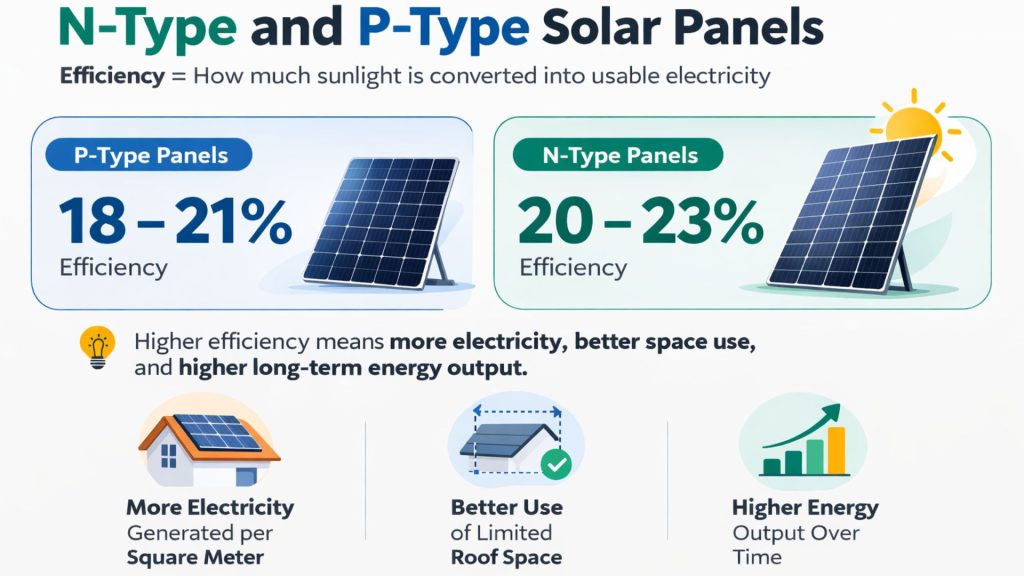
Efficiency refers to how much sunlight a solar panel converts into usable electricity.
The best way to compare is to check the datasheet efficiency for the exact module models you’re considering.
In general:
- P-type panels: ~19–22% efficiency
- N-type panels: ~21–23%+ efficiency
While the difference may seem small, it can significantly impact long-term energy production.
Higher efficiency means:
- More electricity generated per square meter
- Better use of limited roof space
- Higher energy output over time
For commercial properties with large rooftops, efficiency improvements can translate into substantial energy gains over the system’s lifetime.
Temperature Performance in Hot Climates
Solar panels become less efficient as temperatures increase. This performance change is measured by the temperature coefficient.
Typical values include:
Panel Type | Temperature Coefficient |
P-Type Panels | -0.34% to -0.40% per °C |
N-Type Panels | -0.28% to -0.30% per °C |
This means that for every 1°C increase above 25°C, panel efficiency decreases slightly.
Under strong sun in tropical conditions, roof surfaces can reach around ~60°C, which is why temperature coefficient (heat tolerance) becomes an important performance factor for rooftop solar.
Because N-type panels generally have lower temperature coefficients, they tend to perform better in hot climates.
This makes the N-type vs P-type solar panels comparison particularly relevant for tropical regions.
Degradation Rate Over Time
Solar panels gradually lose efficiency over time.
Estimated performance after 25 years:
- P-type panels: ~85%
- N-type panels: ~90–92%
Over a 25-year system lifespan, this difference can lead to higher lifetime energy production for N-type panels.
Estimated performance after 25 years:
Panel Type | Remaining Performance |
P-Type | ~85% |
N-Type | ~90–92% |
Solar panels gradually lose output over time, but the real degradation rate depends on the module model, installation quality, and operating environment.
Across many published field studies, a commonly cited median degradation rate is around ~0.5% per year overall.
Many newer premium N-type product lines are designed and warranted for slower long-term performance loss than many legacy p-type designs, but the exact “year-25 remaining power” depends on the manufacturer’s warranty curve.
So it’s worth comparing the warranty sheet for the exact models you’re choosing.
Resistance to Light-Induced Degradation (LID)
Light-Induced Degradation (LID) is a phenomenon where solar panels lose a small percentage of efficiency shortly after initial exposure to sunlight.
P-type panels are more susceptible to LID due to boron-oxygen reactions within the silicon wafer.
Many N-type designs avoid this specific boron-oxygen LID mechanism, but it’s more accurate to say they reduce exposure to that particular loss mechanism.
As a result:
- N-type panels maintain their initial performance levels better
- Long-term efficiency remains more stable
This advantage contributes to the growing popularity of N-type vs P-type solar panels in modern solar installations.
Typical Cost Differences Between N-Type and P-Type Panels
Cost remains one of the main factors when choosing solar panels.
Approximate pricing trends:
Panel Type | Cost Level |
P-Type | Lower |
N-Type | Higher |
N-type panels typically cost 5–15% more than P-type panels. However, the higher upfront cost may be offset by:
N-type panels often cost more upfront than comparable p-type modules, but the price gap varies a lot by brand, wattage class, and market conditions.
So it’s best to compare quotes from installers for the exact module models to ensure:
- Better efficiency
- Lower degradation
- Higher lifetime energy production
Why Solar Panel Technology Matters in Malaysia’s Tropical Climate
Impact of High Temperatures on Solar Efficiency
Malaysia’s average daytime temperatures range between 28°C and 33°C, but rooftop surfaces can become significantly hotter.
High temperatures reduce panel efficiency because electrical resistance increases in the semiconductor material.
Panels with better temperature performance:
- Maintain higher energy output
- Produce more electricity throughout the day
Humidity and Long-Term Panel Reliability
Malaysia’s climate also features high humidity levels throughout the year. Humidity can contribute to long-term wear through:
- Potential induced degradation (PID): Occurs when voltage differences and humidity cause leakage currents, gradually reducing solar panel performance and power output.
- Material corrosion: High humidity can accelerate corrosion of metal components inside solar panels, potentially weakening electrical connections and reducing long-term reliability.
- Seal degradation: Moisture exposure may slowly degrade panel seals, allowing humidity to enter and potentially damage internal components over time.
High-quality solar panels are designed with protective encapsulation layers to withstand these conditions.
N-type panels often incorporate newer manufacturing processes that provide better durability in humid environments.
Solar Irradiance and Energy Production in Malaysia
Malaysia receives an average 4–5 kWh/m² of solar irradiance daily, making solar energy highly viable for both residential and commercial properties.
Strong sunlight levels mean that even modest rooftop systems can generate substantial electricity.
Because Malaysia has consistent sunlight throughout the year, panel efficiency and degradation rates become important factors in determining lifetime energy production.
Which Solar Panel Type Is Better for Malaysian Homes and Businesses?
When N-Type Panels May Be Worth the Investment
N-type panels may be suitable when:
- Roof space is limited
- Maximum efficiency is desired
- Long-term energy production is a priority
- Electricity consumption is high
For commercial properties, improved efficiency can significantly increase energy generation.
When P-Type Panels Are Still a Practical Choice
P-type panels remain widely used because they offer good performance at a lower price.
They may be suitable for:
- Budget-conscious homeowners
- Large rooftops where space is not limited
- Systems designed with cost efficiency in mind
Factors That Matter More Than Panel Type
While panel technology is important, other factors also influence system performance.
These include:
- Solar system design
- Roof orientation
- Inverter quality
- Installation workmanship
- Shading conditions
A well-designed system can sometimes produce better results than simply choosing the most advanced panel technology.
How Solar Panel Choice Affects Long-Term ROI in Malaysia
Payback Period Differences
N-type panels may slightly shorten payback periods if they generate more electricity over time.
Solar installations in Malaysia typically achieve payback periods of:
- 6.5–8 years for residential systems
- Commercial payback varies widely with tariff type, load profile (daytime usage), export compensation rules, and system size—can be around ~8 years
Electricity Savings Over 25 Years
Solar panels typically have 25–30 year lifespans.
Over this period, a rooftop solar system can reduce electricity bills significantly.
Higher efficiency panels may produce more cumulative energy, increasing overall savings.
Further reading: A Detailed Guide to Solar ATAP: Malaysia’s New Solar Scheme
Conclusion
Choosing between N-type vs P-type solar panels depends on several factors, including budget, roof space, long-term energy goals, and climate performance.
While P-type panels remain a reliable and affordable option, N-type technology offers advantages in efficiency, heat tolerance, and long-term durability—factors that are particularly relevant in Malaysia’s tropical environment.
Ultimately, the best solar system is not determined by panel technology alone. Proper system design, professional installation, and high-quality components all play crucial roles in ensuring reliable performance over decades.
If you are exploring solar panel companies in Malaysia for your home or business, comparing reputable installers is an important first step.
On Listing.my, our business listing makes it easier for property owners to discover trusted installers, compare solutions, and make informed decisions about their solar investment.