Top 10 CRM Software in Malaysia for Businesses
Key Takeaways
- The right CRM depends on how your business sells, including team size, budget, sales process, and customer communication channels.
- Local usability matters, especially for businesses that rely heavily on WhatsApp, social media, and fast lead follow-up.
- SMEs should prioritise ease of use and automation rather than paying for enterprise features they may never use.
- Integrations can be just as important as CRM features, particularly when connecting sales with accounting, marketing, email, or customer service.
- AI is becoming a bigger differentiator, with more CRM platforms using it for lead scoring, follow-ups, forecasting, and sales assistance.
Sales is tough enough without leads getting buried in spreadsheets, WhatsApp chats, emails, and forgotten follow-ups. Customers expect fast replies, sales teams need to know who to contact next, and managers need a clearer picture of what is actually happening in the pipeline.
A good CRM helps bring all of that into one place.
But the right-fit CRM software in Malaysia depends on how your business sells, your team size, your budget, and the tools you already use. And while most popular lists on the internet work as a starting point, most are built around western CRMs and not tailored to local SMEs.
To make the choice easier, we compared 10 CRM platforms available to Malaysian businesses. We look at their core services, pricing, ideal users, and the features that make each one stand out.
The Best CRM Software in Malaysia
| Company | Best For | Pricing | Strength |
| RakanSales | Malaysian SMEs and messaging-heavy sales teams | From RM150/month annually | WhatsApp-first omnichannel CRM with AI sales automation |
| AutoCount CRM | Malaysian SMEs and existing AutoCount users | Custom / quotation-based | CRM integrated with AutoCount accounting and business systems |
| Freshsales | Growing SMEs and B2B sales teams | Free plan; paid from US$9/user/month annually | Freddy AI with built-in sales communication and automation |
| Bitrix24 | SMEs wanting an all-in-one business platform | Free plan; paid flat-rate team plans available | CRM, projects, collaboration, and automation in one workspace |
| monday CRM | Teams needing flexible, custom workflows | From around US$12/seat/month annually | Highly visual no-code CRM with customisable workflows |
| Zoho CRM | SMEs wanting an affordable, scalable CRM | Free for 3 users; paid from around US$14/user/month annually | Zia AI and deep integration across the Zoho ecosystem |
| Pipedrive | Sales-focused and pipeline-driven teams | From around US$14/seat/month annually | Simple drag-and-drop visual sales pipeline |
| HubSpot CRM | Marketing-led businesses and inbound sales teams | Free CRM; Sales Hub Starter from around US$15/seat/month annually | Strong integration between marketing, sales, and customer service |
| Microsoft Dynamics 365 Sales | Microsoft-centric mid-sized and enterprise companies | From US$65/user/month annually | Deep Microsoft 365, Power Platform, and Copilot integration |
| Salesforce | Large enterprises with complex CRM requirements | Enterprise from around US$175/user/month annually | Extensive customisation, integrations, and Agentforce AI |
1. RakanSales
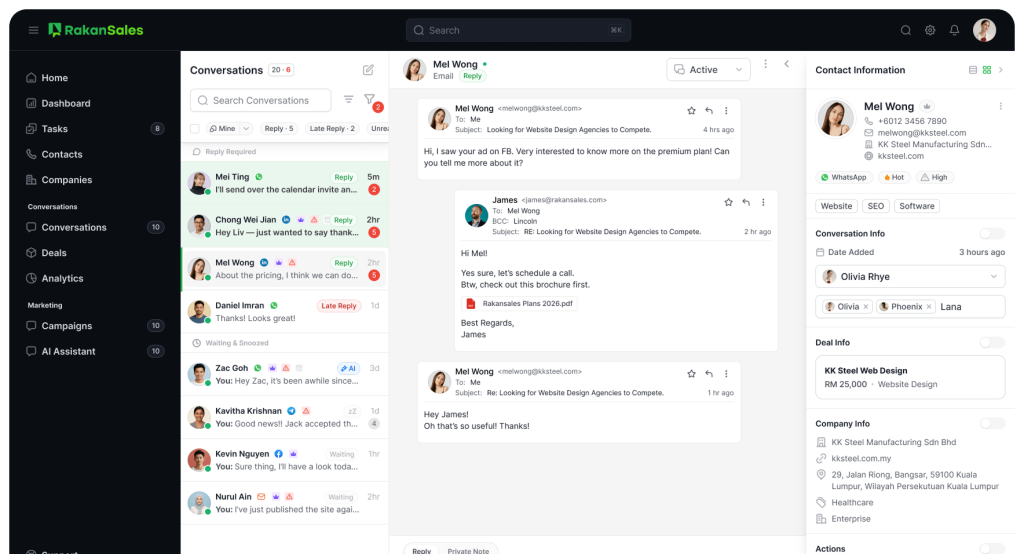
RakanSales is a Malaysian-built AI-powered sales automation CRM designed for SMEs and growing sales teams.
Developed by VeecoTech Solutions, it centralises leads and customer conversations from WhatsApp, Facebook Messenger, Instagram, website live chat, email, SMS, Telegram, Line, and API into one platform.
The focus is on helping businesses automate follow-ups, qualify leads, and manage inbound sales more efficiently across every channel.
Core Services
- Omnichannel Sales Inbox: Combines customer conversations from multiple messaging and social channels.
- Sales Pipeline Management: Uses Kanban-style pipelines to track leads and opportunities through each sales stage.
- AI Sales Automation: Automates lead qualification, responses, and follow-ups.
- Auto Lead Scoring: Prioritises prospects based on engagement and likelihood to convert.
- Round-Robin Lead Assignment: Automatically distributes new leads among salespeople.
- Auto Calendar Setup: Schedules appointments and syncs them with team calendars.
- Sales Reporting Dashboard: Tracks pipeline activity, conversions, and team performance in real time.
- Event Lead Capture: Captures and tracks leads from events using QR codes, name card scanning, and web forms, then routes them into the pipeline.
- API and Email Integration: Connects RakanSales with other tools and workflows.
Pricing
Annual plans currently start from:
- Basic: RM150/month, 2 team members
- Growth: RM350/month, 5 team members
- Pro: RM750/month, 10 team members
- Enterprise: Custom pricing
The Basic plan includes 500 monthly unique conversations, 3 fixed channels (1 WhatsApp, 1 Facebook, 1 Instagram), 2 Kanban boards, and round-robin lead assignment. A 14-day free trial is available with no credit card required. AI features (AI Chatbot and AI Sales Reply Assistant) unlock from the Growth plan upwards.
Ideal For: Malaysian SMEs, property teams, clinics, education providers, agencies, and other businesses that receive high volumes of enquiries through WhatsApp and social media.
What Makes RakanSales Different?
Features such as AI Sales Reply Assistant, AI Chatbot, Auto Lead Scoring, and Round-Robin Lead Assignment allow leads to move from first conversation to structured sales pipeline with less manual work.
RakanSales is ISO/IEC 27001:2022 certified and PDPA Aligned, backed by a local Malaysian development and support team, and designed around regional SME requirements.
Consider This If: Your sales team depends heavily on WhatsApp and social messaging, or you capture leads at events and roadshows and need to track them through to conversion. Businesses needing highly complex enterprise CRM customisation may find larger platforms more suitable.
2. AutoCount CRM
AutoCount CRM is a Malaysia-focused CRM designed to connect customer and sales management with the wider AutoCount business software ecosystem.
It suits companies already using AutoCount for accounting, inventory, billing, or other operational functions. AutoCount positions its CRM around lead tracking, customer service, scheduling, and contract management.
Core Services
- Lead Tracker & Scoring: Track prospects and score sales opportunities.
- Customer Service Management: Record support activities and customer interactions.
- Appointment Scheduling: Organise meetings and sales appointments.
- Contract Management: Keep customer agreements and related information within the CRM.
- Accounting Integration: Connect CRM activities with AutoCount’s wider accounting and business systems.
Pricing
AutoCount does not publish a standalone per-user CRM subscription on its main CRM page. Pricing generally depends on the AutoCount package, modules, and implementation required, and is delivered through a network of local dealers. Businesses will typically need a quotation.
AutoCount also uses a lifetime licence model rather than a monthly subscription, so total cost of ownership includes annual maintenance and any professional services required for setup.
Ideal For: Malaysian SMEs, distributors, wholesalers, retailers, and existing AutoCount users that want customer management to sit closer to their accounting, stock, and sales records.
What Makes AutoCount CRM Different?
AutoCount’s core platform already combines accounting, inventory, billing, purchasing, and more than 30 optional business modules. CRM can therefore become another part of the same operational environment rather than functioning as an isolated sales database.
Consider This If: You already use AutoCount or want closer integration between CRM and back-office systems. Businesses that do not use the AutoCount ecosystem may find less value in this advantage.
3. Freshsales
Freshsales is an AI-powered sales CRM from Freshworks, built around lead management, deal tracking, communication, and sales automation.
Its relatively accessible pricing and straightforward interface make it particularly attractive to growing SMEs that want more automation without moving immediately into enterprise CRM territory.
Core Services
- Contact and Account Management: Centralise customer and company information.
- Sales Pipelines: Track deals through configurable sales stages.
- Email and Communication: Manage sales conversations from within the CRM.
- Workflow Automation: Automate repetitive sales activities.
- Lead Scoring: Prioritise higher-potential opportunities.
- Sales Analytics: Monitor performance, activities, and conversions.
Pricing
Freshsales currently offers:
- Free: Up to 3 users
- Growth: US$9/user/month annually
- Pro: US$39/user/month annually
- Enterprise: US$59/user/month annually
Ideal For: Freshsales works well for SMEs, inside-sales teams, B2B companies, and growing organisations that need a capable CRM without a large implementation burden.
What Makes Freshsales Different?
Its Freddy AI adds AI functionality to everyday sales activity. Features can include AI-assisted lead scoring, email generation, sentiment analysis, and sales insights.
Consider This If: You want strong sales automation at an accessible price. Some advanced AI, reporting, and automation features are reserved for higher-priced plans.
4. Bitrix24
Bitrix24 is an all-in-one business platform that combines CRM with project management, collaboration, marketing, and internal communication tools.
Instead of focusing exclusively on sales, it aims to give smaller businesses one workspace for several day-to-day operations.
Core Services
- CRM: Manage leads, contacts, deals, and pipelines.
- Sales Automation: Build automated workflows around customer activity.
- Marketing: Run campaigns and manage customer engagement.
- Project Management: Tasks, projects, and team collaboration.
- Communication: Internal chat, meetings, and shared workspaces.
- Payments and Inventory: Support additional parts of the customer transaction process.
Pricing
Bitrix24 offers a free plan, while paid plans use a flat-rate structure covering a specified number of users rather than charging purely on a per-user basis.
Its Malaysian pricing page currently positions the free package as an entry option, followed by increasingly capable paid plans for larger teams and more advanced automation.
Ideal For: SMEs that want CRM, projects, communication, and internal collaboration under one subscription.
What Makes Bitrix24 Different?
A company can use Bitrix24 for CRM, task management, marketing, documents, communication, and workflow automation instead of subscribing to several separate platforms. The trade-off is complexity: businesses looking for a very simple sales CRM may find the interface more extensive than necessary.
Consider This If: You want to consolidate CRM, project management, and collaboration into one platform. If your team only needs a straightforward sales pipeline, the interface may feel more complicated than necessary.
5. monday CRM
monday CRM is a highly visual, customisable CRM built on monday.com’s flexible work-management platform. It appeals to businesses that want to adapt the CRM around their own sales process rather than conform to a rigid predefined structure.
Core Services
- Lead and Deal Management: Track opportunities across customised pipelines.
- Contact and Account Management: Centralise customer records.
- Sales Automation: Automate updates, notifications, and repetitive processes.
- Email Management: Connect sales communications with CRM records.
- Dashboards: Build visual reports around pipeline and team performance.
- AI Tools: Use monday AI to assist with sales and workflow tasks.
Pricing: monday CRM’s Basic plan currently starts from US$12 per seat/month when billed annually, with plans starting from three seats. A 14-day trial is available.
Ideal For: SMEs, agencies, consultancies, and teams with unusual or frequently changing sales processes.
What Makes monday CRM Different?
Teams can modify fields, pipelines, dashboards, views, and automations without needing developers or dedicated CRM administrators. That makes it useful when CRM needs to reflect an existing workflow rather than forcing employees to adopt an entirely new one.
Consider This If: Your team values flexibility and wants to customise workflows without coding. Pricing can increase as more users, automations, and advanced functionality are added.
6. Zoho CRM
Zoho CRM is one of the strongest choices for businesses that want a feature-rich CRM without immediately paying enterprise-level prices.
It combines lead management, sales automation, forecasting, analytics, and AI tools, while also connecting with Zoho’s much wider business software ecosystem.
That makes it attractive to SMEs that may start with a relatively simple CRM setup but expect their sales, accounting, support, or marketing requirements to become more complex over time.
Core Services
- Lead and Deal Management: Capture leads, assign them to salespeople, and track opportunities through different pipeline stages.
- Workflow Automation: Automate repetitive activities such as follow-up emails, task creation, lead assignment, and status updates.
- Sales Forecasting: Estimate expected revenue based on current opportunities and pipeline stages.
- Customer Journey Management: Build structured processes for different stages of the customer lifecycle.
- Analytics and Reporting: Create dashboards covering sales performance, conversion rates, pipeline value, and salesperson activity.
- Omnichannel Communication: Connect email, phone, social media, and other customer touchpoints with CRM records.
- Customisation: Create custom fields, modules, layouts, and processes to match different sales structures.
- Integrations: Connect CRM with Zoho applications and external business platforms.
Zoho’s free edition supports three users and includes leads, deals, workflows, reports, and mobile access, making it a practical starting point for very small teams.
Pricing
Zoho CRM offers a free plan for up to three users.
The main editions include:
- Standard: Entry-level sales automation and CRM functionality.
- Professional: Adds more process management and advanced sales tools.
- Enterprise: Adds deeper customisation, AI, and customer journey capabilities.
- Ultimate: Designed for businesses requiring more advanced analytics and CRM limits.
Ideal For: SMEs, growing sales teams, professional service businesses, and companies that expect their software requirements to expand over time.
What Makes Zoho CRM Different?
Its main advantage is the combination of affordability, extensive customisation, and ecosystem depth.
Zoho is also investing heavily in Zia AI. Zia can help users work with CRM data, create reports, build workflows, and automate tasks using AI assistance.
Consider This If: You want good value and room to scale. The large number of features, products, and configuration options can create a steeper learning curve for teams that only need basic CRM functionality.
7. Pipedrive
Pipedrive is a sales-focused CRM built around making deals and sales activities easy to see and manage. Its visual pipeline has long been one of its defining features, allowing salespeople to move opportunities between stages using a simple drag-and-drop interface.
Unlike platforms that attempt to handle every area of business management, Pipedrive remains centred on the everyday needs of sales teams: who needs following up, which deals are progressing, and what action should happen next.
Core Services
- Visual Sales Pipelines: Track opportunities across custom sales stages using a drag-and-drop interface.
- Lead Management: Store and organise prospects before moving them into the active pipeline.
- Contact Management: Keep customer information, communication history, and sales activities together.
- Activity Tracking: Schedule calls, meetings, tasks, and follow-ups around individual deals.
- Email Integration: Sync sales emails and associate conversations with customers and opportunities.
- Workflow Automation: Automate repetitive actions such as notifications, follow-up tasks, and pipeline movements.
- Sales Forecasting: Estimate future revenue based on active deals and their probability of closing.
- Reporting: Monitor conversions, salesperson activity, pipeline health, and sales performance.
Pipedrive’s current plans all include customisable pipelines, a Leads Inbox, custom fields, and data import tools, while higher tiers add more automation, reporting, and customisation capacity.
Pricing
Pipedrive currently uses four main plans:
- Lite
- Growth
- Premium
- Ultimate
Pricing is charged per seat and depends on the billing cycle, user location, and selected add-ons. The Lite plan currently starts from around US$14 per seat/month when billed annually.
Ideal For: B2B sales teams, agencies, property companies, consultancies, and businesses with clear deal-based sales processes.
What Makes Pipedrive Different?
Its biggest advantage remains pipeline simplicity. Each opportunity can be linked with activities, communication history, expected value, and next steps.
That sounds relatively straightforward, but it addresses one of the biggest problems with CRM software: salespeople ignoring the system because it takes too much effort to update.
Consider This If: Your priority is straightforward deal and pipeline management. Businesses that need deep marketing automation, customer service, or broader operational tools may need additional products or integrations.
8. HubSpot CRM
HubSpot is a customer platform that connects CRM, sales, marketing, customer service, and content around the same customer record.
It is strong for businesses where prospects are generated through websites, SEO, content marketing, paid advertising, email campaigns, or other inbound channels.
Its CRM is therefore not simply a place to store contacts. It can track how someone first interacts with a business, what marketing activity they respond to, and how that person eventually moves into the sales process.
Core Services
- Contact Management: Maintain customer profiles and interaction histories.
- Deal Pipelines: Track opportunities across different stages of the sales process.
- Email Tools: Send, track, and manage salesperson outreach.
- Meeting Scheduling: Let prospects book appointments directly through online scheduling links.
- Sales Automation: Automate outreach, follow-ups, and other repetitive sales activities.
- Marketing Integration: Connect forms, campaigns, content, and lead-generation activity with CRM records.
- Customer Service: Extend customer data into service and support workflows.
- Reporting: Analyse sales activities, pipeline movement, and customer acquisition.
- AI Tools: Use HubSpot’s Breeze and Agent Hub capabilities across marketing, sales, and service.
HubSpot currently positions its platform around a shared Smart CRM that connects Marketing Hub, Sales Hub, Service Hub, Content Hub, Data Hub, and Revenue Hub.
Pricing
- Free: US$0
- Starter: Sales Hub Starter starts around US15perseat/monthwhenbilledannually(approximatelyUS20 on monthly billing).
- Professional: Adds more advanced automation, reporting, and sales functionality.
- Enterprise: Intended for larger teams requiring greater control and customisation.
Ideal For: Startups, SMEs, B2B organisations, agencies, and marketing-led businesses.
What Makes HubSpot Different?
HubSpot’s biggest strength is the connection between customer acquisition and sales.
For example, a prospect might go from reading a blog post to booking a consultation. HubSpot can keep much of that journey attached to the same customer record, giving salespeople more context about what a prospect has already done before the first conversation begins.
Consider This If: Marketing and sales need to work closely together. The free and Starter plans can be attractive, but costs can rise significantly as businesses move into more advanced Hubs, automation, and larger contact databases.
9. Microsoft Dynamics 365 Sales
Microsoft Dynamics 365 Sales is an enterprise CRM designed for companies that need sophisticated sales management while remaining closely connected to Microsoft’s wider business ecosystem.
It combines traditional CRM functions such as leads, opportunities, and forecasting with Microsoft 365, Azure, Power Platform, and Copilot, making it particularly attractive to organisations already running much of their business on Microsoft technology.
Core Services
- Lead and Opportunity Management: Track complex sales opportunities from qualification through closing.
- Account Management: Maintain detailed customer and organisational records.
- Sales Automation: Standardise processes and automate repetitive activities.
- Forecasting: Build revenue forecasts using active opportunities and sales data.
- Relationship Intelligence: Surface useful account, contact, and interaction information.
- Microsoft 365 Integration: Connect CRM activity with tools employees already use.
- Analytics: Combine CRM data with Microsoft’s reporting and business intelligence ecosystem.
- Workflow Automation: Extend CRM processes using Microsoft Power Automate and Power Platform.
- AI-Assisted Selling: Use Copilot to summarise opportunities, prepare for meetings, and work with CRM records.
Microsoft says Copilot in Dynamics 365 Sales can provide summaries of leads and opportunities, highlight recent record changes, and help sellers prepare for meetings using natural-language interaction.
Pricing
- Dynamics 365 Sales Professional: US$65/user/month
- Dynamics 365 Sales Enterprise: US$105/user/month
- Dynamics 365 Sales Premium: US$150/user/month
All three are priced on an annual billing basis. The Premium tier currently includes 1,000 Copilot Credits per user.
Ideal For: Mid-sized businesses, large enterprises, and organisations already invested in Microsoft 365, Azure, Power BI, or Power Platform.
What Makes Dynamics 365 Different?
Dynamics 365 fits snugly into any existing Microsoft product and software stack. A salesperson might already spend much of the day using Microsoft productivity tools, while management relies on Power BI and the IT team builds workflows through Power Platform.
Microsoft is also increasingly positioning Dynamics around agentic and AI-powered business applications, with Copilot built directly into sales workflows rather than offered simply as a standalone chatbot.
Consider This If: Your company already relies heavily on Microsoft software and needs CRM to connect with existing enterprise systems. Smaller teams may find the pricing, implementation, and administration requirements difficult to justify.
10. Salesforce
Salesforce is one of the most established names in CRM and remains strong for large businesses that need extensive customisation, complex sales processes, and connections with many other enterprise systems.
Its core Sales Cloud product covers traditional CRM functionality, but Salesforce has expanded far beyond sales management into customer service, marketing, commerce, analytics, data, and AI.
For smaller Malaysian companies, that breadth can be more than necessary. For a large organisation with multiple teams, territories, products, and customer journeys, however, it can be a major advantage.
Core Services
- Lead Management: Capture, qualify, and assign prospective customers.
- Account and Contact Management: Maintain detailed records across complex customer relationships.
- Opportunity Management: Track deals, stages, revenue, and sales activities.
- Pipeline Management: Give managers visibility into active sales opportunities.
- Sales Forecasting: Build forecasts across teams, territories, and business units.
- Workflow Automation: Automate sophisticated sales and customer processes.
- Sales Engagement: Support structured outreach and salesperson productivity.
- Analytics: Build advanced reporting around customers, revenue, and sales activity.
- App Integrations: Extend Salesforce using its large application and integration ecosystem.
- AI Agents: Deploy Agentforce across sales, service, and other business functions.
Pricing
- Enterprise: US$175/user/month annually
- Unlimited: US$350/user/month annually
- Agentforce 1 Sales: US$550/user/month annually
Ideal For: Large businesses, multinational organisations, and companies with complex sales structures, large customer databases, or extensive integration requirements.
What Makes Salesforce Different?
Instead of forcing every company into the same CRM structure, Salesforce can be configured around specific sales processes, customer journeys, data requirements, and internal workflows.
Salesforce also has Agentforce, an autonomous AI platform capable of using business data, reasoning about tasks, and taking actions through workflows, automation, and APIs.
Consider This If: Your organisation genuinely needs enterprise-scale customisation and integrations. Salesforce can become expensive and resource-intensive once implementation, consulting, add-ons, and ongoing administration are included.
How Should You Shortlist CRM Software?
Trying to compare every CRM feature usually makes the decision harder, not easier.
Start by identifying the problems the CRM actually needs to solve:
- Lead Sources: Where do enquiries currently come from?
- Sales Process: How many stages does a typical deal go through?
- Communication: Does the team mainly use WhatsApp, email, calls, or social media?
- Integrations: Which accounting, marketing, or business tools must connect with the CRM?
- Team Size: How many people need access today, and how many may need it later?
- Automation: Which repetitive sales tasks could realistically be automated?
- Budget: What is the total cost once users, add-ons, implementation, and training are included?
Once those requirements are clear, shortlist two or three CRM platforms and test them through demos or free trials.
Pay particular attention to everyday tasks such as adding a lead, assigning it, updating the pipeline, finding conversation history, and producing a basic sales report.
Frequently Asked Questions About CRM Software in Malaysia
How Much Does CRM Software Cost in Malaysia?
CRM software in Malaysia ranges from free plans for small teams to hundreds of ringgit per user each month for advanced platforms. Entry-level SME plans typically start from around RM150 to RM350 per month for the whole team, while enterprise platforms are usually priced per user in US dollars. Total cost also includes setup, add-ons, integrations, training, and implementation.
What Features Should I Look For in CRM Software?
Essential CRM features to look for include lead and contact management, sales pipelines, task tracking, reporting, automation, and integrations with the tools your team already uses. Businesses that rely heavily on messaging should also prioritise WhatsApp or omnichannel inbox support, since most customer conversations in Malaysia now start on chat rather than email.
Should I Choose a Local or International CRM Provider?
Choosing between a local and international CRM provider depends on your support needs and sales channels. A local CRM offers advantages such as Malaysian support hours, ringgit-denominated pricing, PDPA alignment, and features designed around regional sales habits like WhatsApp-first selling. International platforms may offer broader ecosystems, more third-party integrations, and stronger enterprise capabilities but often lack local nuance.
How Do I Know If a CRM Will Be Easy for My Team to Use?
The best way to know if a CRM will be easy for your team is to request a demo or free trial before committing. Test common tasks such as adding leads, updating deals, scheduling follow-ups, and checking reports, because even a powerful CRM can fail if employees find it too complicated to use consistently. Adoption, not features, decides ROI.
Can CRM Software Integrate With My Existing Business Tools?
Yes, most modern CRM software integrates with email, accounting software, marketing platforms, calendars, messaging apps, and other business systems. Check whether integrations are native or require third-party connectors such as Zapier or Make, as this can affect cost, reliability, and ongoing maintenance. Native integrations tend to be more stable and require less technical upkeep over time.
How Long Does It Take to Implement a CRM?
CRM implementation timelines range from a few days for simple platforms to several months for highly customised enterprise systems. Cloud-based SME CRMs with guided onboarding can often be live within a week. Larger or heavily customised deployments depend on data migration, workflow customisation, integrations, training, and the size of the sales team, and typically take four to twelve weeks.