How to Identify Good-Quality Furniture Before Buying

Key Takeaways
- Examine furniture joints, frames and supporting structures before judging its appearance.
- Solid wood is not necessarily superior to well-constructed engineered wood.
- Test cushion recovery, drawer movement, seating comfort and structural stability before purchasing.
- Consider Malaysia’s humid climate when evaluating materials and protective finishes.
- Compare long-term ownership costs, warranty coverage and repairability alongside purchase prices.
Good quality furniture can be identified by examining its materials, structural stability, joints, finishing, hardware and comfort. Well-made furniture should withstand its intended daily use, retain its functionality and offer reasonable durability for the price you pay.
Whether you are furnishing a new condo in Kuala Lumpur, upgrading your family home or purchasing office furniture for your employees, appearance alone tells you very little about how well a piece is constructed.
Knowing what to inspect before buying furniture in Malaysia can help you avoid premature replacements, unnecessary repairs and expensive purchasing mistakes.
How Can You Tell if Furniture Is Good Quality?
You can assess many aspects of furniture quality within a few minutes at a showroom.
| Quality Indicator | Signs of Good Quality | Warning Signs |
| Materials | Clearly identified materials | Vague material descriptions |
| Structure | Stable, rigid construction | Wobbling or excessive creaking |
| Joints | Secure and neatly fitted | Loose connections |
| Surface finish | Smooth, consistent coverage | Peeling or bubbling |
| Upholstery | Even stitching and secure seams | Loose threads |
| Hardware | Smooth, secure operation | Sticking drawers or loose hinges |
| Comfort | Suitable support | Uneven support or excessive sagging |
| Warranty | Written coverage and exclusions | Unclear verbal promises |
No single characteristic guarantees durability. Consider how these factors work together and whether the furniture suits your intended use.
1. Identify the Furniture Materials
Two dining tables may look almost identical in a showroom despite having very different internal construction. Understanding their materials helps you assess whether the asking price is reasonable.
Solid Wood vs Engineered Wood
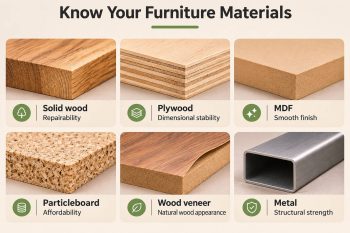
Rubberwood is commonly used in Malaysian furniture manufacturing. However, timber species, drying, construction methods and protective finishes all affect durability.
Look underneath tabletops, inside cabinets and along exposed edges. Ask the salesperson which materials are used for the frame, tabletop, shelves and drawer bottoms separately, as a single piece may contain several different materials.
2. Examine the Joints and Supporting Structure
Furniture often develops problems where its components connect. A beautiful wooden chair offers little value if its legs become loose after repeated use.
Common Furniture Joint Types

Traditional woodworking joints can indicate good craftsmanship, but modern mechanical fasteners can also provide reliable connections. Joint design, material strength and the quality of execution all affect structural durability.
At a furniture store, gently apply sideways pressure to a table or chair under normal handling conditions. Excessive movement, loose connections or unusual cracking sounds deserve further investigation.
3. Inspect the Surface Finish and Workmanship
Good workmanship is often easier to identify in less visible areas. Furniture may look flawless from the front but have rough edges or poorly fitted panels underneath.
Pay attention to the following:
- Surface consistency: Look for uneven coatings, bubbles and peeling laminate.
- Edges and corners: Check for rough surfaces and sharp protrusions.
- Panel alignment: Cabinet doors and drawers should sit evenly.
- Exposed fittings: Screws and fasteners should be securely positioned.
- Hidden surfaces: Inspect table undersides, cabinet interiors and drawer backs.
For dining tables and office desks, ask whether the finish can withstand everyday spills, scratches and cleaning products.
A glossy finish may look attractive under showroom lighting, but it does not necessarily offer better protection than a matte finish.
4. Evaluate Sofa Cushions and Upholstery
A sofa’s durability depends on its frame, suspension system, cushion filling and upholstery.
Foam density is measured in kilograms per cubic metre (kg/m³). Among comparable flexible polyurethane foams, higher-density foam generally offers better durability, although density alone does not determine firmness or comfort.
When testing a sofa:
- Sit in different seating positions to check for consistent support.
- Stand up and observe how the cushions recover.
- Listen for unusual noises from the supporting structure.
- Check whether the armrests are securely attached.
Remember that memory foam and feather fillings recover differently. Slow recovery does not automatically indicate poor quality.
Upholstery Material Comparison
| Upholstery | Advantages | Potential Drawbacks |
| Polyester | Often affordable and relatively easy to maintain | Pilling resistance and care requirements vary |
| Cotton and linen | Can offer breathable, comfortable seating | Can absorb spills and stain |
| Genuine leather | Attractive and potentially durable | Requires appropriate maintenance |
| PU synthetic leather | Often affordable and easy to wipe clean | May crack or peel, particularly in warm, humid conditions |
| Performance fabric | Designed for specific performance characteristics | Durability and stain resistance vary by specification |
For households with children or pets, removable and washable cushion covers may offer more value than premium upholstery requiring professional cleaning. Always check the manufacturer’s care instructions.
5. Test Drawers, Hinges and Moving Components
Moving components experience repeated wear, particularly in wardrobes, kitchen cabinets, office storage units and adjustable chairs.
Open and close drawers several times. Check whether they move evenly, remain aligned and have appropriate stops to prevent accidental removal.
Features worth looking for include:
- Secure drawer runners.
- Adjustable cabinet hinges.
- Smooth extension mechanisms.
- Replaceable hardware.
- Reliable locking mechanisms where required.
Soft-close drawers and hinges improve convenience, but they do not guarantee superior construction. A cabinet with basic, well-installed hardware may outlast one with poorly manufactured soft-close mechanisms.
6. Consider Malaysia’s Climate and Living Conditions
Furniture in Malaysia should be suitable for warm, humid conditions, particularly in rooms without consistent air conditioning or ventilation.
Wood absorbs and releases moisture as surrounding humidity changes. Proper timber drying, construction and finishing help minimise unwanted dimensional changes.
| Furniture Location | Main Concern | What to Look For |
| Living room | Humidity and frequent use | Durable upholstery and protective finishes |
| Kitchen | Spills and moisture | Moisture-resistant materials and sealed edges |
| Bedroom | Moisture accumulation | Adequate airflow and protective finishes |
| Balcony | Rain and sunlight | Outdoor-rated materials |
| Office | Frequent use | Durable hardware and stable construction |
Be particularly careful with exposed MDF and particleboard edges where water contact is likely. Even moisture-resistant boards should not be assumed to be waterproof.
For rarely occupied rental properties or holiday homes, prioritise materials that require less maintenance and can tolerate periods without air conditioning.
7. Check Furniture Quality According to Its Purpose
Different furniture categories experience different types of wear. A decorative coffee table does not require the same structural characteristics as an office chair used throughout the working day.
| Furniture Category | What to Prioritise |
| Sofas | Frame strength, cushion support and upholstery durability |
| Coffee tables | Stable construction and surface protection |
| Bed frames | Supporting slats, frame connections and load capacity |
| Wardrobes | Shelf support, door alignment and suitable anti-tip restraints |
| Dining chairs | Joint strength and seating stability |
| Dining tables | Secure legs and easy-to-clean finishes |
| Office chairs | Adjustability, lumbar support, castors and weight capacity |
| Office desks | Structural rigidity and surface durability |
Secure tall wardrobes, cabinets and shelving units according to the manufacturer’s installation instructions, particularly in homes with young children.
For commercial office furniture purchases, ask whether the specific chair model has been tested against relevant performance standards, such as ANSI/BIFMA X5.1 for general-purpose office chairs.
This standard addresses mechanical safety and performance, including strength, stability and durability. It does not guarantee ergonomic suitability for every individual.
8. Ask About Material Certifications and Safety Testing
Furniture specifications and test reports help buyers evaluate characteristics that cannot be determined through physical inspection alone.
| Certification, Standard or Requirement | What It Indicates |
| FSC certification | Responsible sourcing and traceability, depending on the FSC label category |
| ANSI/BIFMA X5.1 | Mechanical safety and performance of general-purpose office chairs |
| TSCA Title VI | Compliance with US formaldehyde emission requirements for covered composite wood products |
| Upholstery abrasion testing | Fabric resistance to surface wear under specified testing conditions |
Formaldehyde-based resins may be used in composite wood products such as MDF, particleboard and hardwood plywood. Buyers concerned about indoor emissions can request relevant emission test documentation.
These certifications and standards serve different purposes. TSCA Title VI, for example, is a US regulatory requirement rather than a general requirement for all furniture sold in Malaysia.
Responsible timber sourcing does not establish structural durability, just as a high upholstery abrasion rating does not guarantee a longer fabric lifespan.
Always ask for documentation relating to the specific product.
9. Compare Furniture Prices Against Long-Term Value
Expensive furniture is not necessarily well made. Prices can reflect branding, imported materials, design complexity and retail overheads.
A more useful comparison considers the expected cost of ownership rather than the purchase price alone.
Example: Comparing Two Sofas
| Cost Consideration | Sofa A | Sofa B |
| Purchase price | RM1,500 | RM3,000 |
| Assumed service life | 3 years | 8 years |
| Annualised purchase cost | RM500 | RM375 |
| Cushion replacement | Unavailable | Available |
Annualised purchase cost = Purchase price ÷ Expected service life
Although Sofa B costs twice as much upfront, its annualised purchase cost would be RM125 lower under these assumptions.
These figures are illustrative rather than verified furniture lifespan estimates. Actual ownership costs depend on usage, maintenance and repairs.
Cheaper furniture can still make financial sense when furnishing temporary accommodation, short-term rental properties or rooms that are rarely used.
10. Review Warranty and After-Sales Support
Before purchasing furniture, ask the retailer about:
- Warranty duration for individual components.
- Coverage for structural defects and manufacturing faults.
- Exclusions relating to wear, moisture and accidental damage.
- Repair and replacement procedures.
- Availability of spare parts.
- Transportation or labour charges for warranty claims.
A five-year frame warranty, for example, may exclude upholstery, cushions and hinges.
Know Your Consumer Rights in Malaysia
Under Section 32 of Malaysia’s Consumer Protection Act 1999 (Act 599), goods supplied to consumers carry an implied guarantee of acceptable quality. This includes safety, durability, acceptable appearance and finish, freedom from minor defects and suitability for common uses, taking the product’s price and other relevant circumstances into account.
These statutory consumer guarantees are separate from the retailer’s written warranty, although exceptions may apply to defects specifically disclosed before purchase.
Eligible consumers can pursue qualifying disputes through the Tribunal for Consumer Claims Malaysia (TTPM), which handles claims of up to RM50,000 that have accrued within three years.
Purchases made for business purposes or under a company’s name do not qualify under the Tribunal’s definition of a consumer. Written commercial warranties are therefore particularly important for office furniture procurement.
How to Check Furniture Quality When Buying Online
Buying furniture online is convenient, but you lose the opportunity to inspect its construction and test its comfort before purchasing.
| Information to Request | Why It Matters |
| Component material specifications | Identifies the underlying materials |
| Underside and rear photographs | Reveals supporting structures |
| Maximum load capacity | Helps assess suitability |
| Upholstery specifications | Clarifies maintenance requirements |
| Customer photographs | Shows furniture outside promotional settings |
| Warranty and return policy | Clarifies available remedies |
| Assembly instructions | Reveals assembly requirements |
Pay particular attention to recurring customer complaints about loose joints, damaged edges, cushion sagging or difficult assembly.
For expensive sofas, mattresses and ergonomic office chairs, visiting a physical showroom remains worthwhile whenever possible.
Where Should You Spend More on Good Quality Furniture?
You do not need premium furniture throughout your entire home or workplace. Allocate more of your budget to pieces that receive frequent use, support body weight or would be difficult to replace.
| Worth Spending More On | Where You May Be Able to Save |
| Everyday sofas | Decorative side tables |
| Bed frames and mattresses | Guest room furniture |
| Ergonomic office chairs | Occasional seating |
| Frequently used dining chairs | Light-duty display shelves |
| Daily-use office desks | Decorative accent furniture |
| Heavily used storage cabinets | Temporary furnishings |
For businesses, an inexpensive office chair that requires frequent replacement may also generate additional procurement, maintenance and administrative costs.
For homeowners, investing in frequently used furniture can help stretch your budget without compromising everyday comfort.
Making the Right Furniture Selection
Identifying good quality furniture comes down to assessing materials, construction, functionality and suitability. Look beyond attractive designs and promotional discounts, and consider how well the furniture will serve you over time.
Looking for furniture suppliers in Malaysia? Browse Listing.my’s Malaysian business listing directory to discover and compare furniture stores, manufacturers and suppliers before making your purchase.
Sources
- KPDN – Consumer Protection Act 1999 (Act 599), Section 32.
- Tribunal for Consumer Claims Malaysia – Tribunal Jurisdiction.
- USDA Forest Products Laboratory – Wood Handbook: Wood as an Engineering Material (2021).
- Malaysian Meteorological Department – Malaysia’s Climate.
- Sarawak Timber Industry Development Corporation – Rubberwood.
- Polyurethane Foam Association – Foam Performance.
- BIFMA – Furniture Performance Standards.
- Forest Stewardship Council – FSC Claims, Labels and Logo.
- US Environmental Protection Agency – Formaldehyde Emission Standards for Composite Wood Products.
- Association for Contract Textiles – Hydrolysis and Abrasion Testing.
- US Consumer Product Safety Commission – Furniture Tip-Over Prevention.
Frequently Asked Questions About Choosing the Right Furniture
Is Heavy Furniture Always Better Quality?
No. Furniture weight depends on its materials, dimensions and construction. Well-designed lightweight furniture can be durable, while heavy furniture may still have weak joints or poor workmanship.
Is Malaysian-Made Furniture Good Quality?
Malaysia produces furniture across various price and quality categories. Evaluate the manufacturer’s materials, construction methods, specifications and warranty rather than judging quality solely by country of origin.
Is Flat-Pack Furniture Less Durable?
Not necessarily. Flat-pack furniture can offer good durability when its materials, fasteners and structural design are suitable for the intended use and it is assembled correctly.
Is Second-Hand Furniture Worth Buying?
Yes, provided its structure remains sound and there are no serious defects, pest infestations or moisture damage. Solid wood furniture with repairable components can be particularly worthwhile.
Does a Strong Chemical Smell Indicate Poor-Quality Furniture?
Not necessarily. Odours may come from adhesives, finishes or upholstery materials. However, smell alone cannot establish chemical emission levels or product safety. If concerned, request relevant emission test documentation.
Can Showroom Furniture Be Worth Buying?
Yes. Display furniture may offer good value if discounted appropriately. Inspect it for wear, confirm its warranty coverage and ask for existing defects to be documented before purchasing. Specifically disclosed defects may affect your statutory consumer rights.