NLP for CEOs: Mastering Precision in High-Stakes Meetings
Key Takeaways:
- Vague CEO language does not just confuse, it silently kills decisions, erodes trust, and stalls organisations.
- NLP is not a manipulation toolkit; it is a precision communication system that helps leaders engineer how meaning travels from intent to action.
- Different meeting types demand different NLP strategies, one approach does not fit a crisis board meeting and an investor pivot call.
- The CEO Language Audit is a self-diagnostic tool that reveals hidden weak patterns before they cost a deal or a team.
- Malaysian boardroom culture is high-context. What is left unsaid carries real weight, and NLP helps leaders navigate that with skill.
Neuro-Linguistic Programming (NLP) for CEOs is the strategic application of language, framing, and communication patterns to influence outcomes in high-stakes business settings. It equips executives with tools to deliver precise instructions, build rapid rapport, reframe resistance, and guide decisions without ambiguity, manipulation, and without losing authority.
NLP is not about charisma coaching or memorising power phrases. For CEOs and executives, it is about precision communication architecture: knowing exactly what language to use, in which meeting, at which moment, to move people from confusion to clarity and from resistance to commitment.
This is why more senior leaders are turning to NLP training courses in Malaysia not as a personal development exercise, but as a boardroom-ready skill set.
The right training does not teach you to sound better. It teaches you to think in language so that what lands in the room is exactly what you intended.
CEO Language Audit: How to Spot the Words That Are Holding You Back
Before applying any NLP technique, a strategic leader must first identify where their language are working against them.
The CEO Language Audit is a self-diagnostic that maps your habitual communication patterns against two axes:
- Precision vs. Abstraction Are your instructions specific and actionable, or are they visionary but vague?
- Emotional Resonance vs. Logical Structure Do your words move people emotionally, or do they persuade through data and reasoning?
The CEO Language Audit Table
| High Precision | High Abstraction | |
| High Emotional Resonance | Inspires AND activates | Motivates but creates confusion |
| High Logical Structure | Drives clear decisions | Technically correct but flat.People disengage |
Most CEOs live in the top-right or bottom-right quadrant. They either inspire without direction, or they present logic without energy.
The sweet spot; the top-left is where language produces both motivation and movement.
Quick self-audit questions:
- After your last major meeting, did your team know exactly what to do next?
- Did anyone ask for clarification more than once on the same point?
- Did you use phrases like “we need to be more agile” or “think bigger” without defining what that means operationally?
If yes to any of these, your words are working against you
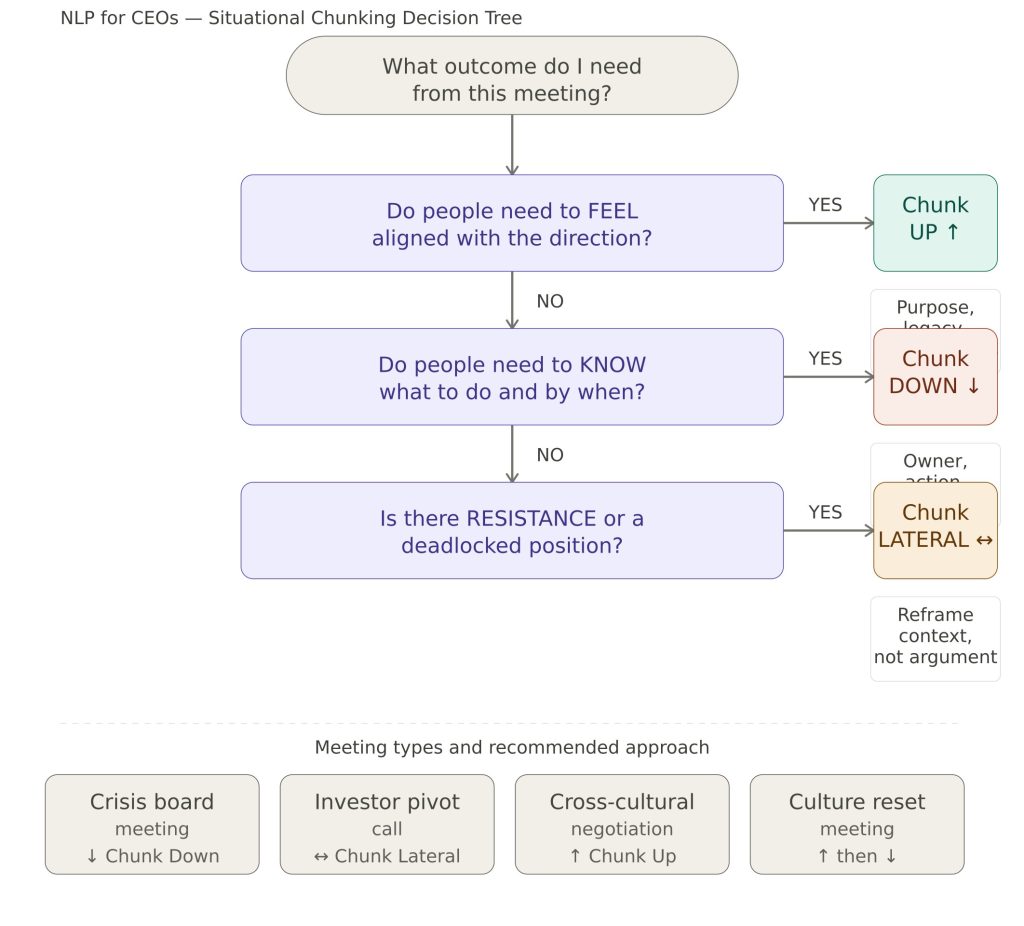
The Situational Chunking Decision Tree
NLP uses a concept called chunking — the ability to move between levels of detail deliberately.
- Chunk Up = move to bigger picture, values, and vision (use to inspire and align)
- Chunk Down = move to specifics, steps, and data (use to drive action and remove ambiguity)
- Chunk Lateral = move to alternatives and analogies (use to reframe resistance)
Use this decision tree before every major meeting:
NLP Across 4 High-Stakes CEO Meeting Types
1. Crisis Board Meeting
The challenge: The room is anxious. Every word you say will be replayed and dissected. Vague reassurances will collapse trust faster than the crisis itself.
NLP Strategy: Anchoring + Precision Language
Open by anchoring calm. Use a steady tone, measured pace, and grounded body language to set the emotional register for the room.
Then chunk down immediately:
- Facts
- Timeline
- Response plan
- Owner
- Next review point
Avoid presuppositions of helplessness: “We are in a difficult situation” keeps people stuck. Instead: “We are already three steps into our response. Here is where we are.”
- Malaysian setting: In GLC and government-linked board settings, maintaining “muka” (face) for all parties while delivering hard truths requires reframing skill. NLP’s meta-model patterns help you challenge distorted thinking (“everything is ruined”) without humiliating the person who said it.
2. Investor Pivot Call
The challenge: You are changing direction. Investors bought into a different story. Your language must honour the original commitment while making the new direction feel inevitable, not desperate.
NLP strategy — Reframing + Outcome-Based Questioning
Reframe the pivot as evidence of intelligence, not failure:
- “The market gave us data we didn’t have at Series A. We are responding to reality, not retreating from vision.”
Use outcome-based questioning to redirect the conversation:
- “The question is not whether we pivot — it is how we move fastest to the outcome we all agreed on.”
Avoid defensive language. Presuppositions matter here:
- “As you already know, agile companies outperform rigid ones” embeds agreement before the investor has consciously decided.
3. Cross-Cultural Negotiation
The challenge: In Malaysia’s multilingual boardroom reality: English, Bahasa Malaysia, Mandarin shifting mid-meeting language patterns shift, and so does meaning.
Rapport Calibration + Sensory-Specific Language
Match the communication style of your counterpart without mimicking them.
- High-context cultures communicate indirectly. Silence is data.
- A soft “we will consider it” in a Malaysian-Chinese business context often means “No” and NLP-trained CEOs recognise this.
Use sensory-specific language:
- “Does this feel like the right direction?” lands differently from “Does this look like the right direction?” Know your counterpart’s dominant processing mode.
- Avoid rushing to close. Rapport calibration means you pace first, then lead.
4. Internal Culture Reset
The challenge: You need the organisation to change behaviour, not just hear a speech. Most internal communications produce nodding, not shifting.
NLP strategy — Chunking Up to Values, Then Anchoring New Behaviours
Start by chunking up to shared identity:
- “We have always been a company that delivers when it is hard. That is not changing.” Then chunk down to specific new behaviours with clear ownership.
Anchor the reset to a concrete moment or symbol like a phrase, a decision, a visible change in practice that people can point to. Language without an anchor fades within 48 hours.
Blur-free instructions matter here:
- Not an instruction: “Be more customer-centric”
- This is an instruction: “Every customer complaint gets a call-back within four hours, logged in the system, reviewed by the team lead weekly”.
Learn more: 5 Reasons Your Sales Team Needs NLP to Close Deals Faster
Staying Calm Under Pressure: The NLP Advantage
NLP equips CEOs with in-the-moment anchoring, which is the ability to access a calm, resourceful state on demand through a practised mental cue. This is not mystical. It is a trained neurological response, and it is the difference between a leader who controls the room and one who is controlled by it.
The ASB ICLIF Executive Education Center formed when ICLIF merged with Asia School of Business in 2020 and backed by Bank Negara Malaysia, has long built its executive programmes around the principle that leadership effectiveness under pressure is a learnable skill, not a personality trait.
Conclusion
Language is strategy. The CEOs who understand this do not just communicate better, they build companies that move faster, negotiate harder, and hold together under pressure.
If you are a senior leader in Malaysia looking to apply NLP in your boardroom, the practical next step is finding a credible, experienced NLP training provider who understands the business ecosystem and not just the theory.
Our business directory is where you can search for trusted NLP training providers, executive communication coaches, and leadership development programmes across Malaysia. We make the search fast and reliable for you.
Sources:
- Wikipedia — Neuro-linguistic programming (updated March 2026)
- PubMed/PMC — Systematic Review on NLP Health Outcomes
- Wikipedia — ICLIF Leadership and Governance Centre (updated April 2024)
- ICLIF Official Website
- HRD Corp Official FAQ — SBL-Khas Scheme
- HRD Corp Support Centre
- ResearchGate: NLP in Coaching Review (2023)
FAQs
Q1. Is NLP scientifically proven?
A: NLP is not widely recognised as a scientifically validated discipline, and research has not confirmed its core claims. However, many techniques associated with NLP, such as reframing, rapport building, and goal-focused questioning, overlap with established fields like cognitive behavioural approaches and communication theory. Its value lies in practical application of these skills in real business communication.
Q2. How is NLP different from manipulation?
A: Manipulation conceals intent. NLP, applied ethically, makes intent clearer and communication more precise. The goal is alignment and clarity..
Q3. Can NLP help in virtual meetings and remote leadership?
A: Yes. Tone, pacing, word choice, and outcome-based questioning are equally powerful over video calls. In fact, virtual environments make precision language more critical because non-verbal cues are reduced.
Q4. Is NLP training available in Malaysia and is it HRDC-claimable?
A: Yes. Several registered training providers in Malaysia offer NLP-based leadership and communication programmes. Many are claimable under HRD Corp’s SBL-Khas scheme (Skim Bantuan Latihan Khas), which allows employers registered with HRD Corp to fund approved training directly from their levy contributions. To check eligibility and find approved providers, visit the official HRD Corp portal at hrdcorp.gov.my.
Q5. How long does it take to apply NLP effectively in the boardroom?
A: Core reframing and chunking techniques can be applied within days of learning them. Deeper rapport calibration and anchoring skills develop over weeks of conscious practice. Most executives report measurable improvement in meeting outcomes within their first month of consistent application.
Q6. Where can I find NLP training providers in Malaysia?
A: Listing.my is a practical starting point. Search for NLP coaching, executive communication training, or leadership development in your preferred state or city to find vetted, listed providers across Malaysia.