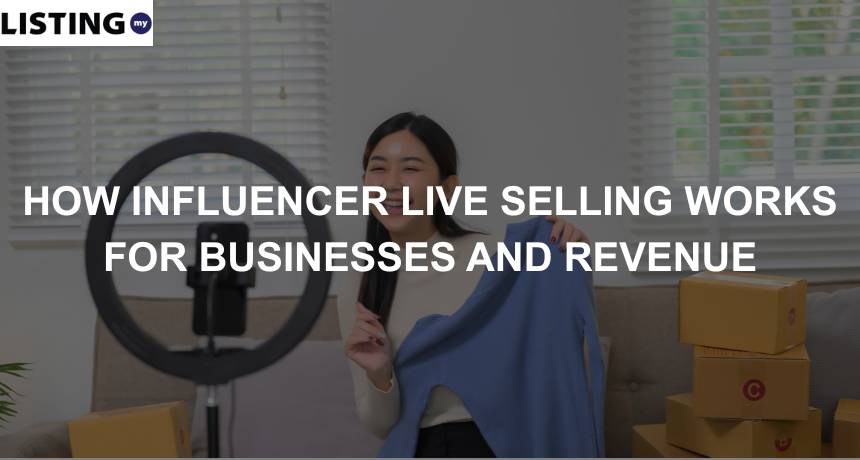
How Influencer Live Selling Works for Businesses and Revenue
- 5 February 2026
- Digital Marketing
Key Takeaways
- Influencer live selling converts attention into revenue through real-time product demos, urgency mechanics, and frictionless checkout.
- Revenue success depends on offer design, host performance, and fulfilment readiness, not follower count alone.
- Influencer-led lives outperform brand-only lives when trust, language fit, and moderation are managed correctly.
- Profitable live selling requires a system covering pre-live planning, live execution, and post-live optimisation.
- Most brands scale faster by working with agencies that manage creators, tracking, live ops, and performance reporting.
Influencer live selling is a real-time commerce format where products are sold during livestreams hosted by creators, with viewers able to ask questions, claim offers, and check out instantly.
If you ever watch a live stream, you have probably heard some version of “Hey guys, welcome back to my live stream~”
What looks casual on screen is actually a tightly run sales operation. Scripts are planned, offers are engineered, moderators observe buyer intent, and fulfilment teams prepare for demand spikes.
Brands that treat live selling as “just content” usually underperform, Brands that treat it as a revenue system scale it.
So if you’re wondering if it’s a gimmick or is it worth dabbling into live selling, we will explain how influencer live selling works for businesses and how revenue is generated step by.
How Does Influencer Live Selling Actually Work?
Influencer live selling combines content, community interaction, and instant purchasing into a single conversion moment.
At a high level, particularly managed by influencer marketing agencies follows this flow:
- Traffic enters the live session
Viewers arrive via platform notifications, algorithmic boosts, creator audiences, or paid amplification. - The influencer demonstrates the product live
Products are shown in live demonstration, not polished ads. Questions are answered in real time, objections are handled publicly. - Offers are triggered during peak attention
Time-limited vouchers, bundle pricing, or gift-with-purchase mechanics create urgency. - Checkout happens without leaving the stream
Platforms allow pinned products or in-stream checkout, reducing drop-off. - Post-live sales continue
Replays, pinned links, and delayed attribution capture additional conversions.
It seems pretty simple, but this format works because it compresses the AIDA funnel model into one session.
Why Influencer-Led Live Selling Converts Better Than Brand-Only Lives
One of the biggest appeals of influencer live selling is that people have someone they already trust explaining the product.
This difference in perception is what separates influencer-led lives from brand-only sessions.
- Brands speak from a position of selling.
- Influencers speak from a position of use, experience, and relatability.
For viewers, that distinction matters.
From a business perspective, influencer-hosted lives consistently outperform brand-hosted lives for three reasons.
Social proof is built in
Viewers already believe the host, in fact they already know the host.
Product explanations feel like personal recommendations rather than scripted sales messages. When a creator shows how they use an item, credibility transfers instantly, especially if they do it with a big smile!
Language and cultural fit increase watch time
Influencers naturally adapt their tone, humour, and pacing to their audience.
Whether switching languages, simplifying explanations, or responding casually to comments, this familiarity keeps viewers engaged longer.
Live objection handling happens publicly
When one viewer asks about price, quality, delivery time, or returns, the answer is visible to everyone.
This removes repeated hesitation and accelerates decision-making across the audience.
For businesses, this results in:
- Higher average watch time
- Stronger click-through rates
- More efficient conversions
All without increasing ad spend or discount depth.
Statistical fact: Live and social commerce are some of the fastest-growing slices of that pie: recent industry estimates suggest Malaysia’s social commerce market will reach around US$1.36 billion in 2025 and could grow to roughly US$2.87 billion by 2030, with live shopping alone already contributing in the low billions of ringgit.
Where Revenue Comes From in Influencer Live Selling
Revenue in influencer live selling does not come from views alone. It comes from how each live session is planned and run.
A live show with 5,000 viewers can flop, another with 2,000 viewers can sell out. The difference is not the platform or the creator’s follower count. It is execution.
A simplified example of how revenue typically stacks up:
- Live viewers: around 5,000
- Average watch time: 6 to 8 minutes
- Click-through rate: 8 to 15 percent
- Conversion rate: 5 to 12 percent
- Average order value (AOV): RM80 to RM150
What pushes these numbers up is not “going live”. It is what happens during the live.
Offer structure
Bundles almost always outperform single products.
A limited set of 100 units creates more urgency than a discount that runs all week. Malaysians respond well to value, but only when it feels time-bound and clear.
Host pacing
Good hosts repeat the benefits of a product (or the USP) every few minutes.
Why? So late joiners do not need to rewind. If the benefit is only mentioned once, half the audience never hears it.
Moderator effectiveness
Fast replies matter. When someone hesitates and asks a question, silence kills intent.
A quick, clear answer keeps the buying momentum going.
Fulfilment confidence
Clear delivery timelines and return policies reduce last-minute doubt. People buy faster when they know when the item will arrive and what happens if it does not suit them.
Brands that only focus on “let’s go live and see what happens” usually see unpredictable results.
The ones that plan these see consistency, in fact let’s go over what happens pre-live.
What Happens Before the Live Session
Most of the revenue is decided before the live starts.
A proper pre-live setup includes:
- Creator selection based on audience match, not follower size
Mid-tier creators with high engagement often outperform celebrities. - Run-of-show planning
A timed structure covering intro, product segments, offer drops, and closing push. - Offer engineering
Deciding bundles, vouchers, quantity caps, and upsell sequencing. - Inventory and fulfilment alignment
Ensuring stock levels, packing capacity, and courier SLAs can handle spikes. - Tracking configuration
Promo codes, affiliate links, and platform analytics are prepared in advance.
“When pre-live planning is weak, lives feel chaotic and everything falls apart when a viewer asks difficult questions.”
This is usually the point where brands realise live selling is not a solo effort.
Once creators, offers, stock, and tracking intersect, coordination becomes more important than creativity.
What Happens During the Live Session
Live selling is closer to a sales floor than a content shoot.
During the live, several roles operate simultaneously:
- The influencer host
Demonstrates products, repeats benefits, responds to high-intent questions. - Moderators
Filter spam, surface buying questions, post reminders about vouchers and bundles. - Live ops manager
Monitors viewer count, pacing, and offer timing. - Paid amplification team (if used)
Boosts the live to new audiences when engagement spikes.
Successful sessions maintain rhythm. Slow moments kill conversions. Over-selling kills trust. Balance is always on purpose, not accidental.
A Scenario Example: How a Live Turns Into Sales
A beauty influencer goes live to demo a makeup foundation.
She is not rushing, instead she applies it slowly, chatting with the chat while doing so. She mentions she has been using it for months, not just today.
Halfway through, someone asks if it feels heavy in hot weather.
She taps her cheek and laughs.
Says she has worn it out the whole afternoon and her face still feels comfortable. Then she casually mentions it has SPF50, which was not even in the script.
At this point, a moderator pins the product and posts a message:
“Bundle available for 10 minutes. Free sponge, limited to 100 sets.”
More questions come in at that moment:
- What’s the shade range?
- What is the delivery time?
- Is it suitable for sensitive skin?
Each answer is given live, in front of everyone.
People watching are not thinking, “I am being sold to.” They are thinking, “This looks okay. Other people are buying. I might as well try.”
That is how revenue happens.
What Happens After the Live Session
For many brands, the live does not end when the camera switches off.
In fact, a meaningful share of sales often happens after. It is common for post-live purchases to make up 20 to 40% of total revenue.
“Businesses are not just closing sales here, they are learning what worked and what did not, so the next livestream performs better.”
Post-live actions usually include:
- Looking at where viewers dropped off
This helps identify which parts were too slow, too long, or confusing. - Reviewing which offers actually converted
Not every bundle or voucher performs the same, and the numbers often tell a different story from gut feel. - Retargeting viewers who showed intent but did not buy
Many people click, hesitate, then leave. A reminder later often brings them back. - Reusing strong moments as short clips
Good explanations and reactions can be turned into ads or reused in future live sessions. - Tweaking scripts and bundles for the next run
Small adjustments, like changing offer timing or phrasing, can lift results quickly.
Brands that skip this step usually find themselves repeating the same mistakes every week.
Which Platforms Are Commonly Used for Influencer Live Selling?
Different platforms behave differently, even with the same creator and product.
Platform choice affects offer design, pacing, and conversion expectations, which is why most brands test more than one before scaling.
Platform | Audience Behaviour | What Sells Well | Business Considerations |
TikTok Live / TikTok Shop Live | Fast-scrolling, discovery-driven, impulse-friendly | Trend-led products, bundles, limited-time deals | Strong algorithmic reach; requires tight pacing and repeated callouts for late joiners |
Shopee Live | Price-conscious, deal-focused, comparison-driven | Discounts, vouchers, value bundles | Clear pricing and voucher mechanics matter; replay sales can be significant |
Instagram Live | Relationship-based, loyal followers, trust-led | Beauty, lifestyle, niche products | Often paired with DMs and post-live follow-ups; slower but higher-intent buyers |
Facebook Live | Community-driven, older demographic, discussion-heavy | Household items, local brands, practical products | Engagement relies on conversation and comments; checkout often happens off-platform |
In Malaysia specifically, social media and live-shopping reach are already mainstream. Recent reports estimate around 25 million active social media user identities, roughly 70% of the population, and TikTok alone reaches more than 18 million users locally.
TikTok’s own Malaysia “shoppertainment” data shows that about half of users watch content and shop at the same time, and nearly 9 in 10 participated in major online sale events, with high-spending shoppers averaging around RM1,100 per mega-sale.
For more information on Micro vs Macro Influencers, we have a whole blog on it!
How Businesses Should Measure Success in Influencer Live Selling
Vanity metrics do not pay invoices. Revenue metrics do.
To understand if a live session is worth repeating or scaling, these metrics need to be tracked consistently:
- Gross revenue per live
- Conversion rate per product
- Average order value
- Voucher cost as a percentage of revenue
- Fulfilment issues and return rates
- Creator-level performance trends
When reporting focuses on outcomes, live selling becomes a forecastable channel.
Conclusion: Influencer Live Selling as a Revenue System for Businesses
With the rise of social media consumption and influencer marketing becoming part of everyday buying behaviour, live selling is no longer a side experiment.
DOSM estimates that e-commerce generated over RM900 billion in revenue in just the first three quarters of 2025, and multiple reports show social and live commerce compounding at high-teens growth rates.
The systems you build around live selling now can realistically become a dependable line of revenue over the next few years if you treat them like a channel.
But trying to do everything solo can be challenging.
Coordinating creators, scripts, moderation, tracking, and fulfilment takes time and experience., and this is where the right support matters.
Our business directory curates a trusted list of influencer marketing agencies and digital service providers, making it easier to find teams that can help you scale with confidence.
For businesses that want live streaming to become a dependable revenue channel rather than a one-off experiment, having the right partners in place makes all the difference.
Source:
- Department of Statistics Malaysia (DOSM) – Malaysia Digital Economy and ICT Satellite Account
- Ipsos – “E-Commerce Landscape in 2024 / 2025” (Malaysia)
- DataReportal – “Digital 2025: Malaysia”
Internet penetration, social media user base and platform reach in Malaysia.
- TikTok Newsroom (Malaysia) – TikTok Drives Shoppertainment for Malaysian Businesses
- DataReportal / TikTok ad reach data (via MediaPlus Digital)
Estimates of TikTok user reach in Malaysia (e.g. >18M users, >50% of population). - Local news & commentary on TikTok shopping behaviour
- Live-stream commerce & TikTok Shop studies (Malaysia / SEA)
- Shopify – Social Commerce & Live Shopping Guides