A Detailed Guide to Solar ATAP: Malaysia’s New Solar Scheme
Key Takeaways
- Solar ATAP is a Malaysian government programme that makes solar adoption more accessible.
- It allows eligible electricity consumers to install rooftop solar PV for self-consumption and export surplus energy to the grid for bill credits (offsets), subject to Solar ATAP rules.
- With Solar ATAP, electricity bills can be reduced significantly while contributing to Malaysia’s renewable energy goals.
- Understanding installation costs and ROI helps homeowners decide whether investing in solar energy is financially worthwhile.
- Comparing solar incentives and installation providers ensures better long-term value and system performance.
Solar Accelerated Transition Action Programme (Solar ATAP) is Malaysia’s government rooftop solar programme that lets eligible electricity consumers install rooftop solar PV primarily for self-consumption, with surplus energy exported to the grid for bill credits under regulated rules.
Electricity prices in Malaysia have been gradually increasing as energy demand grows. At the same time, the government is pushing for cleaner energy under national sustainability goals.
As a result, many homeowners are beginning to explore options offered by solar panel companies in Malaysia to reduce their long-term electricity costs.
One initiative supporting this transition is Solar ATAP, a programme designed to encourage rooftop solar adoption in Malaysia while helping homeowners reduce electricity costs and improve long-term energy sustainability.
This guide will help you evaluate whether solar ATAP is worth considering for your home.
What is the Solar ATAP Programme in Malaysia?
The solar ATAP programme was introduced to expand Malaysia’s rooftop solar capacity under the government’s renewable energy roadmap.
“ATAP” literally means roof in Malay, highlighting the programme’s focus on rooftop solar systems.
The initiative works alongside Malaysia’s broader solar policies administered by agencies such as:
- Sustainable Energy Development Authority (SEDA Malaysia)
- Energy Commission (Suruhanjaya Tenaga)
- Tenaga Nasional Berhad (TNB)
In practice, the Energy Commission regulates the framework, SEDA Malaysia manages the programme process/systems, and TNB handles grid connection, metering, and technical requirements.
The objective is to:
- Increase renewable energy generation
- Reduce reliance on fossil fuels
- Encourage distributed energy production
The programme also provides an opportunity to generate long-term electricity savings.
Understanding Solar Installation Costs in Malaysia
One of the biggest questions property owners in Malaysia may ask before installing solar panels is the total system cost.
Solar systems are priced based on several factors:
- System size (kWp): Larger systems generate more energy but cost more
- Roof type: Roof material affects mounting difficulty and installation cost
- Installation complexity: Complex roof layouts increase labour and installation time
- Solar panel quality: Higher efficiency panels usually cost more but perform better
- Inverter type: Advanced inverters improve efficiency but increase system price
Typical Solar System Cost in Malaysia
System Size | Estimated Cost | Suitable For |
4 kWp | ~RM15,000 – RM22,000 | Small households |
6–6.6 kWp | ~RM18,500 – RM30,000 | Medium households |
8 kWp | ~RM22,000 – RM42,000 | Larger homes |
10 kWp | ~RM26,000 – RM47,000 | High electricity consumption homes |
For medium-usage households, 6–7 kWp is a common sizing range, but the right size depends on your monthly kWh use, available roof space, and how much electricity you use during the day.
A 6 kWp system can often generate on the order of ~6,600–7,800+ kWh per year, assuming typical Malaysia-specific yields of roughly ~1,100–1,300 kWh per kWp per year. Shading, roof tilt/orientation, and weather can push this higher or lower.
Under solar ATAP, excess electricity can be exported to the grid depending on programme conditions.
Source:
- SEDA Malaysia – Solar ATAP
- SEDA (eFiT portal) – Home owners’ guide / specific yield worksheet reference
- Energy Commission (Suruhanjaya Tenaga) – Guidelines for Solar Accelerated Transition Action Programme in Peninsular Malaysia (GP/ST/No.60/2025) [PDF]
- TNB (myTNB) – Solar Accelerated Transition Action Programme (Solar ATAP)
Return on Investment (ROI) for Solar Panels in Malaysia
When homeowners evaluate solar installation, they usually want to know how long will it take to recover their investment?
The ROI depends on several factors:
- Electricity consumption: Higher electricity use increases potential savings from solar energy
- System size: Higher electricity use increases potential savings from solar energy
- Energy export mechanism: Selling excess electricity back to the grid improves overall returns
- Electricity tariff rates: Higher electricity prices increase savings from solar-generated power
Estimated Solar ROI in Malaysia
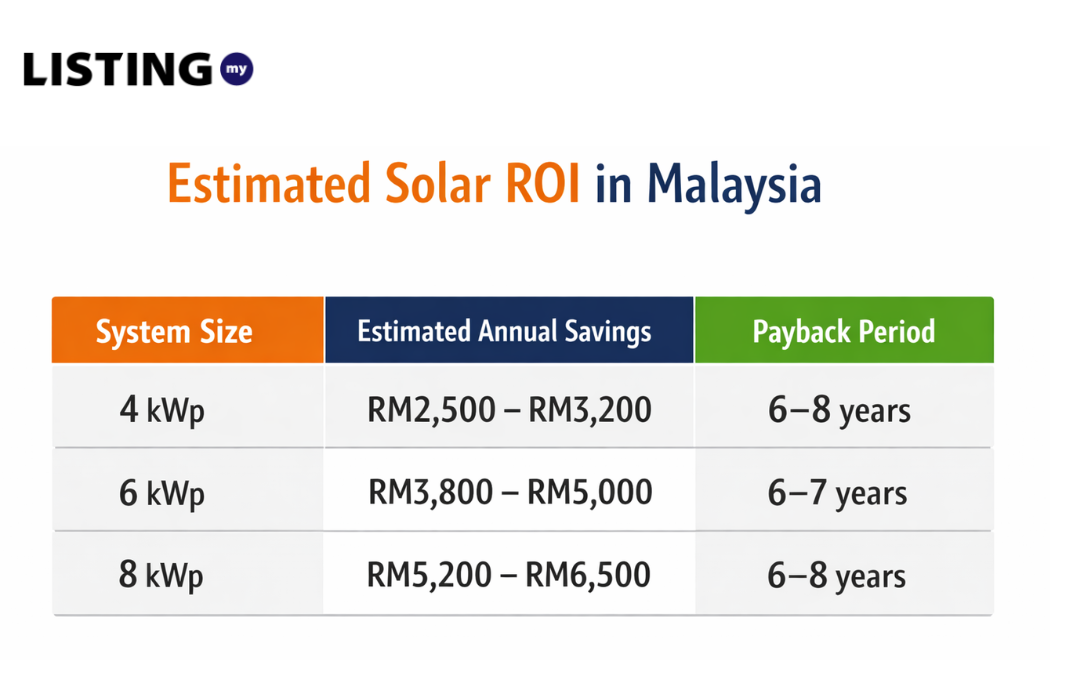 Solar panels commonly come with 25–30 year performance warranties, and many systems operate around 25–35 years depending on environment, component quality, and maintenance.
Key Benefits of Solar ATAP
The solar ATAP programme offers several advantages for Malaysian homeowners.
1. Lower Electricity Bills
Solar panels generate electricity during the day, reducing reliance on grid electricity. Bill savings vary widely.
Households that use more electricity during daytime (when solar is producing) typically see stronger reductions, while evening-heavy usage may see smaller savings unless loads can be shifted.
2. Long-Term Energy Savings
Solar panels typically have a lifespan of 25 years or more, making them a long-term investment rather than a short-term expense.
3. Property Value Enhancement
Homes with solar installations are increasingly seen as energy-efficient properties, which may increase property appeal and re-sale value.
4. Environmental Benefits
Solar power is a clean energy source. Installing solar panels helps reduce:
- Carbon emissions
- Fossil fuel dependency
- Environmental impact
5. Support for Malaysia’s Renewable Energy Goals
The Malaysian government aims to increase renewable energy capacity significantly in the coming years.
By joining the solar ATAP programme, homeowners can participate in the national energy transition.
How to Apply for Solar ATAP
Applying for the solar ATAP scheme typically involves several steps.
Step 1: Assess Your Home’s Solar Suitability
Installers will evaluate:
- Roof orientation
- Roof structure
- Sunlight exposure
- Available installation space
Step 2: Obtain Quotes from Solar Installers
When comparing prices with a few solar providers, it is important to evaluate:
- System size recommendations: Installer may suggest system capacity based on household electricity usage
- Installation costs: Total price for solar panels, inverter, labour, and installation equipment
- Warranty coverage: Protection period for panels, inverter, and installation workmanship
- Estimated savings: Projected electricity bill reduction based on system output and usage
Step 3: Submit Application to Authorities
Solar ATAP applications are submitted via SEDA Malaysia’s eATAP system, and applicants must appoint a Registered PV Service Provider (RPVSP) to prepare and submit the technical and compliance documents.
TNB then reviews grid connection and metering requirements as part of the process:
- Solar installers: Installers prepare documents and submit technical details for the application
- Grid operators: Utility companies review grid connection and electricity export requirements
- Regulatory agencies: Authorities approve compliance with national energy regulations and programme rules
- Submission assistance: Installers usually manage paperwork and application submission for homeowners
Step 4: Installation and Grid Connection
Once approval is granted:
- Solar panels are installed
- Inverters are connected
- System is linked to the grid
- Metering system is activated
Step 5: Start Generating Solar Energy
After installation, homeowners can begin generating electricity and benefiting from the solar ATAP programme.
Conclusion
Malaysia’s push toward renewable energy is opening new opportunities for homeowners to reduce electricity costs and contribute to sustainability.
Before installing solar, it is important to compare installer quotes, understand the potential ROI, assess roof suitability, and review available solar schemes.
Programmes like solar ATAP make rooftop solar more accessible, with many homeowners achieving payback in 6–8 years.
For solar providers looking to reach these homeowners, listing their services on online directories such can help increase visibility and make it easier for potential customers