How to Find Suppliers in Malaysia: Guide for First-Time Businesses
Key Takeaways
- Decide whether you need a manufacturer, wholesaler, distributor or importer before you start searching.
- Use specific searches such as “food packaging manufacturer Selangor” instead of broad terms such as “supplier Malaysia”.
- Search Listing.my, Google, Google Maps, MATRADE, industry associations and trade exhibition directories for different types of suppliers.
- Build a list of 5 to 10 possible suppliers before narrowing it down to the best 3 to 5 companies.
- Treat directories, social media and recommendations as discovery tools, then check each business before placing an order.
Finding your first supplier often sounds simpler than it actually is. You may already know what you want to sell, but then comes the next question:
Where do you actually get it from?
A Google search for “supplier Malaysia” is usually too broad. You may get manufacturers, retailers, distributors, overseas businesses and companies that have nothing to do with the quantity or product you need.
The better approach is to know what type of supplier to search for, what words to type and which websites or directories to check. This guide focuses on exactly that.
1. Decide What Type of Supplier You Need to Find
The word “supplier” is broad, so identifying the type of business you need will immediately improve your search results.
There are four common supplier types.
Manufacturer: Makes the product itself. Search for manufacturers if you need custom specifications, private-label goods, branded packaging or larger quantities.
Wholesaler: Buys products in bulk and sells smaller quantities to businesses. Wholesalers are often more suitable for first-time businesses that do not want to commit to very large orders.
Distributor: Supplies products from particular manufacturers or brands. Search for distributors when you want to sell an existing branded product.
Importer: Brings products from another country into Malaysia and sells them locally. This is useful when you want imported goods without handling the overseas sourcing process yourself.
For example, if you need 300 takeaway cups for a new café, these two searches may lead to very different results “takeaway cup wholesaler Kuala Lumpur” and “plastic cup manufacturer Malaysia”.
The first may lead you to businesses willing to sell smaller quantities.
The second may lead to factories that work with much larger order volumes.
So before searching, ask: Do I need someone who makes the product, or someone who already stocks and sells it?
2. Turn What You Need Into Search Terms
Before opening Google or a directory, write down the product in enough detail to make your search specific.
You do not need a formal purchasing document.
Start with:
Requirement | Example |
| Product | Cake box |
Size | 10-inch |
| Colour | White |
Approximate quantity | 300 pieces |
| Custom logo | No |
Location | Petaling Jaya |
Now turn that information into search terms.
“cake box supplier Malaysia”
“cake box wholesaler Selangor”
“bakery packaging supplier Petaling Jaya”
“10 inch cake box supplier Kuala Lumpur”
If you need custom manufacturing then use “Custom cake box manufacturer Malaysia”.
Use + [supplier type] + [location]
3. Search Google Using Several Variations
Do not stop after one Google search because different suppliers may describe themselves using different terms.
Let’s say you need food packaging.
Search:
- food packaging supplier Malaysia
- food packaging manufacturer Malaysia
- takeaway packaging wholesaler Selangor
- food container supplier Kuala Lumpur
- restaurant packaging supplier Petaling Jaya
- disposable food packaging supplier Malaysia
You may find completely different companies from each search.
- A manufacturer may use the word “manufacturer”.
- A reseller may call itself a “supplier”.
- Another business may use “wholesale”.
4. Search Listing.my by Business Category
Business directories are useful when you know the industry but do not know which companies operate in it.
Start with a Malaysian business directory such as Listing.my.
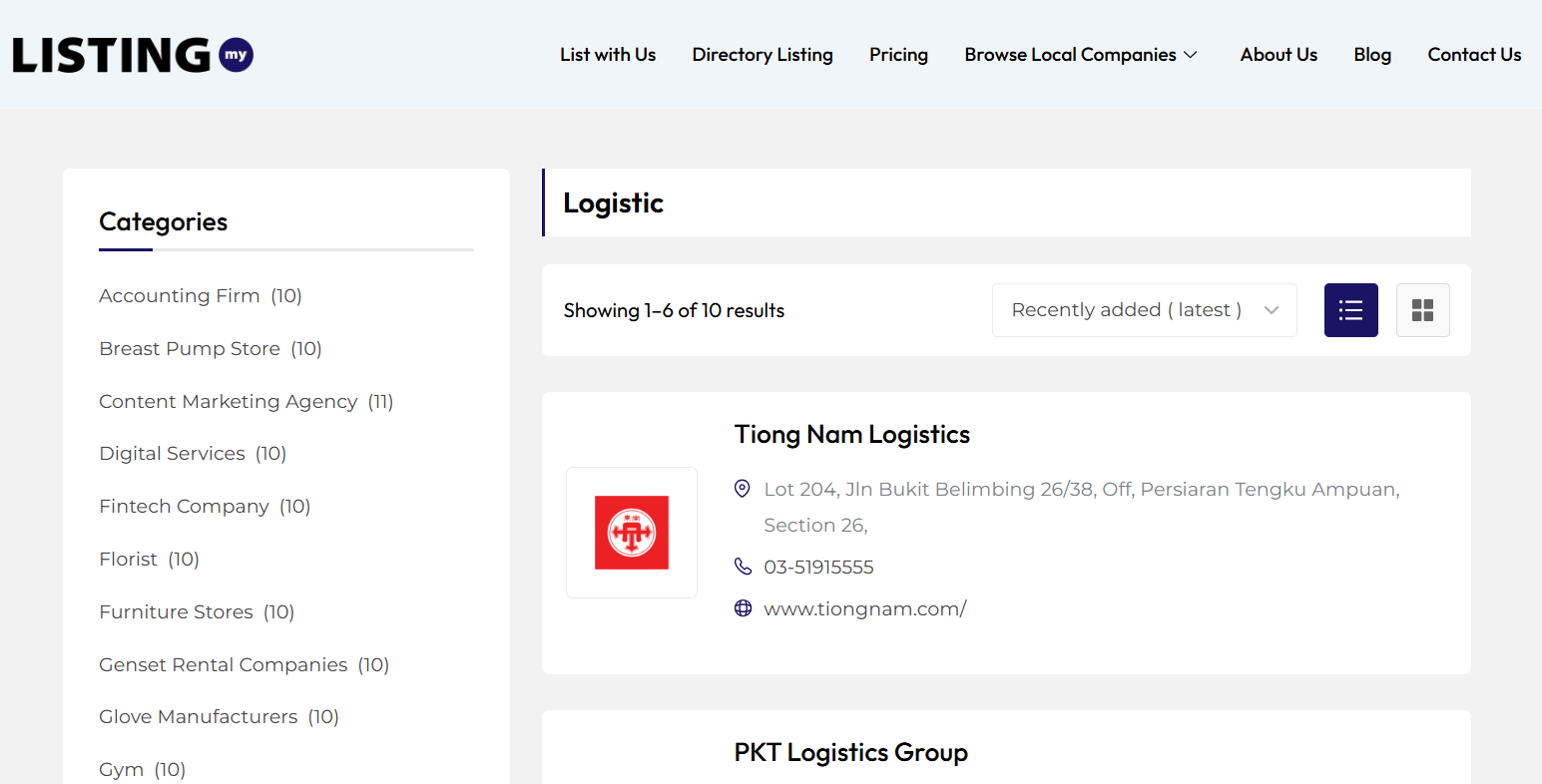 Search by the product or business category rather than entering a very broad term.
For example:
- Glove Manufacturing
- Packaging companies
- Food manufacturers
- Furniture suppliers
- Printing companies
- Electrical suppliers
- Industrial suppliers
- Cleaning product suppliers
Directories are especially useful when you are still learning the terminology used by an industry.
For example, you may initially search for “food supplier” and discover businesses describing themselves as:
“food distributor”
“food ingredients supplier”
“frozen food wholesaler”
“food manufacturer”
Those terms can then be used in Google and Maps to expand your search.
What should you record from a directory?
Create a basic list with:
- Company name
- Location
- Product or service
- Website
- Phone number
- Supplier type
- Notes
Do not contact every business immediately, the first job is to collect possibilities.
5. Use Google Maps to Find Suppliers Near Your Business
Google Maps is one of the best tools when location matters or when you want to visit the supplier yourself. Despite it being more manual and old fashioned, it does work!
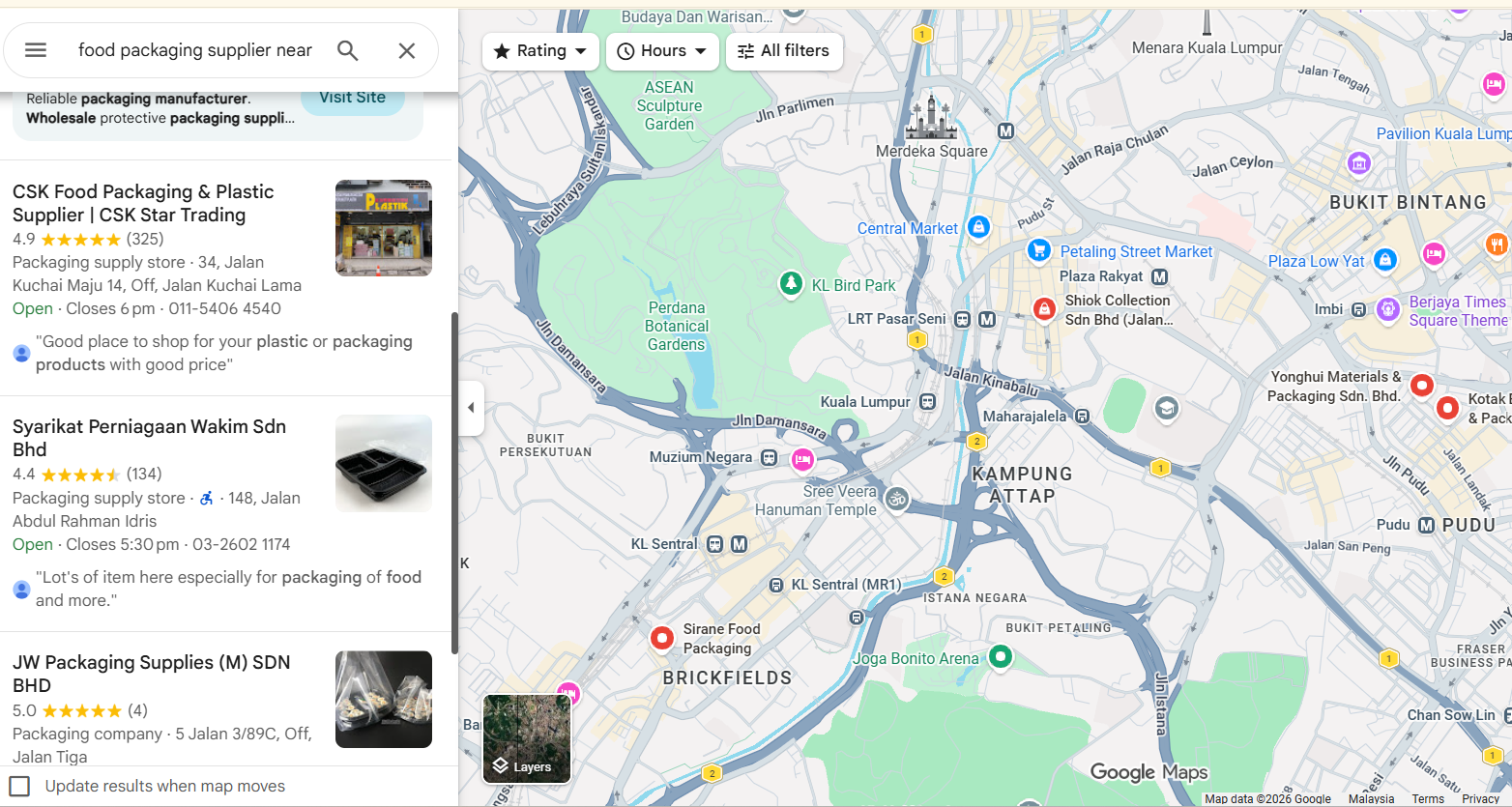
Maps is very useful for finding smaller local businesses that may not rank prominently in normal Google search results. Though there are more for niche businesses.
What should you check on Google Maps?
Look at:
- Business location
- Website
- Phone number
- Business category
- Photos
- Reviews
- Opening hours
Photos can sometimes tell you a lot.
For example, a supplier may have photos of:
- A warehouse
- Product shelves
- Delivery vehicles
- A showroom
- Factory facilities
That can help you understand the type of operation before you contact them.
Search nearby industrial areas too
Do not only search your exact suburb. If you are in Petaling Jaya, you may also search supplier-heavy areas such as:
- Shah Alam
- Subang Jaya
- Klang
- Puchong
- Kuala Lumpur
Conversely Melaka might show:
- Ayer Keroh
- HICOM
- Batu Berendam
6. Search MATRADE When You Want Malaysian Manufacturers
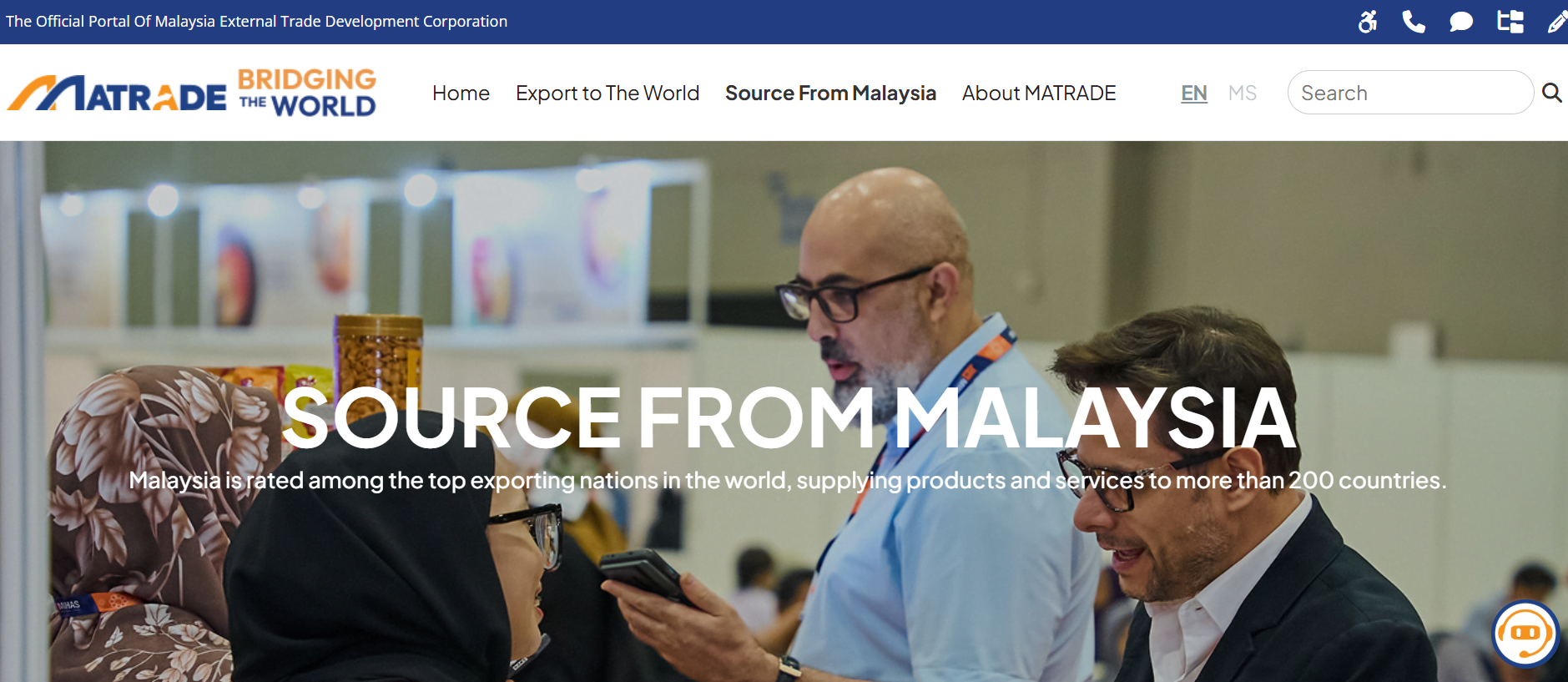
MATRADE is more useful when you want manufacturers, contract manufacturers or established Malaysian exporters rather than small retailers.
MATRADE’s Malaysia Products Directory contains companies across a wide range of product categories.
This can include industries such as:
- Packaging
- Food products
- Furniture
- Plastics
- Medical products
- Electrical products
- Machinery
- Building materials
- Chemicals
- Apparel
When should you use MATRADE?
Use it when:
- You want Malaysian-made products
- You want direct manufacturers
- You need contract manufacturing
- You are looking for larger supply capacity
- You are comparing local manufacturers
7. Use Trade Exhibition Exhibitor Lists as Supplier Directories
One of the most overlooked ways to find suppliers is to search trade exhibition websites, even if you never attend the event. Yes, there’s no need.
Trade exhibitions usually publish information about participating companies.
Search Google: [industry] exhibition Malaysia exhibitors
Examples:
“food exhibition Malaysia exhibitors”
“packaging exhibition Malaysia exhibitors”
“construction exhibition Malaysia exhibitor list”
Once you find an exhibition website, look for:
- Exhibitor List
- Exhibitors
- Brands
- Supplier Directory
- Participating Companies
These pages can give you dozens or even hundreds of businesses in one industry.
Example
If you are sourcing food products, ingredients or halal-related goods, an event such as MIHAS may expose you to companies operating in those categories.
If you are sourcing building materials or architectural products, exhibitions such as ARCHIDEX can lead you to suppliers in construction-related categories.
You do not need to wait for the event, just use the exhibitor list to discover company names today.
8. Search Facebook, Instagram and TikTok for Smaller Suppliers
Some small wholesalers and local suppliers rely heavily on social media rather than maintaining a strong company website.
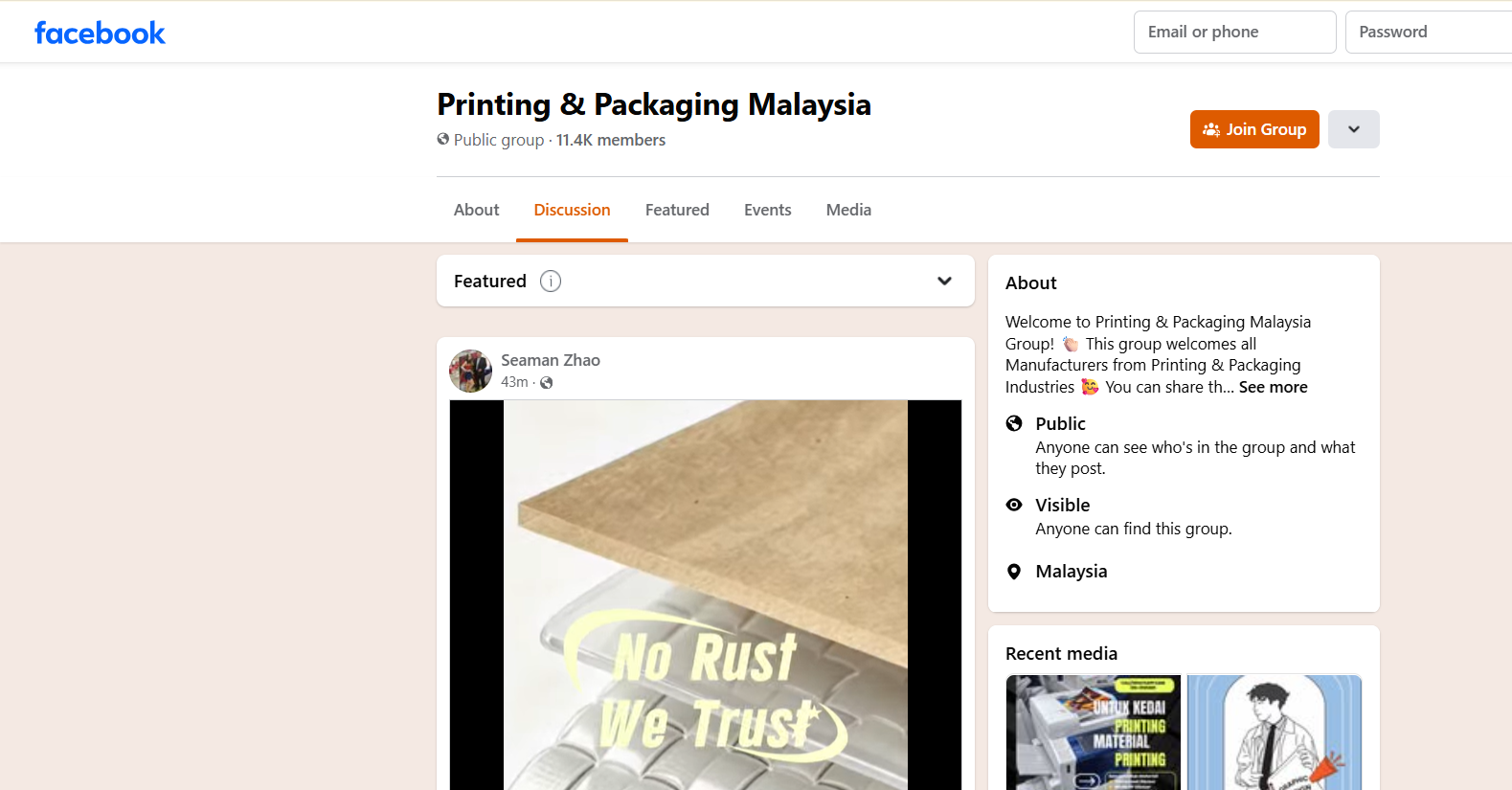
You may also find Facebook Groups built around:
- Small business
- Wholesale goods
- Retail businesses
- Food businesses
- Fashion businesses
Instagram and TikTok can also help in visually driven product categories such as:
- Fashion
- Accessories
- Gifts
- Beauty
- Packaging
- Homeware
- Food
Word of caution: A polished Instagram page does not automatically mean the supplier is established or reliable. You can use them to find names, but not verify.
9. Ask Other Businesses Who Their Suppliers Are
Perhaps the most old school approach but it’s the easiest and simplest. Supplier recommendations often come from businesses already buying related products.
If you are opening a café, you may already be dealing with:
- A renovation contractor
- Coffee machine supplier
- POS provider
- Ingredient supplier
- Furniture company
Just ask them “Do you know any suppliers for takeaway packaging?” Businesses working in the same sector often know each other’s suppliers.
You can also ask business owners outside your immediate competitive area.
For example, a café owner in another town may be more willing to recommend suppliers than the café next door.
Read more: How to Check if a Malaysian Company Is Legitimate
10. Build a List of 5 to 10 Possible Suppliers
Do not try to pick the best supplier while you are still searching. First build a broad list.
Use a simple spreadsheet:
| Supplier | Found Through | Location | Type | Product Match |
| Supplier A | Listing.my | Selangor | Wholesaler | Strong |
| Supplier B | Kuala Lumpur | Manufacturer | Strong | |
| Supplier C | MATRADE | Penang | Manufacturer | Medium |
| Supplier D | Google Maps | Petaling Jaya | Distributor | Strong |
| Supplier E | Exhibition directory | Selangor | Manufacturer | Strong |
Aim for around 5 to 10 possible businesses. Then eliminate the weaker matches by asking:
- Does this company actually supply what I need?
- Does it serve businesses like mine?
- Is the location workable?
- Does it appear active?
- Is there a clear way to contact it?
You should eventually have around 3 to 5 suppliers worth speaking to.
11. Consider China If Local Searches Do Not Meet Your Needs
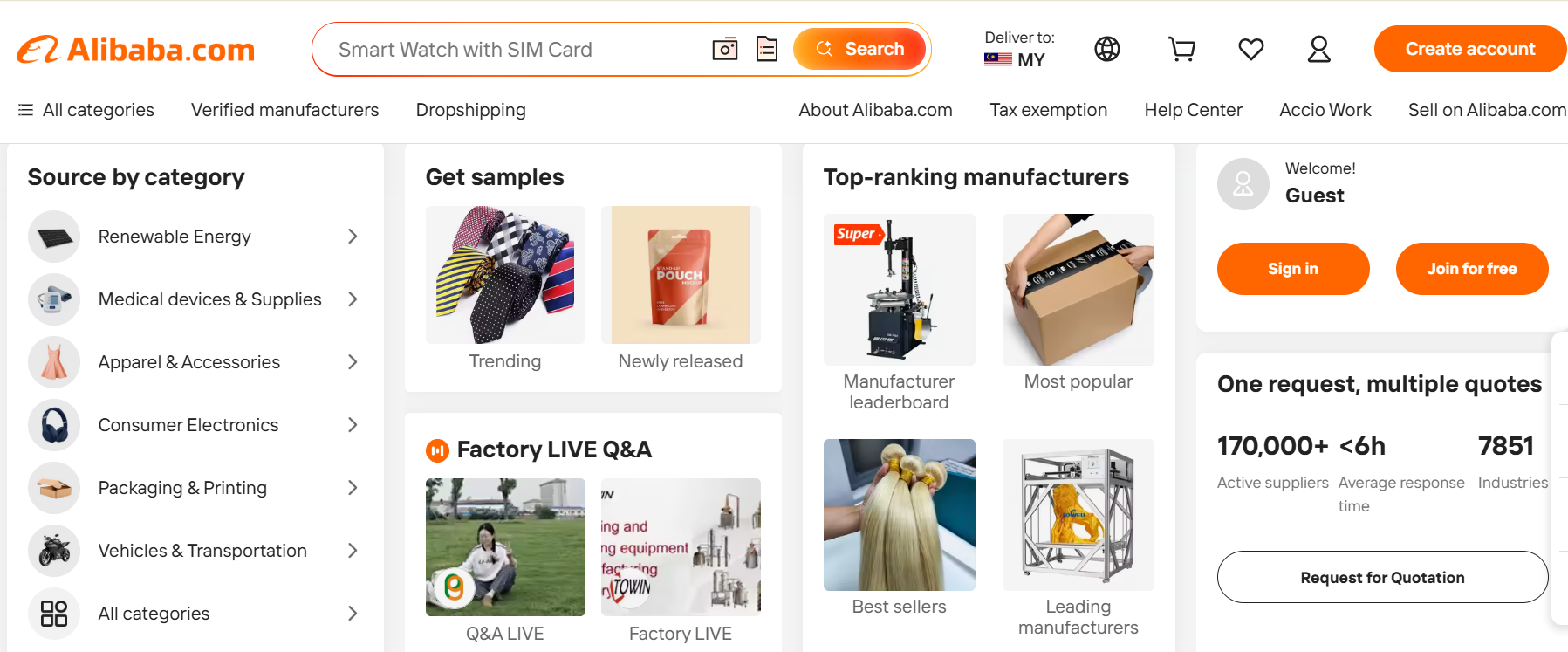
If you cannot find the product locally, need very large quantities or require custom manufacturing, overseas sourcing may be worth considering.
Common platforms for finding Chinese suppliers include:
- Alibaba
- 1688
- Made-in-China
- Global Sources
Alibaba.com is designed as a global B2B marketplace, while 1688.com is primarily a domestic Chinese wholesale marketplace. For a first international sourcing project, Alibaba.com may therefore be the more straightforward starting point of the two.
However, overseas sourcing introduces other questions such as:
- International shipping
- Freight forwarders
- Import charges
- Samples
- Supplier verification
- Longer delivery times
Do not assume a China supplier is cheaper just because the unit price is lower, always compare the cost of getting the product all the way to Malaysia, customs is also another factor too.
12. Contact Only the Best 3 to 5 Suppliers
Once you have finished searching, contact the strongest matches instead of sending enquiries to every company you found.
Send each supplier the same basic information.
For example:
Hi, I am starting a bakery business in Petaling Jaya and I am looking for 10-inch white cake boxes. My first order would be around 300 pieces. Could you share your unit price, minimum order quantity, delivery cost and lead time? Thank you.
Ask for:
- Unit price
- Minimum order quantity
- Availability
- Delivery cost
- Lead time
- Sample availability
You can then compare the replies and decide which suppliers deserve further discussion.
That is where supplier selection begins and the search stage is now complete.
Find Suppliers in Malaysia by Searching More Specifically
Finding suppliers in Malaysia becomes much easier when you know where to look and what to search for.
Do not rely on a single search for “supplier Malaysia”.
Use the product name, supplier type and location to create specific Google searches. Your first target should be simple:
Find 5 to 10 realistic supplier options, then narrow them down to the strongest 3 to 5.
Once you have those companies, you can start comparing prices, order quantities and delivery terms.
When you are ready to begin, use Listing.my to browse Malaysian businesses by industry and discover manufacturers, wholesalers, distributors and other potential suppliers. Our business directory is ready to help!
Frequently Asked Questions About How to Find Suppliers
How do I find suppliers in Malaysia?
Search Listing.my, Google, Google Maps and MATRADE using your product, supplier type and location. Industry association directories, exhibition exhibitor lists, LinkedIn and business referrals can provide additional supplier leads.
What should I type into Google to find suppliers?
Use + [supplier type] + [location]. Examples include “food packaging manufacturer Selangor”, “restaurant equipment supplier Johor” and “stationery wholesaler Kuala Lumpur”.
Where can I find Malaysian manufacturers?
Start with MATRADE’s Malaysia Products Directory, Google, Listing.my and relevant industry associations. Use the word “manufacturer” in your search if you specifically want companies that make the product.
How do I find suppliers near my business?
Search Google Maps using the product and location, such as “packaging supplier Petaling Jaya” or “industrial supplier Klang”. Check surrounding commercial and industrial areas as well.
How many suppliers should I find?
Aim to collect around 5 to 10 possible suppliers first. Review them and narrow the list to the best 3 to 5 companies before requesting prices and other purchasing details.
Do I need to buy directly from a manufacturer?
No. Wholesalers and distributors may be more suitable when you need ready-made products in smaller quantities. Manufacturers are more relevant for custom products, private labels or larger production volumes.