What Are New Car vs Used Car Pros and Cons in Malaysia?
Key Takeaways
- New cars offer manufacturer warranties, predictable maintenance and updated features, but cost more and face early depreciation.
- Used cars offer lower purchase prices, although hidden damage and unexpected repairs can reduce the savings.
- Insurance premiums depend on vehicle value, driver profile and coverage, not simply whether a car is new or used.
- A well-maintained used car can offer excellent value, provided its condition and ownership records are verified.
- The better choice depends on your budget, driving needs, ownership period and tolerance for unexpected expenses.
Buying a new car offers greater certainty about its condition, while buying a used car can save you money upfront. However, neither is automatically the better deal. The right choice depends on whether you value reliability, lower depreciation or a smaller financial commitment.
In Malaysia, the decision also involves insurance, servicing costs, vehicle condition and potentially expensive repairs that may not be obvious during a test drive.
Let’s break down the new car vs used car pros and cons to see which option makes more sense for your money.
New Car vs Used Car: What’s the Difference?
The biggest difference is what you are paying for. A new car generally comes without previous consumer ownership, with manufacturer support and a documented delivery history. A used car costs less because it has already depreciated, but its condition depends on previous ownership and maintenance.
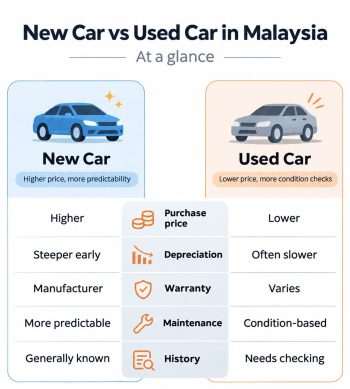
New cars favour predictability and convenience. Used cars favour affordability, provided you buy carefully.
What Are the Pros and Cons of Buying a New Car?
New cars are particularly appealing if you want dependable daily transport without worrying about how the previous owner treated the vehicle.
However, that reassurance comes at a higher price.
Pros of Buying a New Car
Full manufacturer warranty
Most new cars sold through authorised dealers include a manufacturer’s warranty, although coverage and exclusions vary by brand and model.
This can reduce unexpected repair expenses when a covered component develops a manufacturing defect. However, consumables such as tyres and brake pads are generally excluded from ordinary wear-and-tear coverage.
No previous ownership history
Buying new removes most risks associated with previous private ownership, such as undisclosed accidents, neglected servicing or mileage tampering.
However, you should still check the vehicle’s condition and delivery documents before accepting the keys.
You also begin with a known maintenance schedule, making it easier to maintain proper records.
Updated safety and convenience features
Depending on the model and variant, newer cars may offer autonomous emergency braking, blind-spot monitoring, adaptive cruise control and improved connectivity.
Nevertheless, a new entry-level vehicle does not necessarily have better safety equipment than a higher-specification used car.
More predictable early maintenance
Regular servicing and manufacturer warranty coverage can make early ownership costs more predictable, although warranties do not cover every fault or wear-and-tear expense.
This is valuable if you depend on your vehicle for commuting, family responsibilities or frequent interstate travel.
Cons of Buying a New Car
Higher purchase price
A comparable used model may offer similar everyday functionality at a considerably lower price.
Faster initial depreciation
New vehicles commonly lose a substantial portion of their value during their first few years.
For example, a hypothetical car purchased for RM80,000 and sold three years later for RM55,000 would lose RM25,000, equivalent to 31.25% of its purchase value.
Actual depreciation depends on the model, mileage, condition and market demand.
Higher financial commitment
A more expensive vehicle may require a larger deposit, higher instalments or a longer repayment commitment.
Even if the monthly payment seems manageable, you must account for insurance, fuel, tolls and maintenance.
What Are the Pros and Cons of Buying a Used Car?
A used car can offer excellent value, particularly when you purchase a reliable model with a documented maintenance history.
The challenge is that two seemingly identical used cars can have very different conditions.
Pros of Buying a Used Car
Lower purchase price
Instead of spending RM80,000 on a new vehicle, you might find a suitable used alternative for considerably less.
That leaves more money available for insurance, maintenance and other household expenses.
Less exposure to initial depreciation
The previous owner has already absorbed part of the vehicle’s early depreciation.
Although used cars continue losing value, the rate may be slower after the initial years.
More features within the same budget
A used-car budget of RM50,000 may give you access to a higher-specification vehicle than a new car at the same price.
You might find better interior materials, additional safety features or more cabin space. However, higher-end vehicles can have more expensive replacement parts.
Greater budget flexibility
Buying a cheaper vehicle can free up money for emergency savings, repairs or a future upgrade.
Cons of Buying a Used Car
Hidden mechanical problems
A used car may look excellent during a short test drive yet have underlying problems involving its engine, transmission, suspension, cooling system or electrical components.
Some defects only become noticeable after extended driving.
Accident and flood damage
A professionally repaired vehicle may look normal externally.
However, serious past accidents can affect structural integrity, while flood exposure can cause electrical corrosion and recurring faults.
Refurbishment expenses
A used car may need tyres, brakes, a battery or suspension repairs shortly after purchase.
These expenses can quickly consume the savings you expected.
Limited warranty protection
Some used cars retain their original manufacturer warranty, while others come with dealer warranties or optional extended coverage.
Always check what the warranty actually covers, including claim limits and exclusions.
Which Costs More to Own: A New Car or a Used Car?
A new car costs more to purchase, but a used car may require more repairs. The better financial option depends on depreciation, maintenance and other ownership expenses.
Consider this simplified three-year comparison.
Example: RM80,000 New Car vs RM50,000 Used Car
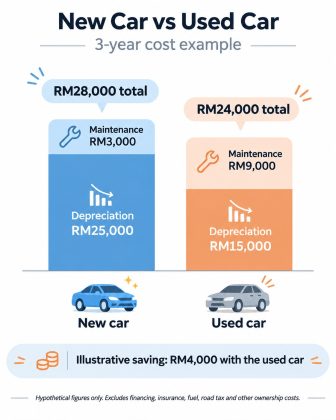
These are hypothetical figures for illustration, not actual vehicle quotations or resale forecasts.
In this example, the used car saves RM4,000 over three years across the two cost categories shown.
However, if its maintenance expenses increase from RM9,000 to RM15,000, the combined cost becomes RM30,000, making it RM2,000 more expensive than the new car on these measures.
This illustrates an important point: a lower purchase price does not automatically mean lower ownership costs.
For a complete comparison, also consider financing costs, insurance, road tax, fuel, parking and tolls.
Is Car Insurance Cheaper for Used Cars in Malaysia?
Used cars may have cheaper insurance because their market value is often lower. However, vehicle age alone does not determine the premium.
According to the General Insurance Association of Malaysia (PIAM), motor insurance pricing can vary according to individual risk profiles and selected coverage.
| Factor | Why It Matters |
| Vehicle value | Higher sums insured can increase premiums |
| Driver profile | Insurers assess individual risk factors |
| No Claim Discount | Eligible drivers receive premium discounts |
| Coverage type | Comprehensive insurance generally covers damage to your own car, subject to policy terms |
| Add-ons | Flood protection usually requires additional Special Perils coverage |
For example, a used luxury vehicle could cost more to insure than a brand-new entry-level car because its replacement parts and repairs may be more expensive.
Also, remember that third-party-only insurance does not cover accidental damage to your own vehicle.
Practical advice: Request quotations for both shortlisted vehicles using comparable coverage, add-ons and NCD assumptions.
What Hidden Problems Should You Check Before Buying a Used Car?
The biggest risk with a used car is paying a fair-looking price for a vehicle that needs expensive repairs.
Before committing, arrange an independent mechanical inspection and verify the vehicle’s paperwork.
Essential Used Car Inspection Checklist
- Accident damage: Check for uneven panel gaps, inconsistent paintwork and unusual welding marks.
- Flood damage: Look for rust, moisture, musty smells and unusual electrical problems.
- Mechanical condition: Inspect the engine, transmission, suspension, brakes and cooling system.
- Service history: Compare maintenance records against the displayed mileage.
- Ownership documents: Verify the seller’s authority, registration details and outstanding financing status.
What About PUSPAKOM Inspections?
In Malaysia, used private cars generally must pass a Transfer of Ownership Inspection before registration can be transferred. Motorcycles are generally exempt from this inspection requirement.
According to PUSPAKOM’s official inspection guidelines:
- Transfer of Ownership Inspection (MV15): RM30.
- Hire Purchase Inspection (B7): RM60, required for applicable used-car financing arrangements.
- Voluntary Private Vehicle Inspection: RM50.
These inspections serve different purposes. MV15 primarily checks vehicle identity and unlawful modifications, while B7 assesses requirements relevant to hire-purchase transactions.
Neither replaces a comprehensive independent mechanical inspection, which can help identify hidden defects before purchase.
If a used car dealer refuses an independent inspection or pressures you to pay before checking the documents, consider another vehicle.
Is a Two- or Three-Year-Old Used Car the Best Compromise?
A well-maintained two- or three-year-old used car can offer an attractive balance between purchase price, features and remaining useful life.
You may avoid part of the initial depreciation while still purchasing a relatively modern vehicle.
However, age alone does not determine whether a car is worth buying.
Consider two vehicles of the same model year:
- Car A: 35,000 km, documented servicing and no known major accident history.
- Car B: 110,000 km, incomplete maintenance records and signs of neglected repairs.
Even if Car B costs RM5,000 less, the additional maintenance uncertainty could outweigh the savings.
A slightly older, well-maintained car may also be a better purchase than a newer vehicle with questionable history.
A two- or three-year-old used car can be a good starting point, but condition, service history, price and expected maintenance costs matter more than age alone.
Who Should Buy a New Car and Who Should Buy a Used Car?
The right choice depends on your finances, how long you intend to keep the vehicle and how much uncertainty you can accept.
| Your Situation | Better Starting Point | Why |
| First-time buyer with a limited budget | Used car | Lower purchase commitment |
| Family relying on one daily vehicle | New car | Warranty and predictable early maintenance |
| Buyer planning to keep the car for 10 years | Either | Long-term reliability matters |
| Buyer who changes cars frequently | Used car | May reduce early depreciation losses |
| Buyer unfamiliar with vehicle inspections | New or certified used | More structured purchase support |
| Buyer with limited emergency savings | Affordable new or carefully inspected used | Avoid excessive debt or repair risks |
When a New Car Makes More Sense
Consider buying new when:
- You need dependable transport for frequent long-distance journeys.
- You value manufacturer warranty coverage.
- You intend to keep the vehicle for many years.
- You can comfortably afford the higher price.
When a Used Car Makes More Sense
Consider buying used when:
- You want to reduce initial spending.
- You can find a vehicle with reliable maintenance records.
- You have access to a trustworthy mechanic.
- You are comfortable budgeting for potential repairs.
There is also a third option: waiting.
If neither purchase fits comfortably within your budget, continuing to use your existing vehicle or relying on public transport may be more financially sensible.
Is It Better to Buy a New or Used Car in Malaysia?
There is no universal winner in the new car vs used car pros and cons debate. New cars offer greater certainty, while used cars can deliver meaningful savings if their condition and history justify the asking price.
Choose based on your total budget, ownership plans and the risks you are prepared to manage.
If you are comparing local dealerships, explore Listing.my to discover automotive businesses and services across Malaysia. Business owners can also use our Malaysia business listing services to help potential customers find their businesses online.
Disclaimer: This article is for general information only, not personalised financial or insurance advice. Confirm current prices, financing terms, insurance coverage and inspection requirements before purchasing.
Sources
- Employees Provident Fund (KWSP) — Buying Your First Car in Malaysia: Guidance on budgeting, depreciation and new versus used vehicles.
- PUSPAKOM — Inspection Types & Fees: Official ownership-transfer, hire-purchase and voluntary inspection requirements and fees.
- Road Transport Department Malaysia (JPJ) — Guide to Voluntary Transfer of Ownership: Official ownership-transfer requirements and restrictions.
- General Insurance Association of Malaysia (PIAM) — Comparing Car Insurance Malaysia: September 2026 consumer guidance on motor insurance pricing and coverage.
- PIAM — Motor Insurance Types and Coverage: Information on third-party and comprehensive motor insurance.
- PIAM — Motor Insurance Renewal Checklist: Guidance on add-ons, exclusions and flood protection.
Frequently Asked Questions About The Pros and Cons of New Cars vs Used Cars in Malaysia
Is Buying A Used Car Worth It In Malaysia?
Yes, provided the vehicle is reasonably priced, mechanically sound and has a verifiable history. A used car can reduce purchase costs and early depreciation, but you should budget for repairs and arrange an independent inspection.
Do New Cars Last Longer Than Used Cars?
A new car starts with no previous consumer usage, but longevity depends on servicing, driving conditions and vehicle reliability. A properly maintained used car can still provide many years of dependable transport.
Is It Better To Buy A New Car Or A Five-Year-Old Car?
A five-year-old car may offer substantial purchase savings, but it could be approaching replacement intervals for certain components. Compare its mileage, service history, condition and expected repairs against the price of a new vehicle.
Can You Negotiate Prices At Used Car Dealerships In Malaysia?
Yes. Used-car prices are often negotiable, particularly when inspections reveal worn components or necessary repairs. Request a written breakdown of the vehicle price, processing fees and other charges before agreeing to purchase.
Should I Buy A Used Car With Over 100,000 Km?
High mileage is not automatically a reason to reject a vehicle. Maintenance history, driving conditions and mechanical condition matter more than the odometer reading alone. However, inspect major components carefully and budget for age-related replacements.
Are Certified Used Cars Safer To Buy?
Certified used cars may offer greater reassurance through documented inspections and warranty arrangements. However, certification standards differ between sellers. Check what was inspected, the warranty exclusions and whether independent inspection is permitted.