What You Should Look Out For When Buying a Used Car in Malaysia

Key Takeaways
- Check accident history, flood damage, mileage and maintenance records before negotiating.
- Verify outstanding summons, JPJ restrictions and unsettled loans before purchasing.
- An MV15 ownership-transfer inspection does not replace a mechanical inspection.
- Compare asking prices and include potential repair costs in your budget.
- Avoid sellers who refuse inspections, cannot prove ownership or pressure you into paying.
Buying a used car in Malaysia involves more than finding a good price. Before paying, check its physical condition, service history, outstanding summons, financing status and ownership documents. These checks can help you avoid expensive repairs and complications during ownership transfer.
A five-year-old car with a clean service history could be a better purchase than a three-year-old model with hidden accident damage.
Here are ten things worth checking before you sign anything.
What Should You Check Before Buying a Used Car?
Start with the vehicle’s condition, then verify its legal and financial status. Both matter because a mechanically sound car can still be difficult to transfer if it has unresolved restrictions.
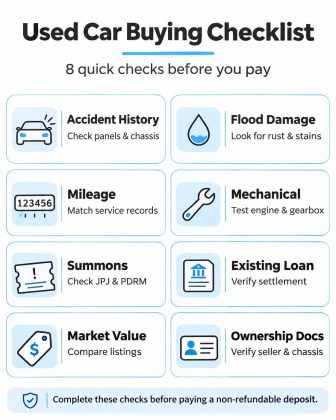
Complete the physical, financial and ownership checks before paying a non-refundable deposit.
1. Has the Used Car Been Involved in an Accident?
A previous accident does not automatically make a used car unsuitable. What matters is the severity of the damage and whether structural components were affected.
A replaced bumper is quite different from a repaired chassis.
How to Spot Previous Accident Damage
Inspect the vehicle during daylight and look for:
- Uneven gaps between the bonnet, doors and boot.
- Paint colours that differ between panels.
- Overspray around rubber seals or headlights.
- Welding marks inside the engine bay.
- Bent structural components or misaligned panels.
- Uneven tyre wear.
A repainted door might simply mean the previous owner repaired a parking scratch.
However, evidence of structural damage deserves professional assessment. If the seller cannot explain extensive repairs, consider another vehicle.
2. How Can You Check Whether a Used Car Has Flood Damage?
Flood damage is particularly relevant in Malaysia, where heavy rain and flash flooding can affect vehicles in residential areas, basement car parks and flood-prone roads.
A flooded vehicle might look perfectly presentable after cleaning, but electrical problems and corrosion can appear months later.
Signs of a Flood-Damaged Used Car
Check for:
- Rust beneath seat rails and mounting brackets.
- Mud or sediment beneath carpets.
- Watermarks behind interior trim.
- Damp or musty smells.
- Corrosion around electrical connectors.
- Unexplained electrical faults.
Be cautious if the interior looks unusually new compared with the rest of the vehicle.
Buyer tip: Ask whether the vehicle has experienced flooding and request that the seller’s answer be recorded in the sales agreement.
If several warning signs appear together, arrange a specialist inspection or walk away.
3. Is the Mileage Genuine, and Has the Car Been Serviced Properly?
Mileage helps estimate how much a used car has been driven, but it does not tell the whole story.
A vehicle with 120,000 km and consistent servicing may be in better condition than one showing 60,000 km with neglected maintenance.
How to Check for Mileage Tampering
Compare the odometer reading against:
- Service booklets and workshop invoices.
- Digital maintenance records, where available.
- Previous inspection records.
- Tyre replacement history.
- The condition of the steering wheel, pedals and seats.
For example, a car showing 45,000 km should raise questions if an earlier service invoice records 85,000 km.
Also check whether important maintenance has been completed, including transmission servicing, brake fluid replacement and timing belt replacement where applicable.
Missing records do not prove poor maintenance, but they increase uncertainty.
4. What Mechanical Problems Should You Check?
A used car can look excellent in photographs while hiding mechanical problems.
You do not need to be a mechanic to identify obvious warning signs, but a professional inspection is advisable.
Engine and Transmission
Ask to see the engine start from cold. Watch for:
- Excessive exhaust smoke.
- Unusual knocking or rattling.
- Visible oil or coolant leaks.
- Rough idling or overheating.
- Jerking during acceleration.
- Delayed or harsh gear changes.
Brakes, Suspension and Electronics
During the test drive, check whether:
- The steering feels loose or unusually heavy.
- The suspension makes knocking sounds.
- The brakes produce grinding noises.
- The car pulls to one side.
- Dashboard warning lights remain illuminated.
- The air-conditioning and electronic features work properly.
If you identify a problem, request a repair quotation before negotiating.
A seemingly minor issue could indicate a more expensive underlying fault.
5. Does the Used Car Have Outstanding Summons or a JPJ Blacklist?
Before buying a used car in Malaysia, check for outstanding summons, blacklist records and restrictions that could affect ownership transfer.
The Road Transport Department (JPJ) requires relevant transaction restrictions to be resolved before a voluntary ownership transfer can proceed.
How to Check Outstanding Summons
Use the relevant official services:
- MyJPJ: Check available JPJ summons and blacklist information. The app may not display every past or resolved summons.
- JPJ public portal: Check available blacklist and enforcement records. Some searches require identity and vehicle registration details.
- PDRM MyBayar Saman: Check police-issued summons through the relevant account.
Ask the registered owner to assist with checks requiring their identity or account. Never request their login password.
An unpaid summons does not automatically mean the vehicle is blacklisted. However, unresolved restrictions can delay or prevent ownership transfer.
Ask the seller to settle relevant offences and provide confirmation before completing the purchase.
Refer to the official JPJ blacklist status information for further details.
6. Is There an Outstanding Loan on the Used Car?
A vehicle can still have an active hire-purchase agreement when its owner decides to sell it.
That is not automatically suspicious, but the financier’s claim must be properly settled or released before ownership transfer.
What Documents Should You Request?
Ask for:
- Confirmation of the vehicle’s financing status.
- An official settlement statement if money is owed.
- Confirmation that the financier’s claim will be released.
- Written details explaining how the outstanding loan will be settled.
Avoid transferring the entire purchase amount based solely on a promise that the seller will settle the loan later.
Be Careful With Sambung Bayar Arrangements
A sambung bayar arrangement typically involves continuing someone else’s car instalments without completing a proper ownership transfer.
The vehicle generally remains registered under the original owner’s name, while the existing financing agreement stays in place.
Selling or transferring a financed vehicle without the financier’s consent can also raise legal issues under Malaysia’s Hire-Purchase Act 1967.
If you cannot complete a lawful ownership transfer, do not treat the car as yours.
7. Has the Used Car Passed the Required Ownership-Transfer Inspection?
For an ordinary private-car ownership transfer in Malaysia, the vehicle must pass an MV15 inspection at a JPJ-authorised inspection centre before the transfer can be completed.
The ownership-transfer inspection is called MV15, formerly known as B5.
PUSPAKOM provides this service, but other JPJ-authorised centres, including selected Carro and CARSOME facilities, may also offer MV15 inspections.
Which Inspection Do You Need?
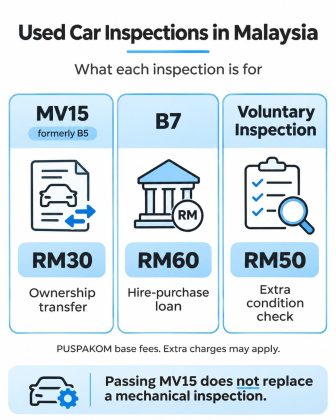
Source: PUSPAKOM’s published inspection fees, checked November 2026. Processing charges and applicable taxes may increase the final amount.
If you are using a hire-purchase loan to buy a used car, a B7 inspection is also required. This is separate from the MV15 ownership-transfer inspection.
Does Passing the Inspection Mean the Car Is Problem-Free?
No. Passing an ownership-transfer inspection does not guarantee that every mechanical component is in good condition.
Arrange an independent pre-purchase inspection to assess the engine, transmission, brakes, suspension, structural repairs and possible flood damage.
The seller should be willing to accommodate reasonable inspection requests.
For official requirements, refer to PUSPAKOM’s inspection types and fees.
8. How Do You Know Whether a Used Car Is Good Value for Money?
A good used car is not necessarily the cheapest one advertised. It offers a reasonable balance of purchase price, condition, maintenance history and expected repair costs.
Compare at least three to five listings for the same model, year and variant to determine value for money.
Consider mileage, maintenance records, accident history and remaining warranty coverage.
Used Car Price Comparison Example
Imagine you are comparing two used cars of the same model and year.
| Cost Component | Car A | Car B |
| Asking price | RM32,000 | RM35,000 |
| Immediate repairs | RM4,500 | RM500 |
| Initial total | RM36,500 | RM35,500 |
| Maintenance condition | Several repairs needed | Better maintained |
| Overall value | Higher initial cost | Better initial value |
Illustrative figures only, not actual market quotations. The example excludes insurance, road tax, financing, transfer fees and future repairs.
Although Car A is RM3,000 cheaper upfront, its immediate repair costs make it RM1,000 more expensive overall.
The lesson is simple: negotiate based on the car’s actual condition, not just its advertised price.
9. Should You Buy From a Used Car Dealer or a Private Seller?
Both options can offer good value, but the buying process differs.
| Factor | Used Car Dealer | Private Seller |
| Asking price | May include dealer margin | May be more negotiable |
| Vehicle selection | Multiple vehicles | Usually one vehicle |
| Financing | Often offers assistance | Buyer may arrange financing |
| Paperwork | May handle transfer process | Parties arrange transfer |
| After-sales support | Check warranties and applicable consumer rights | Depends on agreement and applicable law |
What Makes a Used Car Dealer Trustworthy?
A reliable used car dealer should:
- Have verifiable business registration details that you can check through SSM.
- Allow independent mechanical inspections.
- Provide a written price breakdown.
- Disclose known defects.
- Explain processing and administration fees.
- Provide clear warranty terms, where applicable.
Ask for the total on-the-road price rather than focusing only on the advertised figure.
Manufacturer-backed certified pre-owned vehicles are another option, but always check the actual inspection standards and warranty exclusions.
10. What Should You Do Before Paying a Deposit?
Before paying, confirm that the vehicle matches its advertisement and that the seller can legally complete the transaction.
Follow this buying sequence:
- Verify the seller and vehicle: Match the registration details, seller identity and vehicle identification information.
- Inspect and test-drive the car: Check its condition and arrange an independent mechanical inspection.
- Check outstanding records: Verify summons, blacklist status, financing and ownership restrictions.
- Agree on the complete price: Document repair commitments, additional fees and deposit conditions.
- Complete the ownership transfer: Arrange inspections, loan settlement, insurance and the applicable JPJ procedures, including identity verification where required.
What Should Be Written on the Deposit Receipt?
Make sure it includes:
- Vehicle registration details.
- Seller or dealer information.
- Agreed purchase price.
- Deposit amount and remaining balance.
- Promised repairs or included accessories.
- Cancellation and refund conditions.
Where possible, make the purchase conditional on satisfactory inspections, financing approval and successful ownership transfer.
When Should You Walk Away From a Used Car Deal?
Some problems can be resolved through repairs or negotiation. Others are serious warning signs.
| Situation | Recommended Decision |
| Minor cosmetic damage | Negotiate if disclosed |
| Worn tyres or routine maintenance | Obtain repair quotation |
| Missing service history | Inspect more thoroughly |
| Suspected structural damage | Avoid unless independently cleared |
| Serious flood damage | Strong reason to walk away |
| Unresolved ownership restrictions | Do not proceed until resolved |
| Seller refuses inspection | Consider another vehicle |
Be particularly cautious about sellers who demand immediate payment, refuse documentation or repeatedly change their explanation of the vehicle’s history.
A good deal should still make sense after all the necessary checks.
Evaluating a Used Car Well
Buying a used car in Malaysia can offer excellent value, provided you know what you are purchasing. Check its physical condition, service history, outstanding summons, financing status and ownership documents before committing.
The best used car is one you can afford to buy, maintain and drive confidently.
If you are comparing businesses that offer vehicle-related services, Listing.my provides a platform for discovering companies across Malaysia. You can also explore our Malaysia business listing services to find relevant businesses and compare your options before deciding.
Sources
- Jabatan Pengangkutan Jalan Malaysia (JPJ) – Panduan Tukar Hakmilik Secara Sukarela: Official ownership-transfer requirements.
- JPJ – Semakan Status Senarai Hitam: Official blacklist information.
- MyJPJ – Official FAQ: JPJ digital services and summons information.
- PDRM – MyBayar Saman: Police summons enquiries and payments.
- PUSPAKOM – Inspection Types & Fees: Vehicle inspection requirements and published fees.
- MyGovernment – Vehicle Ownership Transfer: Government guidance on ownership-transfer procedures.
- Companies Commission of Malaysia (SSM): Business registration verification.
- National Highway Traffic Safety Administration (NHTSA) – Flood-Damaged Vehicles: Guidance on detecting vehicle flood damage.
Frequently Asked Questions
How Many Kilometres Is Too Much for a Used Car?
There is no fixed mileage limit. A well-maintained car with 150,000 km may be better than a neglected car with 70,000 km. Check its age, service records and mechanical condition.
Can I Buy a Used Car With Outstanding Summons?
Ask the seller to resolve outstanding summons and relevant restrictions first. An unpaid summons does not always prevent ownership transfer, but an active blacklist or restriction can cause problems at JPJ.
Can I Check a Used Car’s Accident History Using Its Number Plate?
A number plate alone cannot confirm a complete accident history. Vehicle-history services may provide available records, but coverage varies. Combine these checks with maintenance records and an independent inspection.
Is an MV15 Inspection Enough Before Buying a Used Car?
No. The mandatory ownership-transfer inspection serves a regulatory purpose. Arrange an independent mechanical inspection to identify engine problems, transmission issues, accident repairs and other potential defects.
Can I Get My Deposit Back if I Change My Mind?
It depends on the written deposit terms and applicable law. Check the refund conditions before paying, including what happens if financing fails or the vehicle does not pass an agreed inspection.
What Documents Should I Receive After Buying a Used Car?
Keep the signed sales agreement, payment receipts and ownership-transfer confirmation. Also retain relevant inspection reports, insurance documents, financing agreements and any written warranty or repair commitments.