Business Closures in Malaysia Rise 36%: 2026 Statistics

Malaysia’s business landscape ended 2025 with an interesting contradiction. More enterprises entered the market, yet business closures climbed to their highest level in three years.
According to the Department of Statistics Malaysia (DOSM), 39,418 enterprises ceased operations in 2025, a 36.3% increase from the previous year. Meanwhile, 60,671 new enterprises were recorded, and the country’s five-year business survival rate improved to 72.5%.
The figures challenge a straightforward reading of Malaysia’s business environment. Rising closures do not necessarily point to a shrinking business population, just as stronger business formation does not guarantee long-term commercial success.
Our business directory research report examines the latest enterprise birth, death and survival statistics to identify where business turnover is most pronounced, how industries and states compare, and what these developments reveal about Malaysia’s commercial landscape.
2. Malaysia Business Closure Trends, 2023–2025
Malaysia’s enterprise closure statistics have fluctuated considerably over the past 3 years.
In 2023, DOSM recorded 33,077 enterprise deaths. This declined to 28,924 in 2024 before increasing to 39,418 in 2025.
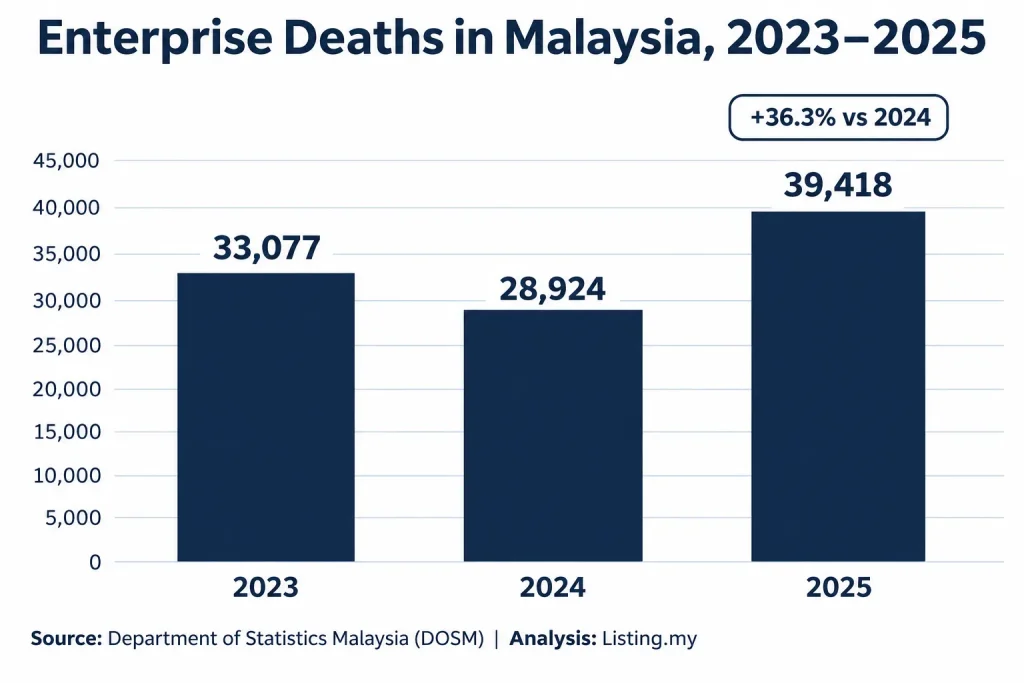
Enterprise Deaths in Malaysia, 2023–2025
| Year | Enterprise Deaths | Year-on-Year Change |
| 2023 | 33,077 | Not shown |
| 2024 | 28,924 | -12.6% |
| 2025 | 39,418 | +36.3% |
Source: DOSM Business Demography 2024 and 2025.
2.1 The 2025 Increase in Perspective
Malaysia recorded 10,494 more enterprise deaths in 2025 than in 2024.
This represents a 36.3% annual increase, the most notable change across the three-year comparison.
However, the 2024 figures provide important context.
Enterprise deaths had previously declined by 12.6% between 2023 and 2024. Consequently, the subsequent increase in 2025 represents a reversal of that decline.
Compared directly with 2023, enterprise deaths were approximately 19.2% higher in 2025.
Research observation: The increase in business closures is substantial, but the available three-year data does not establish a continuous upward trend. Instead, it shows a decline in 2024 followed by a pronounced increase in 2025.
2.2 Understanding Enterprise Death Statistics
DOSM measures business closures using the statistical concept of enterprise death.
An enterprise death refers to the cessation of an enterprise under the relevant business demography methodology.
This differs from legal and administrative measures such as bankruptcy, insolvency proceedings, company liquidation or the closure of individual retail outlets.
Therefore, the 39,418 enterprise deaths recorded in 2025 should not be interpreted as 39,418 bankrupt companies.
3. Business Closures by Industry
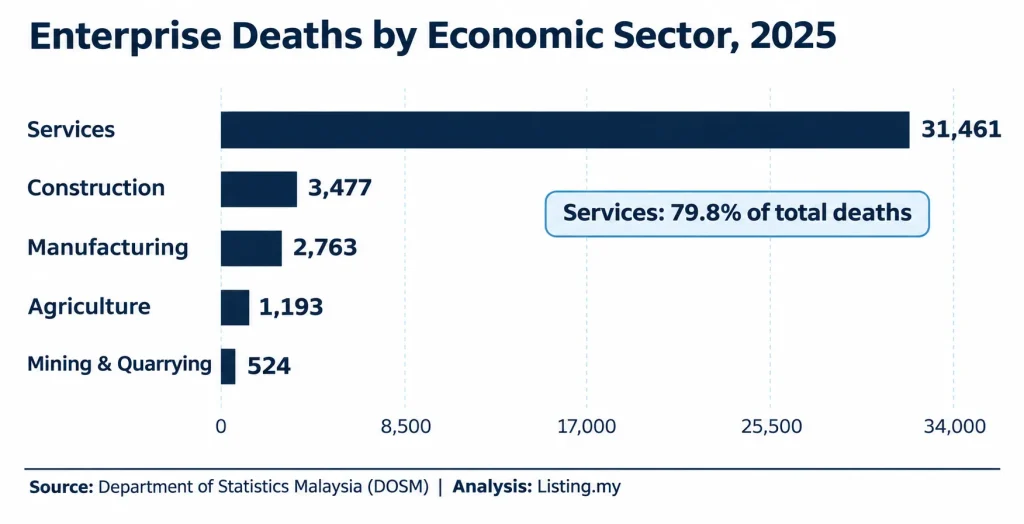
The Services sector accounted for 31,461 enterprise deaths in 2025, representing nearly four in five closures nationwide.
At first glance, the concentration appears substantial. However, services also accounted for 78.8% of Malaysia’s active enterprises. Its share of closures was therefore broadly consistent with its dominance of the country’s enterprise population.
The more revealing comparison comes from enterprise death rates.
Mining and quarrying recorded the highest death rate at 6.6%, despite accounting for just 524 enterprise deaths. Manufacturing, meanwhile, recorded the lowest rate at 4.6%.
Enterprise Deaths by Economic Sector, 2025
Table 2. Enterprise Deaths and Death Rates by Industry
| Industry | Enterprise Deaths | Share of Deaths | Death Rate |
| Services | 31,461 | 79.8% | 5.3% |
| Construction | 3,477 | 8.8% | 5.2% |
| Manufacturing | 2,763 | 7.0% | 4.6% |
| Agriculture | 1,193 | 3.0% | 4.9% |
| Mining and Quarrying | 524 | 1.3% | 6.6% |
| Malaysia | 39,418 | 100% | 5.2% |
3.1 Services Accounted for Nearly Four in Five Closures
The Services sector recorded the largest number of enterprise deaths in absolute terms.
However, services also accounted for 78.8% of Malaysia’s active enterprises in 2025.
Its substantial contribution to enterprise deaths is therefore partly explained by the size of the sector itself.
The figures should not be interpreted as evidence that service-based businesses face a disproportionately high risk of closure.
Furthermore, the Services sector covers a broad range of commercial activities. The performance of individual industries within the sector may differ considerably.
3.2 Mining and Quarrying Recorded the Highest Death Rate
Although mining and quarrying recorded only 524 enterprise deaths, it had the highest enterprise death rate at 6.6%.
Manufacturing recorded the lowest enterprise death rate among the five major economic sectors in 2025, at 4.6%. However, this does not necessarily indicate stronger profitability or business performance, as enterprise death rates measure cessation rather than financial outcomes.
4. Business Closure Rates by State
DOSM’s 2025 statistics also reveal geographical differences in enterprise death rates.
Perlis recorded the highest enterprise death rate at 6.2%, followed by Selangor at 5.6%.
Kuala Lumpur and Labuan each recorded 5.5%, exceeding the national average of 5.2%.
Table 3. Selected States and Territories With the Highest Enterprise Death Rates
| State or Territory | Enterprise Death Rate |
| Perlis | 6.2% |
| Selangor | 5.6% |
| Kuala Lumpur | 5.5% |
| Labuan | 5.5% |
| National Average | 5.2% |
Source: DOSM Business Demography 2025.
4.1 Perlis Recorded the Highest Enterprise Death Rate
Perlis also recorded Malaysia’s highest enterprise death rate in 2024 at 4.7%.
Its rate subsequently increased to 6.2% in 2025, representing a rise of 1.5 percentage points.
However, the highest enterprise death rate does not necessarily correspond to the highest number of enterprise deaths.
States with smaller business populations may record relatively high rates despite having fewer closures in absolute terms.
4.2 Business Concentration and Closure Rates
Kuala Lumpur, Selangor and Johor accounted for approximately 69.0% of Malaysia’s active enterprises in 2025.
The three locations recorded:
| State or Territory | Active Enterprises |
| Kuala Lumpur | 244,406 |
| Selangor | 201,111 |
| Johor | 75,661 |
| Combined | 521,178 |
Source: DOSM Business Demography 2025.
The concentration of enterprises in these locations demonstrates their importance within Malaysia’s commercial landscape.
Nevertheless, business concentration alone cannot explain differences in enterprise death rates.
Industry composition, enterprise characteristics and local economic conditions may influence outcomes, but further research would be required to establish their relationships.
5. Enterprise Births Versus Deaths in Malaysia
Despite the increase in business closures, Malaysia continued recording substantial enterprise formation.
DOSM reported 60,671 enterprise births in 2025, compared with 55,376 in 2024.
This represented an annual increase of approximately 9.6%.
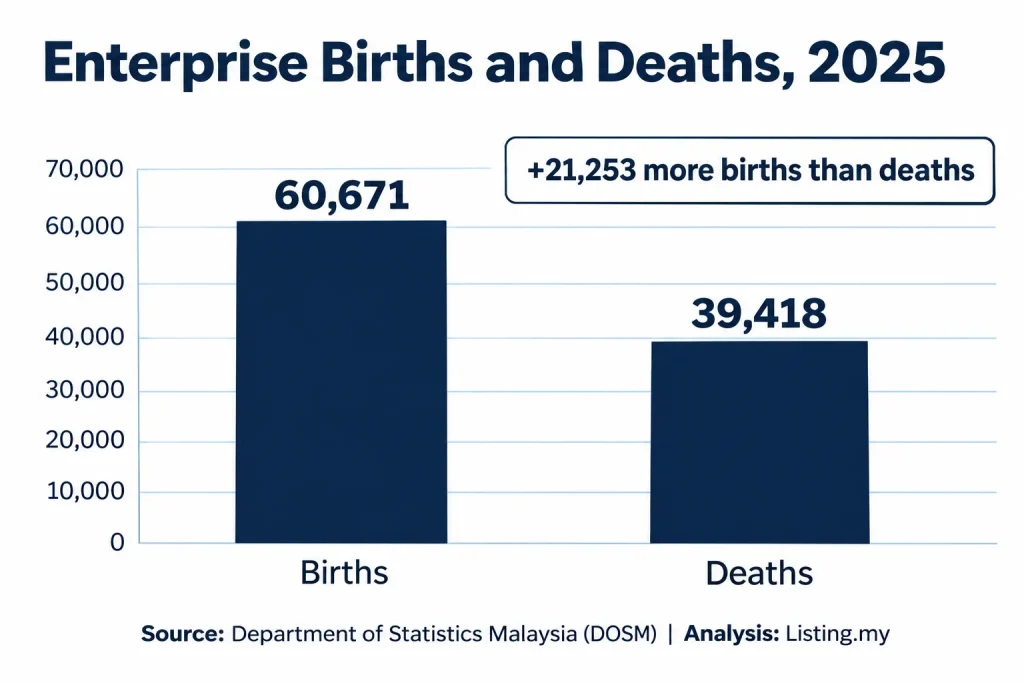
Enterprise Births and Deaths, 2025
Table 4. Malaysia Enterprise Formation and Cessation
| Indicator | 2024 | 2025 | Change |
| Enterprise Births | 55,376 | 60,671 | +9.6% |
| Enterprise Deaths | 28,924 | 39,418 | +36.3% |
| Enterprise Birth Rate | 7.5% | 8.0% | +0.5 pp |
| Enterprise Death Rate | 3.9% | 5.2% | +1.3 pp |
Source: DOSM Business Demography 2024 and 2025. pp = percentage points.
5.1 Enterprise Deaths Relative to New Business Formation
Using DOSM’s published figures, our business consultancy calculated the following relationship:
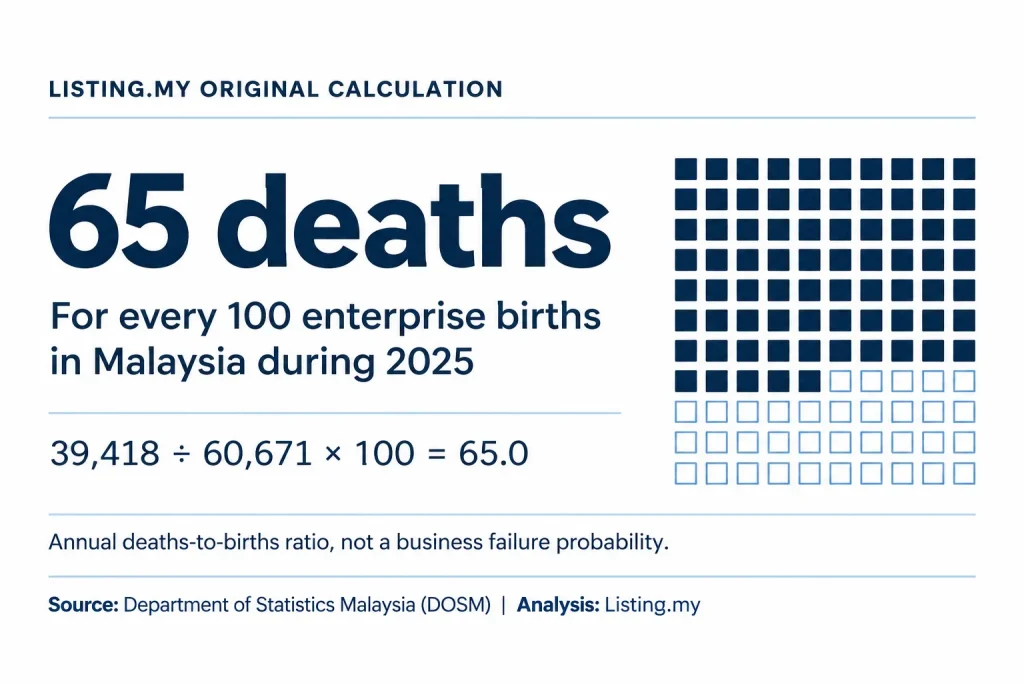
This ratio compares the annual number of enterprise deaths with enterprise births.
It is not a business failure probability and does not imply that 65% of enterprises established in 2025 ceased operating during that year.
The enterprises recorded as deaths may have been established in previous years.
Nevertheless, the ratio provides another perspective on the scale of enterprise turnover within Malaysia’s economy.
5.2 Which Industries Recorded the Most New Enterprises?
Services recorded the largest number of enterprise births, with 43,328 in 2025.
Construction recorded the highest enterprise birth rate at 11.4%.
Table 5. Enterprise Births by Industry, 2025
| Industry | Enterprise Births | Birth Rate |
| Services | 43,328 | 7.3% |
| Construction | 7,635 | 11.4% |
| Manufacturing | 6,607 | 10.9% |
| Agriculture | 2,284 | 9.3% |
| Mining and Quarrying | 817 | 10.3% |
At the state level, Johor recorded the highest enterprise birth rate at 9.5%, followed by Putrajaya at 9.0%.
This demonstrates that enterprise formation remained active across different industries and geographical markets.
6. Five-Year Business Survival in Malaysia
One of the more surprising findings in DOSM’s latest business demography data is that long-term enterprise survival improved despite the sharp increase in annual closures.
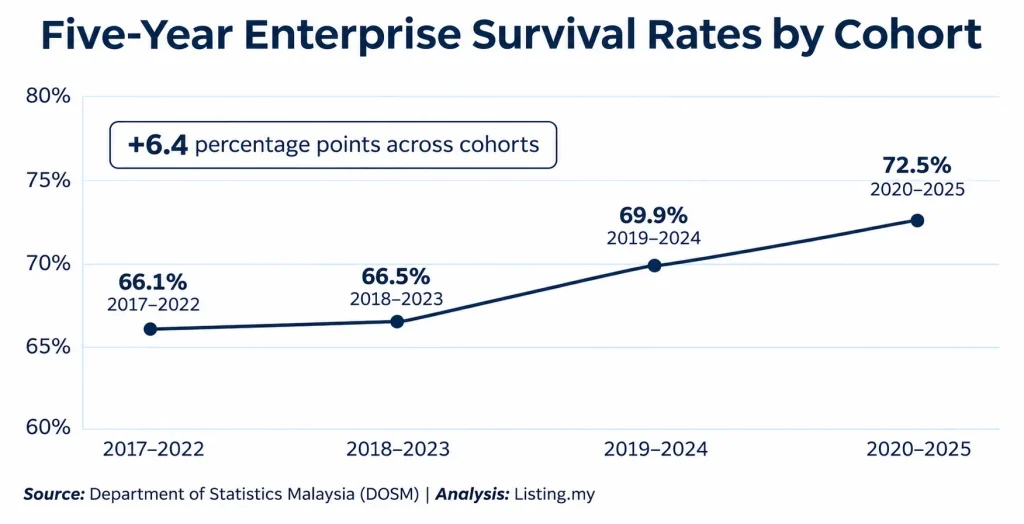
The five-year survival rate reached 72.5% for businesses established in 2020 and still operating in 2025. This compares with 69.9% for the preceding five-year cohort.
The apparent contradiction comes down to what each indicator measures.
Enterprise deaths capture businesses that ceased operations during a particular year. Five-year survival rates, on the other hand, track how many businesses from a specific establishment cohort remained operational.
Both findings can therefore be true simultaneously.
Five-Year Enterprise Survival Rates by Cohort
6.1 Business Survival Improved Despite Higher Annual Closures
Although enterprise deaths increased sharply during 2025, the five-year survival rate for the 2020 cohort was higher than the comparable rate for the preceding cohort.
Five-year survival statistics measure how many enterprises from a specific establishment cohort remained operational after five years.
Research observation: Malaysia’s rising enterprise death count does not, by itself, establish that long-term business survival has deteriorated.
6.2 Business Survival by Industry
| Industry | Five-Year Survival Rate |
| Construction | 73.8% |
| Agriculture | 73.1% |
| Services | 72.5% |
| Manufacturing | 70.5% |
| Mining and Quarrying | 70.1% |
| Malaysia | 72.5% |
Source: DOSM Business Demography 2025.
Construction recorded the highest five-year enterprise survival rate among the five major industries.
At the state level, Sarawak recorded the highest rate at 79.5%, exceeding the national average by seven percentage points.
The findings demonstrate that business survival varies across industries and geographical locations.
7. The Importance of SMEs to Malaysia’s Business Landscape
Business sustainability is particularly relevant in an economy where micro, small and medium enterprises represent the overwhelming majority of commercial establishments.
According to SME Corp Malaysia, MSMEs accounted for 96.2% of Malaysia’s business establishments in 2025.
This represented approximately 1.29 million MSMEs.
Table 6. Malaysia MSMEs by Business Size, 2025
| Business Size | Establishments | Share of MSMEs |
| Micro | 1,000,876 | 77.4% |
| Small | 276,924 | 21.4% |
| Medium | 14,780 | 1.1% |
| Total | 1,292,580 | 100% |
These establishment counts use a different statistical framework from DOSM’s enterprise death statistics and should not be directly combined.
However, they illustrate the scale of Malaysia’s small-business economy.
7.1 MSME Contributions to the Malaysian Economy
DOSM reported that MSMEs contributed RM689.8 billion to Malaysia’s GDP in 2025, representing 39.7% of national GDP.
They also employed approximately 8.09 million people, accounting for 48.7% of national employment.
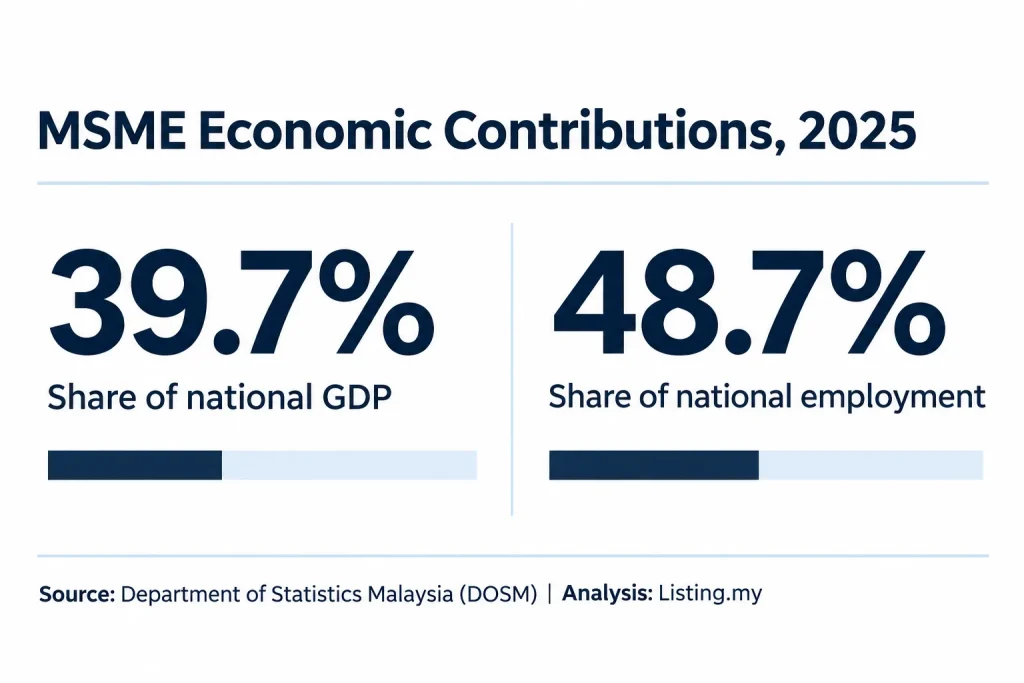
These figures underline the importance of MSMEs beyond their contribution to entrepreneurship.
Smaller enterprises collectively support a substantial proportion of Malaysia’s workforce and economic activity.
However, the available enterprise death statistics do not establish how many workers lost their jobs specifically because of enterprise closures.
8. What Malaysia’s Business Closure Statistics Really Tell Us
A 36.3% increase in business closures is significant, but it does not tell the whole story of Malaysia’s business environment.
The latest figures reveal a market in which new businesses are still entering, established enterprises are demonstrating stronger long-term survival, and some industries are experiencing considerably more turnover than others.
Five findings stand out.
8.1 Malaysia Added 21,253 More Businesses Than It Lost in 2025
Despite the sharp rise in closures, Malaysia still recorded more enterprise births than deaths.
According to the Department of Statistics Malaysia (DOSM), 60,671 enterprises were established in 2025, compared with 39,418 that ceased operations. That represents a positive difference of 21,253 enterprises.
The number of active enterprises also rose from 734,089 in 2024 to 755,342 in 2025, an increase of 2.9%.
Enterprise births grew by 9.6%, while deaths increased almost four times as quickly at 36.3%.
8.2 Construction and Manufacturing Show Strong Business Formation Despite Closure Concerns
The Services sector accounted for almost 80% of enterprise deaths in 2025. However, looking only at closure totals can obscure developments in other industries.
Construction recorded the highest enterprise birth rate among the five major economic sectors at 11.4%, followed by Manufacturing at 10.9%.
| Economic Sector | Enterprise Birth Rate | Enterprise Death Rate |
| Construction | 11.4% | 5.2% |
| Manufacturing | 10.9% | 4.6% |
| Mining and Quarrying | 10.3% | 6.6% |
| Agriculture | 9.3% | 4.9% |
| Services | 7.3% | 5.3% |
Manufacturing also recorded the lowest enterprise death rate at 4.6%.
These figures offer a more nuanced picture of sector-level business activity.
Construction and Manufacturing both recorded relatively strong rates of new enterprise formation, while Mining and Quarrying experienced the highest proportional rate of closures.
8.3 Businesses Established During the Pandemic Recorded the Strongest Five-Year Survival Rate in the Published Comparisons
One of the more striking findings concerns enterprises established in 2020.
Despite beginning operations during the COVID-19 pandemic, this group recorded a five-year survival rate of 72.5% in 2025.
That was higher than the rates recorded for the three preceding cohorts:
- 2017–2022: 66.1%
- 2018–2023: 66.5%
- 2019–2024: 69.9%
- 2020–2025: 72.5%
The latest figure represents a 6.4-percentage-point increase compared with the 2017 cohort’s five-year survival outcome.
Malaysia recorded more business closures during 2025, yet the enterprises established five years earlier demonstrated stronger survival than those in the preceding published comparisons.
8.4 Johor, Perlis and Sarawak Tell Three Different Stories About Regional Business Conditions
Malaysia’s state-level enterprise statistics show why business performance cannot be judged using a single national average.
Johor recorded the highest enterprise birth rate in 2025 at 9.5%, exceeding the national rate of 8.0%.
Perlis, by contrast, recorded the highest enterprise death rate at 6.2%, compared with the national rate of 5.2%.
Sarawak led in a different measure, recording the country’s highest five-year enterprise survival rate at 79.5%.
Each figure describes a different aspect of business activity:
- Johor: Relatively strong new enterprise formation.
- Perlis: The highest proportion of enterprise deaths.
- Sarawak: The strongest five-year survival outcome.
A state with a high birth rate may have an active environment for new business formation, but that does not automatically mean its enterprises have the strongest long-term survival prospects.
8.5 Business Closures Matter Beyond the Companies That Shut Down
The implications of enterprise closures extend beyond individual business owners.
Malaysia’s micro, small and medium enterprises (MSMEs) contributed RM689.8 billion to the economy in 2025, accounting for 39.7% of national GDP.
They also represented 48.7% of employment.
At the same time, MSME GDP grew by 5.7%, outperforming Malaysia’s overall GDP growth of 5.2%.
For policymakers and industry organisations, the findings raise questions worth examining further:
- Which types of enterprises face the greatest difficulty moving beyond their early years?
- Are closure patterns concentrated among particular business sizes or industries?
- How do financing conditions, operating costs and customer demand affect business continuity?
- What explains the differences in enterprise survival between Malaysian states?
The available business demography statistics identify where turnover is occurring.
More Businesses, but a Tougher Road to Staying Open
The country is not experiencing a shortage of new businesses. In 2025, 60,671 enterprises entered the market, while 39,418 ceased operations.
Meanwhile, the five-year survival rate reached 72.5%, its highest level among the four published cohort comparisons.
This tells us Malaysia remains a market where new businesses continue to emerge, but a growing number of existing enterprises are also leaving.
The 2025 figures offer a clear warning against judging Malaysia’s business environment by its closure statistics alone. More enterprises were established than ceased operations, yet closures accelerated sharply.
Whether this represents a temporary adjustment or a longer-term change in business turnover remains an open question.
For now, the figures establish one important distinction: Malaysia continues to create new enterprises, but the pace at which existing businesses leave the market deserves closer attention.
Sources:
- Department of Statistics Malaysia (DOSM) – Business Demography 2025
- Department of Statistics Malaysia (DOSM) – Business Demography 2024
- Department of Statistics Malaysia (DOSM) – Micro, Small & Medium Enterprises (MSMEs) Performance 2025
- SME Corporation Malaysia – Profile of MSMEs in 2015–2025
- Listing.my – Original Calculations Based on DOSM Business Demography Statistics 2024 and 2025