What Are Some Used Car Dealer Red and Green Flags in Malaysia?

Key Takeaways
- A reliable used car dealer provides transparent pricing, accurate vehicle information and clear ownership-transfer procedures.
- Refusing independent inspections, hiding fees and pressuring buyers into deposits are major warning signs.
- A PUSPAKOM ownership-transfer inspection does not replace a comprehensive mechanical inspection.
- Compare the total purchase cost, including processing fees, insurance, financing and potential repairs.
- Check the dealer’s business identity, customer reviews and written terms before making any payment.
Buying a used car in Malaysia can save you money, but choosing the wrong dealer can turn a good deal into an expensive mistake. A trustworthy used car dealer is transparent about the vehicle’s condition, pricing, paperwork and inspection process. An unreliable one may hide defects, introduce unexpected charges or rush you into paying a deposit.
The challenge is that both can appear professional at first glance.
Before committing to a used car, here are the red and green flags worth recognising, along with practical ways to protect yourself.
Used Car Dealer Red Flags vs Green Flags at a Glance
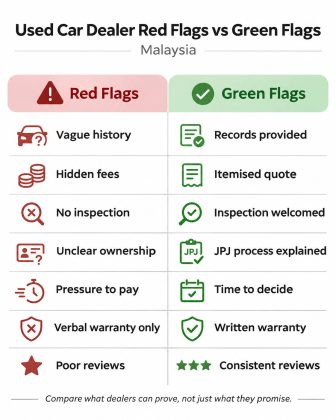
The simplest rule is to judge a dealer by what they can prove, not just what they promise.
What Are the Biggest Red Flags When Choosing a Used Car Dealer?
Certain warning signs deserve more attention than others. A minor disagreement over pricing is different from a dealer refusing to disclose a vehicle’s history or ownership details.
The Dealer Refuses an Independent Vehicle Inspection
One of the biggest red flags is a dealer who discourages you from having the car inspected by an independent mechanic.
You might hear:
- “We already checked everything.”
- “The car passed PUSPAKOM, so there is no problem.”
- “You can inspect it after paying the deposit.”
These statements should prompt further questions.
In Malaysia, the MV15 ownership-transfer inspection helps identify issues such as unlawful vehicle modifications. However, passing this inspection does not guarantee that every mechanical component is in good condition.
A comprehensive pre-purchase inspection by an independent mechanic can uncover additional problems involving the engine, transmission, cooling system, suspension and electronics.
What to do: Ask whether you can arrange an inspection before signing the purchase agreement. If the dealer refuses without a reasonable explanation or alternative arrangement, consider another vehicle.
Read More: What You Should Look Out For When Buying a Used Car in Malaysia
The Advertised Price Is Different From the Final Price
A used car advertised at RM35,000 might look attractive until the dealer introduces additional charges.
These may include:
- Processing or documentation fees
- Loan arrangement charges
- Insurance and road tax
- Ownership-transfer expenses
- Optional warranty packages
Not every additional charge is unreasonable. Insurance and certain transaction expenses are legitimate costs.
The warning sign is when a dealer hides them until you are ready to pay.
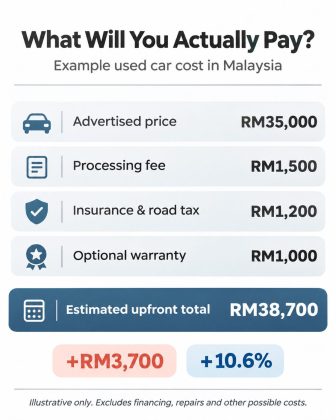
The additional charges increase the upfront cost by RM3,700, approximately 10.6% above the advertised price.
These figures are hypothetical and exclude financing costs, repairs and other possible transaction expenses.
What to do: Request an itemised, written quotation before paying a deposit. Ask which charges are compulsory, which are optional and whether you can arrange insurance independently.
The Dealer Cannot Explain the Vehicle’s History
A used car dealer should be able to answer reasonable questions about a vehicle’s background.
Be cautious when the salesperson cannot explain:
- Whether the car has experienced major accidents
- Whether it has suffered flood damage
- Whether the displayed mileage is supported by records
- Whether major repairs have been performed
- Whether service records are available
Missing service records do not automatically mean a car is problematic. However, the dealer should acknowledge any uncertainty rather than guarantee an undocumented history.
What to do: Compare the odometer reading with available service records, inspection findings and vehicle condition. Request written confirmation of important claims where possible.
The Salesperson Pressures You to Pay a Deposit Immediately
A salesperson might claim another buyer is arriving shortly or that a promotional price expires within the hour.
Sometimes another interested buyer genuinely exists. However, repeated pressure to make a payment before reviewing the vehicle or purchase terms is a warning sign.
Pay particular attention when:
- The dealer refuses to provide written deposit conditions.
- You are discouraged from comparing other vehicles.
- The salesperson requests payment to a personal bank account without a clear explanation.
- You are told that financing approval is guaranteed.
What to do: Before transferring money, confirm the recipient, amount, refund conditions and what happens if financing is rejected or the inspection reveals serious problems.
Ownership Documents or Transfer Arrangements Are Unclear
Ownership-transfer problems can delay your purchase or prevent the transaction from proceeding.
According to the Road Transport Department (JPJ), voluntary ownership transfers must satisfy applicable requirements, including the absence of certain restrictions involving financial institution claims, blacklisting and unresolved registration matters.
Watch for dealers who cannot explain who the registered owner is, whether outstanding financing exists or how the ownership transfer will be completed.
A car does not necessarily have to be registered in the dealership’s name. Dealers may sell vehicles on behalf of owners, but their authority to arrange the sale should be clear.
What to do: Verify the vehicle details, seller’s authority and ownership-transfer arrangements before completing payment.
The Dealer Makes Vague Warranty Promises
A salesperson saying “everything is covered” sounds reassuring, but the actual warranty may contain substantial exclusions.
Some used car warranties cover selected engine or transmission components while excluding wear-and-tear parts and maintenance items.
Before accepting warranty claims, ask about:
- Coverage duration
- Covered and excluded components
- Maximum claim amounts
- Approved repair workshops
- Conditions that could invalidate coverage
A written warranty is useful, but it should never replace a proper vehicle inspection. Warranty exclusions also do not automatically override applicable consumer rights.
What Are the Green Flags of a Trustworthy Used Car Dealer?
Good dealers make the buying process easier to verify. Their strongest selling point is often the clarity of their information and willingness to answer difficult questions.
Transparent Vehicle Information
A trustworthy dealer provides accurate information about the vehicle’s mileage, specifications, service history and known repairs.
They should also distinguish verified facts from information provided by previous owners.
For example, acknowledging that an accident history cannot be fully verified is more responsible than making an unsupported guarantee.
Independent Inspections Are Welcomed
A dealer willing to accommodate a qualified third-party inspection demonstrates confidence in the vehicle they are selling.
They may allow inspection at an independent workshop, an on-site mechanic assessment or a diagnostic scan.
Reasonable conditions around insurance, scheduling and vehicle security are understandable.
Complete Written Price Breakdown
Reliable dealers explain how the advertised price becomes the final amount payable.
A proper quotation should identify the vehicle price, processing fees, insurance, road tax and optional services.
For financed purchases, request the proposed financing amount, repayment period, instalments and total repayment figure.
A lower monthly instalment does not necessarily mean a cheaper purchase. A longer loan term can increase the total amount repaid.
Clear JPJ and PUSPAKOM Procedures
A professional used car dealer in Malaysia should understand the applicable vehicle inspection and JPJ ownership-transfer requirements.
According to PUSPAKOM’s published inspection fees, the following charges apply to inspections carried out by PUSPAKOM:
| Inspection Type | Published Fee | Purpose |
| Transfer of Ownership (MV15) | RM30 | Ownership-transfer checks for applicable vehicles |
| Hire Purchase (B7) | RM60 | Inspection for used-vehicle hire-purchase financing |
| Voluntary Private Vehicle Inspection | RM50 | Voluntary assessment of vehicle condition and roadworthiness |
Note: These are PUSPAKOM’s published inspection fees, checked on 4 November 2026. Additional service or dealer charges may apply. The former B5 ownership-transfer inspection report was renamed MV15 effective 1 November 2024.
Other authorised vehicle inspection centres may also provide relevant inspections, subject to their approval and available services.
A good dealer should explain who arranges the inspection, who pays the fees and how ownership transfer will be completed.
Clear Purchase Terms and After-Sales Support
A reliable dealership documents important agreements, including the final price, payment terms, deposit conditions and any repairs promised before delivery.
Positive signs also include:
- A clear contact person
- Written warranty procedures
- A physical business address
- Proper receipts and transaction records
- Reasonable responses to post-sale enquiries
Even a trustworthy dealer cannot guarantee that a used vehicle will never develop faults. What matters is whether the dealer honours the commitments agreed during the sale.
How Can You Verify a Used Car Dealer in Malaysia?
Before visiting a dealership, carry out a few checks to reduce unnecessary risk.
Check the business identity. Ask for the dealership’s registered business name and registration details. You can verify business information through the relevant Companies Commission of Malaysia (SSM) search services.
Read customer reviews. Look for recurring complaints about hidden fees, warranty disputes or delayed ownership transfers. Prioritise detailed accounts over vague praise or criticism.
Compare similar vehicles. Check at least three listings with comparable models, manufacturing years, mileage and condition. A cheaper vehicle may require more repairs.
Request written information. Ask for the vehicle’s specifications, asking price and estimated additional charges before visiting the showroom.
Inspect before committing. Check for inconsistent paintwork, unusual interior wear, signs of water intrusion and dashboard warning lights. Arrange a qualified independent inspection where possible.
Is a Cheaper Used Car From an Unknown Dealer Worth the Risk?
Sometimes, but the lower asking price must be considered alongside the vehicle’s condition, documentation and potential repair expenses.
Consider two hypothetical used cars of the same model and year.
| Factor | Dealer A | Dealer B |
| Asking price | RM30,000 | RM33,000 |
| Immediate repairs | RM4,000 | RM500 |
| Processing fees | RM1,500 | RM500 |
| Estimated total | RM35,500 | RM34,000 |
Dealer A appears RM3,000 cheaper initially.
However, Dealer B works out RM1,500 cheaper once the assumed repair and processing costs are included.
These figures are illustrative and exclude insurance, road tax, financing and future maintenance.
The lesson is straightforward: compare the expected cost of owning the vehicle, not just the advertised selling price.
A smaller dealership may offer an excellent car at a competitive price. Equally, an established dealership may sell a vehicle that requires expensive repairs.
Evaluate the particular vehicle and transaction rather than relying exclusively on the dealership’s size or reputation.
What Should You Ask a Used Car Dealer Before Paying a Deposit?
Before making payment, ask these questions and keep written records of the answers.
Used Car Dealer Checklist
- Can you confirm the complete on-the-road price?
- Are there any outstanding loans or ownership restrictions?
- Has the car experienced major accidents or flood damage?
- Can I arrange an independent mechanical inspection?
- Are service records or repair receipts available?
- Which warranty terms and exclusions apply?
- Is the deposit refundable, and under what conditions?
- Who handles the required vehicle inspection and JPJ ownership transfer?
- Will all agreed repairs be documented before delivery?
- Will I receive an official receipt for every payment?
If the dealer cannot answer several of these questions clearly, avoid rushing into the purchase.
When Should You Walk Away From a Used Car Deal?
Not every concern requires abandoning the purchase. Some can be resolved through further checks, negotiation or written clarification.
However, certain situations justify walking away.
| Situation | Recommended Action |
| Minor cosmetic damage disclosed upfront | Inspect and negotiate |
| Missing service records | Arrange a detailed inspection |
| Unexplained ownership restrictions | Pause until resolved |
| Refusal to permit independent inspection | Consider walking away |
| Suspected falsified mileage or documents | Do not proceed without verification |
| Pressure to pay without written terms | Walk away |
Be particularly cautious when several warning signs appear together.
For example, missing service records alone do not make a vehicle a bad purchase. However, missing records combined with suspicious mileage, an unusually low price and refusal of independent inspection create a much higher-risk situation.
No discount is worth accepting an unresolved ownership problem that prevents you from completing the transaction.
Choose a Dealer Who Makes Verification Easy
A trustworthy used car dealer should be willing to explain the vehicle’s condition, pricing, documentation and purchase terms without unnecessary pressure.
Before choosing a dealer, compare several options, verify their business information and arrange an independent inspection whenever possible.
At Listing.my, you can explore Malaysian business listings as a starting point for finding dealerships to research and compare. Before making a purchase, verify each dealer’s credentials, reviews and vehicle details independently.
Sources
- Road Transport Department Malaysia (JPJ) – Voluntary Vehicle Ownership Transfer Guidelines
- PUSPAKOM – Inspection Types and Fees
- PUSPAKOM – Renaming of Ownership Transfer Inspection Report, October 2024
- Government of Malaysia – Vehicle Buying and Selling
- Companies Commission of Malaysia (SSM) – Business Information
- Consumer Protection Act 1999
- Tribunal for Consumer Claims Malaysia (TTPM) – Tribunal Jurisdiction
- Ministry of Transport Malaysia – Additional Authorised Vehicle Inspection Providers
Frequently Asked Questions About Red and Green Flags For Used Car Dealers in Malaysia
How Do I Know if a Used Car Dealer Is Trustworthy?
Check the dealer’s business registration, customer reviews, pricing transparency and willingness to allow independent inspections. A trustworthy dealer should also explain the vehicle’s history and ownership-transfer process clearly.
Should I Buy a Used Car From a Dealer or Private Seller?
A dealer may offer more convenient paperwork, financing assistance and warranty options, while a private seller may offer a lower price. Both options require careful vehicle inspection, ownership verification and written purchase terms.
Can a Used Car Dealer Refuse an Independent Inspection?
Yes, a dealer can decline an inspection request, but you are not obliged to continue with the purchase. If an independent inspection is important to you, agree on the arrangements before paying a deposit.
Is a PUSPAKOM Inspection Enough Before Buying a Used Car?
No. An ownership-transfer inspection is not a comprehensive mechanical assessment. Arrange an independent inspection to check the engine, transmission, suspension and other components that may require expensive repairs.
Are Used Car Dealer Deposits Refundable in Malaysia?
Whether a deposit can be refunded depends on the agreement, circumstances and applicable consumer protection laws. Request written refund conditions before paying, especially if financing is rejected or an inspection reveals serious problems. A dealer’s deposit terms do not automatically override your legal rights. If a dispute arises, eligible consumers may seek assistance through the Tribunal for Consumer Claims Malaysia (TTPM).
What Is the Safest Way to Pay a Used Car Dealer?
Use a traceable payment method and obtain an official receipt. Verify the recipient’s identity, confirm the agreed terms and avoid paying the full amount before ownership-transfer arrangements and other purchase conditions are clear.