A Malaysian First-Time Homeowner’s Guide to Property Management

Key Takeaways
- Property management covers home maintenance, budgeting, safety, paperwork and protecting your property’s condition.
- Strata homeowners share responsibility for common areas, while landed homeowners handle most maintenance themselves.
- New homes under prescribed Schedule G or H agreements generally have a 24-month defect liability period.
- Budget beyond your mortgage for taxes, insurance, repairs and maintenance charges.
- Regular inspections help identify problems before they become expensive repairs.
Buying your first home is a major milestone. Keeping it in good condition, however, requires more than paying the mortgage every month.
Property management for Malaysian homeowners involves maintaining the property, managing expenses, handling repairs and following relevant regulations. For strata properties, it also means understanding the responsibilities shared with your building’s management body.
But what should you actually do once the keys are yours?
Let’s go through the practical side of homeownership, including responsibilities that are easy to overlook until something goes wrong.
What Does Property Management Mean for a Homeowner?
Property management means looking after your home’s physical condition, financial commitments and administrative responsibilities throughout your ownership.
Your responsibilities depend partly on the type of property you own.
| Responsibility | Landed Property | Strata Property |
| Interior repairs | Homeowner | Homeowner |
| Roof and external structure | Generally homeowner | Depends on parcel boundaries and common-property rules |
| Shared facilities | Where applicable | Developer, JMB or MC |
| Maintenance fees | May apply | Statutory strata charges |
| Sinking fund | Not ordinarily applicable | Required |
| Renovation approval | Local authority | Local authority and management |
| Property taxes | Homeowner | Homeowner |
Note: Some landed homes are strata-titled, while gated communities may have separate management arrangements.
For example, a landed homeowner may need to arrange roof repairs personally.
Meanwhile, a condominium homeowner can report common-property maintenance problems to the management office.
The first step is knowing which responsibilities belong to you and which belong to someone else.
What Should You Check Before Moving Into Your First Home?
Before moving in, inspect your property, organise important documents and confirm that essential services are ready.
1. Inspect the Property for Defects
If you purchased a newly completed home, inspect it carefully during the vacant possession (VP) stage.
Look for:
- Water stains, damp patches and leaks
- Cracked tiles, walls or ceilings
- Poorly fitted doors and windows
- Plumbing and drainage problems
- Faulty electrical sockets
- Uneven flooring
- Poorly installed bathroom fittings
Take photographs and record each defect’s location.
Under Malaysia’s prescribed Schedule G and H agreements, the defect liability period (DLP) is generally 24 months from the date vacant possession is taken or legally deemed to have been taken.
Check your SPA and vacant possession notice to confirm the start date. You can also review KPKT’s defect liability guidance for a general explanation of how the DLP works.
Developers generally have 30 days after receiving written notice to rectify defects covered by the applicable agreement. Keep written records and proof of submission in case follow-up is needed.
For subsale properties, do not assume the original developer’s warranty still applies.
2. Organise Your Property Documents
Keep digital copies of:
- Sale and Purchase Agreement (SPA)
- Loan agreement and title documents
- Vacant possession correspondence
- Insurance certificates
- Defect inspection reports
- Renovation approvals
- Contractor warranties
- Maintenance statements
These documents may become important during insurance claims, disputes or future property sales.
3. Confirm Utilities and Access
Before moving in:
- Arrange electricity and water account setup.
- Check internet availability.
- Confirm access cards and parking arrangements.
- Locate the main water valve and electrical distribution board.
- Save emergency and building management contacts.
For condominium residents, ask about move-in procedures and lift bookings.
What Ongoing Costs Should Malaysian Homeowners Budget For?
Your mortgage is only one part of homeownership. Taxes, insurance, maintenance and unexpected repairs also require planning.
Assessment tax (cukai taksiran) and quit rent (cukai tanah) are separate obligations.
For example, Petaling Jaya City Council (MBPJ) requires assessment tax payments on or before 28 February and 31 August each year. Other councils may have different arrangements, so check the deadlines that apply to your property.
How Much Should You Budget Monthly?
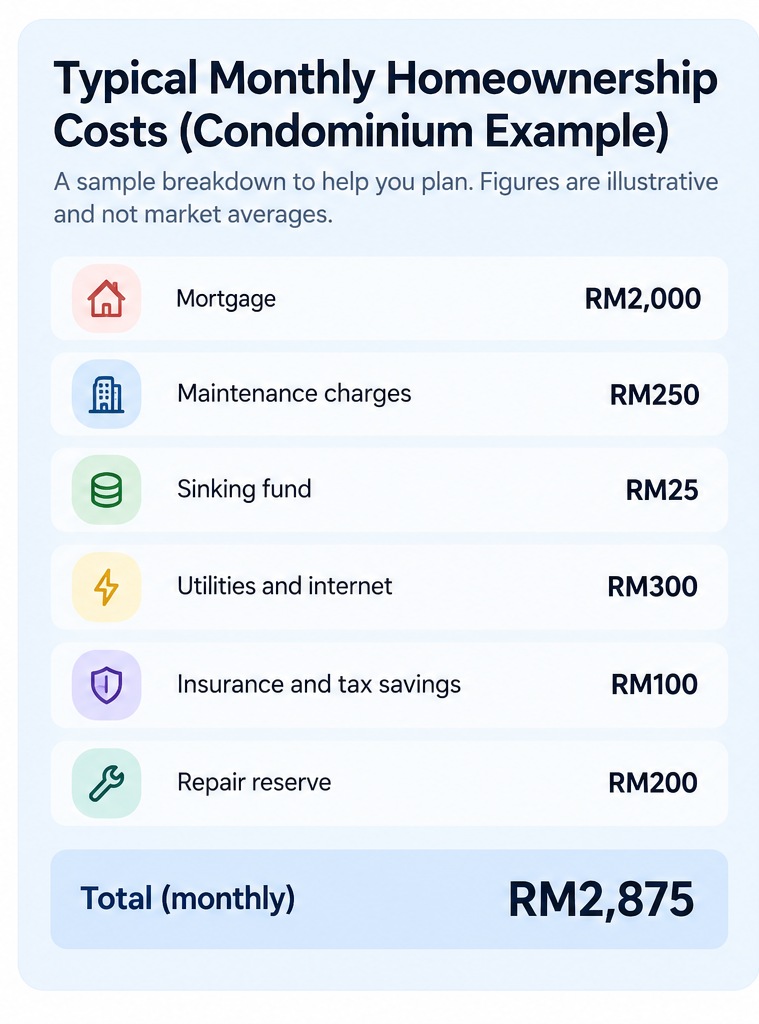
Consider this hypothetical condominium budget:
| Expense | Monthly Amount |
| Mortgage | RM2,000 |
| Maintenance charges | RM250 |
| Sinking fund | RM25 |
| Utilities and internet | RM300 |
| Insurance and tax savings | RM100 |
| Repair reserve | RM200 |
| Total | RM2,875 |
Annual allocation: RM2,875 × 12 = RM34,500
Of this amount, RM24,000 goes towards the mortgage, while RM10,500 covers other expenses and reserves.
These are illustrative figures, not market averages. They exclude major renovations, furnishings and unexpected large repairs.
Budget for the total cost of owning a home, not just the mortgage repayment.
Who Manages a Condominium or Strata Property in Malaysia?
Strata properties have legally defined management bodies responsible for maintaining shared facilities and common property.
Under Malaysia’s strata management framework, responsibilities generally progress through three stages.
1. Developer Management
Initially, the developer manages common property and arranges essential services such as security, cleaning and maintenance.
2. Joint Management Body (JMB)
The JMB comprises the developer and purchasers. It manages common property, maintenance charges and building finances during the applicable transitional period.
3. Management Corporation (MC)
The MC is established under the strata-title framework and takes over management responsibilities through the statutory handover process.
Its responsibilities include maintaining common property, managing funds and overseeing the building’s long-term upkeep.
A property management company may handle daily operations on behalf of the responsible management body.
What Are Maintenance Charges and Sinking Funds?
These payments have different purposes.
Maintenance charges cover:
- Security and cleaning
- Lift servicing
- Common-area electricity
- Landscaping
- Routine maintenance
Sinking fund contributions cover larger capital expenses, including:
- Building repainting
- Major equipment replacement
- Common-property upgrades
- Refurbishment works
Under applicable strata arrangements, the sinking fund contribution is generally at least 10% of maintenance charges, although a building may collect more if needed.
Importantly, an insufficient sinking fund can create additional financial pressure when major repairs become necessary.
As a homeowner, request the latest available financial statements, AGM minutes and maintenance information to understand how your building is managed.
What Home Maintenance Should You Do Throughout the Year?
Preventive maintenance helps identify deterioration early, potentially reducing the need for expensive repairs.
Malaysia’s rainfall, humidity and warm weather make drainage, moisture control and air-conditioning maintenance especially relevant.
| Frequency | What to Check |
| Monthly | Visible leaks, dampness and drainage |
| Monthly | Air-conditioner filters |
| Every 3 months | Door seals, windows and bathroom fittings |
| Every 6 months | Accessible gutters and drainage outlets |
| Every 6 months | Water heater and electrical safety indicators |
| Annually | Roof, waterproofing and exterior condition |
| Annually | Insurance coverage and repair budget |
These are suggested checks, not statutory inspection intervals. Follow manufacturer instructions and obtain professional assistance where necessary.
Which Problems Need Immediate Attention?
Prioritise problems involving safety or active damage:
- Water leaking near electrical equipment
- Repeated circuit-breaker trips
- Burning smells from electrical fittings
- Significant water intrusion
- Serious structural cracking
- Exposed electrical wiring
Avoid attempting dangerous electrical or structural repairs yourself.
For strata residents, report suspected common-property problems to building management.
Prioritise maintenance according to safety, active damage and the likelihood of deterioration.
What Should You Know Before Renovating Your Property?
Before renovating, check approval requirements, building rules and potential effects on neighbouring properties.
For landed homes, certain extensions and structural modifications require local authority approval.
Strata properties may also have specific rules covering renovation hours, deposits and permitted works.
Before hiring a contractor:
- Define the scope: Separate essential repairs from cosmetic improvements.
- Check approvals: Contact the local authority and management office where applicable.
- Compare quotations: Request itemised material and labour costs.
- Verify credentials: Check CIDB registration for construction and renovation contractors, unless a statutory exemption applies. Confirm any additional licences needed for specialist work.
- Agree on payment terms: Establish milestones and completion dates.
- Keep records: Save quotations, approvals, receipts and warranties.
For example, removing a wall between your kitchen and living room may require structural assessment and approval.
It is not comparable to painting or replacing furniture.
For newly completed properties, finish your defect inspection before undertaking major alterations that could complicate warranty claims.
Should You Hire a Property Management Company?
Professional property management can be useful when managing a property requires more time, coordination or specialist knowledge than you can provide.
However, not every homeowner needs one.
| Situation | Suggested Approach |
| Owner-occupied landed home | Self-manage and hire contractors |
| Condominium unit | Work with appointed building management |
| Distant investment property | Consider professional management |
| Multiple rental properties | Professional management may help |
| Specific maintenance problem | Hire a specialist contractor |
What Should You Check Before Hiring?
Compare companies based on:
- Services: Maintenance, inspections, tenant management or administration
- Fees: Monthly charges and additional costs
- Reporting: Financial and maintenance updates
- Contractors: Vendor selection and repair approvals
- Emergency response: Availability for urgent problems
- Credentials: For regulated property-management services, check the registration of the firm and responsible practitioner with the Board of Valuers, Appraisers, Estate Agents and Property Managers (BOVAEP)
For rental properties, clarify which decisions require your approval, particularly expensive repairs.
Remember that an individually appointed property manager cannot automatically take over responsibilities belonging to a strata development’s JMB or MC.
Professional help makes sense when the services and time savings justify the cost.
What If Your Developer or Building Management Ignores a Complaint?
The appropriate complaint channel depends on the type of property dispute. Always begin by documenting the problem with photographs, dates and written correspondence.
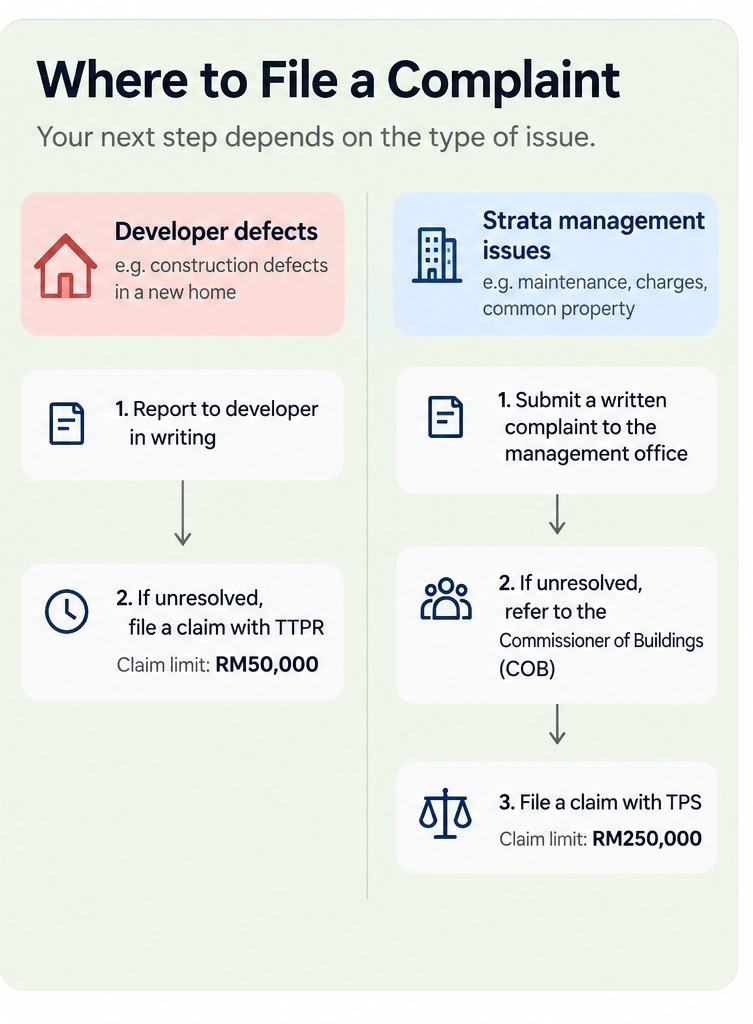
For Developer Defects
Report qualifying defects according to your SPA and keep written records of all communication.
The Tribunal for Homebuyer Claims (Tribunal Tuntutan Pembeli Rumah, TTPR) handles eligible disputes between homebuyers and housing developers within its jurisdiction.
The standard claim limit is RM50,000, although a higher claim may be heard if both parties agree in writing.
Filing deadlines also matter. For qualifying technical defect claims, KPKT generally requires submission within 12 months after the defect liability period expires. Other claim types may have different deadlines.
The TTPR framework covered by this guidance applies to Peninsular Malaysia and Labuan. Homeowners in Sabah and Sarawak should check the relevant local complaint and dispute-resolution procedures before filing.
For Strata Management Problems
Start with a written complaint to the management office or responsible management body.
Unresolved matters may be referred to the relevant Commissioner of Buildings (COB).
Certain disputes fall under the Strata Management Tribunal (Tribunal Pengurusan Strata, TPS), which has a claim limit of RM250,000.
The tribunals have different jurisdictions, so check which one applies before filing.
What Should Your First-Year Property Management Plan Look Like?
Your first year should focus on understanding expenses, organising records and building a sustainable maintenance routine.
| Period | Priority Actions |
| First 30 days | Inspect defects, organise documents and set up utilities |
| Months 2–3 | Finalise your budget and resolve handover issues |
| Months 4–6 | Review maintenance needs and contractor arrangements |
| Months 7–9 | Check moisture-prone areas and drainage |
| Months 10–12 | Review expenses, insurance and next year’s maintenance budget |
Why Does Early Maintenance Matter?
Imagine two homeowners noticing water stains near their bathroom walls.
Homeowner A reports the problem immediately and arranges an inspection.
Homeowner B paints over the stain without investigating the source.
If the moisture continues, Homeowner B may eventually face more extensive repairs.
The actual outcome depends on the cause and severity, but the principle is straightforward:
Investigating problems early is more useful than repeatedly repairing their visible symptoms.
Making Sure You Get Things Right
Being a first-time homeowner in Malaysia comes with responsibilities beyond paying your mortgage.
Understanding property management helps you maintain your home, plan expenses, protect your ownership interests and decide when professional help is worthwhile.
For homeowners searching for property-related services, Listing.my helps you discover Malaysian businesses in one directory. If you operate a property maintenance, renovation or management business, our Malaysian business listing services can help potential customers find your services online.
Sources / References
- Ministry of Housing and Local Government (KPKT), Defect Liability Period guidance and FAQ.
- National Housing Department / KPKT, strata management guidance and Act 757 resources.
- KPKT, Roles and Functions of the Housing and Strata Management Tribunals.
- KPKT, Homebuyer Claims Tribunal FAQ.
- KPKT, Strata Management Tribunal information.
- Petaling Jaya City Council (MBPJ), official assessment tax information.
- Construction Industry Development Board Malaysia (CIDB), contractor registration guidance.
- Board of Valuers, Appraisers, Estate Agents and Property Managers (BOVAEP), relevant accreditation and practice guidance.
Frequently Asked Questions About Property Management for First Time Homeowners
Is Property Management Compulsory for Homeowners in Malaysia?
Hiring a property management company is not compulsory for every homeowner. However, strata properties are subject to statutory management arrangements, and owners must fulfil applicable financial and management obligations.
Can I Refuse to Pay Condominium Maintenance Fees?
No. Strata owners must pay applicable maintenance charges and sinking fund contributions. If you dispute a charge, seek clarification through the appropriate management or legal process.
Does My Condominium Maintenance Fee Cover Repairs Inside My Unit?
Not ordinarily. Maintenance charges mainly cover common property. Interior repairs are generally the owner’s responsibility, although responsibility may depend on the cause of damage and applicable legal provisions.
Do First-Time Homeowners Need Home Insurance?
Home insurance is worth considering, and lenders may require specified coverage. Check your protection for the building, improvements and contents, including any insurance maintained by your strata management.
Can I Manage My Property Without Hiring a Professional?
Yes. Many homeowners manage their properties by maintaining records, scheduling inspections and hiring contractors when necessary. Professional management is more useful for rental properties or homes requiring frequent coordination.
What Is the Biggest Property Management Mistake First-Time Homeowners Make?
Failing to budget beyond the mortgage can create financial difficulties. Maintenance fees, taxes, insurance and unexpected repairs should be included in your ongoing homeownership budget.