Terrace House vs Apartment Property Management in Malaysia
Key Takeaways
- Terrace homeowners with individual titles generally manage their own repairs, while apartment owners share responsibility for common facilities.
- Apartments have recurring maintenance charges and sinking fund contributions, while terrace houses can face larger individual repair bills.
- Strata-titled terrace houses may have management fees and regulations similar to apartments.
- Apartment owners have less control over shared facilities, while individual-title terrace owners generally have greater flexibility.
- Ownership title, maintenance budget and management quality matter more than property type alone.
Choosing between a terrace house and an apartment in Malaysia involves more than comparing floor space, location and purchase price.
The biggest difference in property management is who maintains the property, who makes the decisions and how the costs are shared.
A conventional terrace homeowner manages most repairs independently. An apartment owner maintains their own unit while contributing towards shared facilities through a management body.
Neither arrangement is automatically cheaper or better. Here’s what Malaysian homebuyers should compare before deciding.
Important legal note: The Strata Management Act 2013 (Act 757) applies to Peninsular Malaysia and the Federal Territory of Labuan. Sabah and Sarawak have separate legal frameworks, so buyers should check the requirements applicable to their property.
Terrace House vs Apartment: Property Management at a Glance
| Factor | Terrace House (Individual Title) | Apartment (Strata Title) |
| Management responsibility | Homeowner | Owner and strata management body |
| Monthly management fees | Generally no statutory strata charges | Mandatory maintenance charges |
| Sinking fund | Personal repair savings | Statutory contributions |
| Roof maintenance | Generally the homeowner | Management where roof is common property |
| Internal plumbing | Homeowner | Usually unit owner, subject to pipe ownership |
| Shared facilities | Limited or none | Lifts, corridors and amenities |
| Security | Owner or neighbourhood arrangements | Building management, if provided |
| Renovation flexibility | Greater, subject to regulations | Subject to regulations and by-laws |
| Major repairs | Individually funded | Shared for common property |
| Decision-making | More individual control | Shared management governance |
This comparison assumes a conventional individual-title terrace house and a strata-titled apartment. Responsibilities may vary depending on parcel boundaries, ownership documents and applicable local laws.
The main trade-off: Terrace houses provide greater independence, while apartments offer shared management and collective maintenance.
Who Is Responsible for Managing Each Property?
The responsibility depends on the property’s ownership structure and location.
Terrace House: The Homeowner Takes Charge
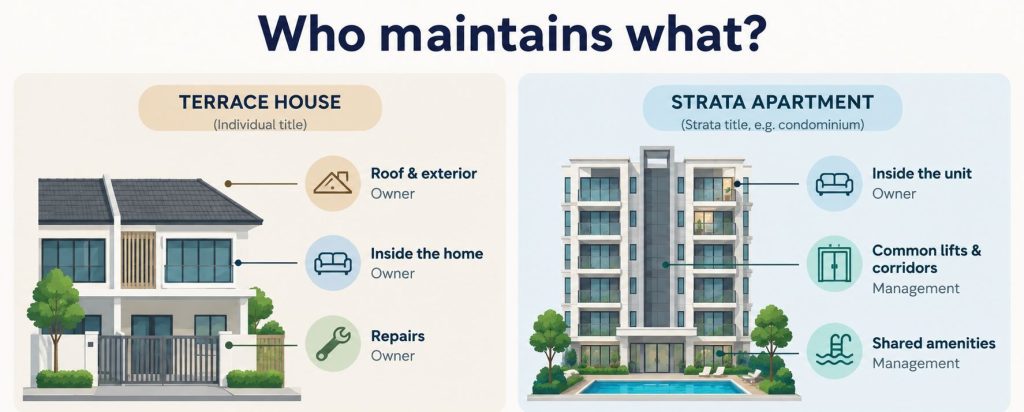
For a conventional terrace house with an individual land title, the homeowner generally manages and pays for maintenance, including:
- Roof repairs and waterproofing
- Plumbing and electrical maintenance
- Exterior painting
- Drainage within the property
- Gate, fence and driveway repairs
- Pest control
For example, if your roof starts leaking, you must usually find a contractor, compare quotations and pay for the repair.
However, public roads, public drains and municipal services generally fall under the relevant authorities, depending on their legal status and jurisdiction.
Apartment: Responsibilities Are Shared
In Peninsular Malaysia and Labuan, the Strata Management Act 2013 (Act 757) governs how strata common property is managed.
Depending on the development stage, responsibilities fall to the developer, Joint Management Body (JMB) or Management Corporation (MC).
The management body generally handles:
- Lift servicing
- Common-area cleaning
- Shared water tanks
- Security services, where provided
- Common-area lighting
- Shared facilities and building maintenance
Owners generally maintain their private units, while the management body looks after common property.
However, responsibility for shared pipes, waterproofing and components crossing parcel boundaries may require further investigation.
Example: A leaking kitchen sink is ordinarily the owner’s responsibility, while a problem with a common water tank generally falls under building management.
For disputed leaks, responsibility depends on the source and applicable strata regulations.
How Much Does Property Management Cost?
Apartments involve recurring management expenses, while terrace homeowners must budget independently for repairs.
Apartment Maintenance Fees and Sinking Funds
Apartment owners pay maintenance charges for managing common property.
In Peninsular Malaysia and Labuan, Act 757 provides for sinking fund contributions generally amounting to at least 10% of maintenance charges, depending on the applicable statutory provisions and management arrangements.
These funds help finance major capital expenses such as repainting common areas, replacing equipment and upgrading facilities.
Consider this illustrative calculation:
| Expense | Monthly | Annually |
| Maintenance charge | RM250 | RM3,000 |
| Sinking fund (10%) | RM25 | RM300 |
| Total | RM275 | RM3,300 |
Calculation: RM250 × 10% = RM25 sinking fund contribution.
RM275 × 12 = RM3,300 annually.
These are hypothetical figures, not verified national averages.
Actual charges depend on allocated share units or share units, facilities, operating expenses and applicable management arrangements. Charges can also change over time.
Terrace House Maintenance Expenses
Conventional individual-title terrace homeowners generally do not pay statutory strata maintenance charges, but they finance their own repairs.
Consider this hypothetical annual budget:
| Maintenance Item | Annual Budget |
| Air-conditioner servicing | RM400 |
| Plumbing and minor repairs | RM300 |
| Pest control | RM300 |
| Painting and roof repair reserve | RM1,500 |
| Electrical repairs reserve | RM500 |
| Total | RM3,000 |
This works out to RM250 monthly.
These figures are planning assumptions, not market-average contractor prices.
Actual expenses fluctuate. A homeowner may spend little one year, then face a significant roofing bill the next.
The difference is predictability: Apartments involve regular shared-management payments, while terrace owners must maintain personal repair reserves.
Both property types also incur applicable taxes, utilities and insurance expenses.
Which Property Is More Expensive to Maintain Over Five Years?
A five-year comparison shows why having no monthly management fee does not necessarily mean lower costs.
Consider two hypothetical properties:
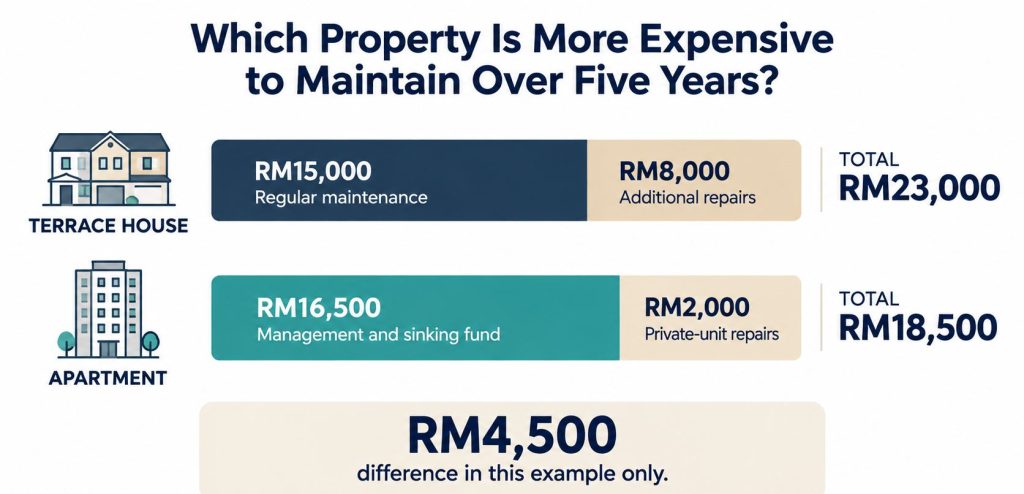
Terrace house: RM15,000 + RM8,000 = RM23,000.
Apartment: RM16,500 + RM2,000 = RM18,500.
In this hypothetical scenario, the terrace house costs RM4,500 more over five years.
However, this does not mean apartments are generally cheaper to maintain. The example simply illustrates how unexpected repairs affect long-term costs.
For the apartment, the additional RM2,000 represents private-unit repairs. The calculation assumes shared capital works are covered by existing sinking fund reserves without extra contributions.
Actual costs depend on property condition, maintenance fee changes, unexpected repairs and available reserves.
The example excludes financing, taxes, insurance, utilities and inflation.
Compare total maintenance costs over several years, not just monthly charges.
What Happens When Major Repairs Are Needed?
Major repairs reveal another important difference between property types.
Terrace House: Full Financial Responsibility
Suppose a terrace house develops a serious roof leak.
The homeowner must arrange inspections, obtain quotations, appoint contractors and pay for repairs.
If the repair costs RM10,000, the owner must rely on savings, applicable insurance coverage or financing.
The advantage is control over the process. The disadvantage is bearing the financial responsibility individually.
Apartment: Shared Repairs Require Collective Decisions
If an apartment’s common lift requires replacement, the management body oversees the work.
Expenditure may be financed through the sinking fund, subject to available reserves and applicable approvals.
However, a sinking fund does not guarantee sufficient money for major repairs.
If reserves are insufficient, owners may face higher contributions or additional approved charges, depending on management decisions and applicable legal procedures.
Apartment owners therefore depend partly on their management body’s financial health and decision-making.
Are All Terrace Houses Exempt From Management Fees?
No. Strata-titled terrace houses can have mandatory maintenance charges, sinking fund contributions and shared-property regulations.
Malaysia’s Department of Director General of Lands and Mines (JKPTG) confirms that strata developments can include landed homes in gated community schemes.
| Property Arrangement | Management Implications |
| Individual-title terrace house | Owner generally manages the property |
| Individual-title house in guarded neighbourhood | Possible residents’ association or security contributions |
| Strata-titled terrace house | Statutory strata charges and management, where applicable |
| Strata-titled apartment | Statutory strata charges and management, where applicable |
A guarded neighbourhood does not automatically mean the properties have strata titles.
Unlike statutory strata charges, residents’ association contributions and payment obligations depend on the applicable legal requirements and arrangements.
Before purchasing a terrace house, ask:
- Is it under an individual or strata title?
- Are maintenance charges mandatory?
- Is there a sinking fund?
- Who maintains shared facilities?
- Are renovations restricted?
Always verify the ownership documents before assuming that a landed property has no management fees.
Which Property Offers More Renovation Freedom?
Conventional individual-title terrace houses generally allow greater renovation flexibility, although local authority approvals and building regulations still apply.
Terrace House Renovations
Owners may consider:
- Kitchen extensions
- Porch renovations
- Roof replacements
- Gate modifications
- Internal layout changes
However, structural work and certain alterations require relevant approvals.
Strata-titled terrace houses may face additional restrictions under their management arrangements and by-laws.
Apartment Renovations
Apartment owners must comply with applicable management by-laws and renovation guidelines, potentially covering:
- Working hours
- Contractor registration
- Renovation deposits
- Debris removal
- Structural modifications
- Shared plumbing and waterproofing
For example, modifying a shared pipe or removing a structural wall cannot be treated as an ordinary interior renovation.
Buyer tip: Request renovation guidelines before purchasing an apartment that requires extensive work.
How Do Security and Shared Facilities Affect Management?
Apartments may provide centralised security and shared amenities, but their effectiveness depends on management quality.
Terrace House Security
Terrace homeowners may install CCTV, alarms, smart locks and perimeter fencing, subject to applicable requirements.
Guarded neighbourhoods may also operate community security arrangements.
Owners have greater flexibility over individual security improvements, while neighbourhood-wide measures require cooperation.
Apartment Security and Facilities
Depending on the development, management may oversee:
- Guardhouse operations
- Access-card systems
- CCTV
- Visitor registration
- Parking
- Swimming pools and gyms
These facilities offer convenience but contribute towards operating costs.
A frequently malfunctioning lift or neglected swimming pool can signal management weaknesses.
Inspect actual facility conditions rather than relying entirely on promotional brochures.
Which Is Easier to Manage if You Plan to Rent Out the Property?
Apartments can reduce some shared-building maintenance tasks, but landlords remain responsible for managing their properties.
Regardless of property type, landlords must arrange:
- Tenant communication
- Rent collection
- Unit repairs
- Tenancy agreements
- Property inspections
A terrace landlord must additionally manage private-building elements such as roofing and exterior maintenance.
An apartment landlord contributes towards shared-building upkeep through management charges.
Owners may engage a suitably registered or authorised property-management or estate-agency service provider for relevant tasks.
Before appointing a provider, check their professional credentials, service scope, fees and reporting arrangements.
How Can You Tell Whether a Property Is Well Managed?
A property’s physical condition and financial records provide useful evidence of management quality.
Apartment Management Checklist
Before purchasing, review or request:
- Current maintenance charges
- Sinking fund balance
- Audited financial statements
- Management meeting minutes
- Lift servicing records
- Common-area condition
- Outstanding charges relating to the unit
Request the latest available management records through the seller or management office. Confirm which documents you are entitled to inspect or receive.
Also check whether the development has significant unpaid maintenance charges or upcoming major repair projects.
Poor fee collection and inadequate reserves can affect the development’s ability to maintain facilities.
Read More: Moving House: The Role of Property Management in Malaysia Maintenance Checklist
Inspect:
- Roof condition and water stains
- Ceiling cracks
- Plumbing and water pressure
- Electrical wiring
- Drainage and flood exposure
- Termite damage
- Exterior walls
- Renovation approvals
For older properties or suspected defects, consider engaging a suitable building inspector.
Terrace House or Apartment: Which Should You Choose?
The better choice depends on your budget, lifestyle and willingness to manage maintenance.
| Your Priority | More Suitable Option |
| Greater renovation freedom | Individual-title terrace house |
| Centralised shared maintenance | Apartment |
| No statutory strata maintenance fees | Individual-title terrace house |
| Shared security facilities | Apartment or guarded development |
| Greater control over contractors | Terrace house |
| Less involvement in common-area upkeep | Apartment |
| More private outdoor space | Often terrace house |
| Lower maintenance costs | Depends on property condition and fees |
Choose a Terrace House If…
You prefer controlling maintenance decisions, want greater renovation flexibility and can maintain an emergency repair reserve.
However, you must be comfortable arranging and financing repairs independently.
Choose an Apartment If…
You prefer centralised management of common facilities and are comfortable paying recurring charges.
However, management quality, financial reserves and building conditions deserve careful evaluation.
Consider Strata-Titled Terrace Houses
A strata-titled terrace house can combine landed living with shared facilities and collective management.
However, owners may face both private-house maintenance expenses and mandatory strata contributions.
Review the full cost structure and restrictions before committing.
Conclusion
Terrace house and apartment property management in Malaysia differ mainly in responsibility, cost structure and decision-making.
Terrace houses offer more independence but require owners to manage repairs. Apartments provide centralised shared maintenance but involve recurring fees and collective decisions.
Before buying, assess the property’s title, condition, management quality and long-term costs.
For buyers comparing local property-related services, Listing.my provides a starting point to discover businesses across Malaysia. Our Malaysia business listing platform can help you identify property management companies and relevant service providers for further evaluation.
Sources and References
- Strata Management Act 2013 (Act 757) — Malaysian legislation governing strata management, including maintenance charges, sinking funds and management responsibilities, within its territorial application.
- JKPTG — Strata Title Guidance — Official guidance on strata titles, landed strata developments, parcels and common property.
- Strata Management (Maintenance and Management) Regulations 2015 — Management regulations, including procedures relevant to inter-floor leakage.
- KPKT — Ministry of Housing and Local Government — Government guidance on strata management and the Strata Management Tribunal.
- JKPTG — Department of Director General of Lands and Mines — Official strata title and ownership guidance.
- Board of Valuers, Appraisers, Estate Agents and Property Managers — Professional regulatory information for property-management and estate-agency services.
Disclaimer: Legal references are provided for general information. Buyers should verify the latest applicable requirements, relevant state laws and their property’s ownership documents.
Frequently Asked Questions About Property Management for Terrace Houses vs Apartments
Can Terrace Houses Have Monthly Maintenance Fees in Malaysia?
Yes. Strata-titled terrace houses can have mandatory maintenance charges and sinking fund contributions under applicable strata laws. Individual-title houses in guarded neighbourhoods may also have residents’ association or security contributions, depending on their arrangements.
Is Apartment Maintenance Included in the Housing Loan?
No. Maintenance charges and sinking fund contributions are generally separate from mortgage repayments. Owners must budget for them alongside other property expenses.
Can Apartment Maintenance Fees Increase?
Yes. Charges may be revised through the applicable strata management process to meet operating expenses. Review financial records, current charges and previous fee adjustments before purchasing.
Who Pays for Water Leakage Between Two Apartment Units?
Responsibility depends on the source of the leak and whether the affected component belongs to an individual parcel or common property. Owners should notify the management body so the appropriate inspection and investigation procedures can be followed.
Does a Terrace House Need a Sinking Fund?
A conventional individual-title terrace house is not subject to the statutory strata sinking fund requirements under Act 757. However, homeowners should maintain personal savings for major repairs. Strata-titled terrace houses may have mandatory sinking fund contributions under applicable law.
Can Apartment Owners Complain About Poor Property Management?
Yes. In Peninsular Malaysia and Labuan, owners can raise complaints with their management body or the relevant Commissioner of Buildings. Eligible disputes may also be referred to the Strata Management Tribunal. For properties in Sabah and Sarawak, owners should check the relevant local authorities and dispute-resolution procedures.